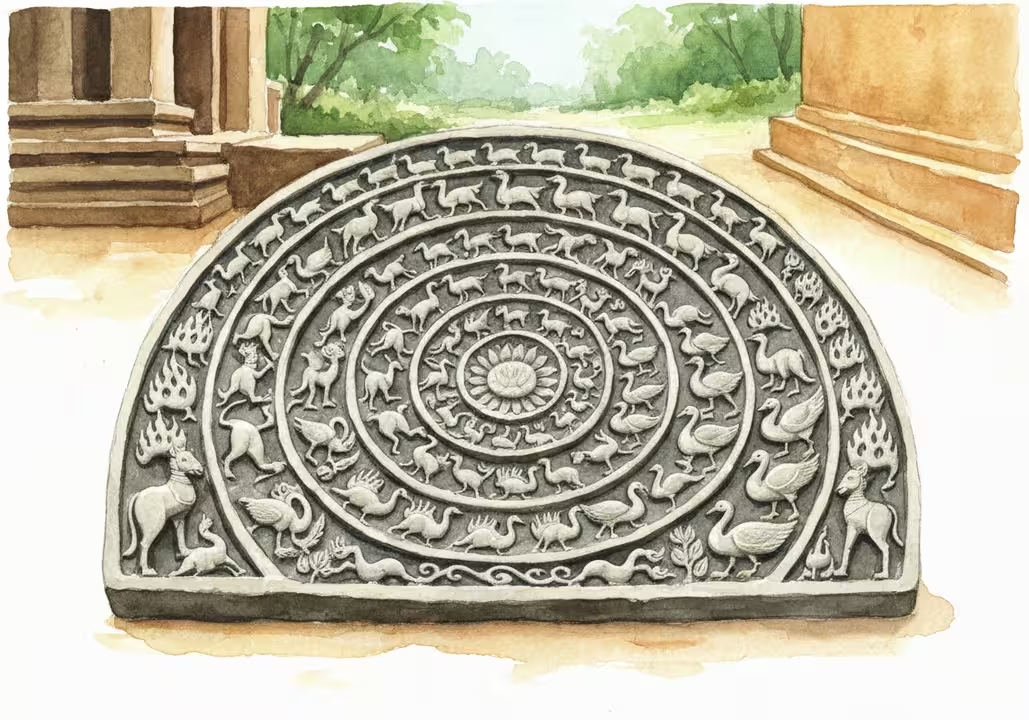
At the entrance to nearly every ancient Buddhist temple in Sri Lanka, pilgrims pause before ascending the steps. Beneath their feet lies a semicircular stone slab, its surface alive with concentric bands of flames, animals, foliage, and sacred geese, all spiraling toward a lotus at the center. This is the sandakada pahana—the moonstone—a uniquely Sri Lankan art form that transforms Buddhist philosophy into stone, offering worshippers a symbolic journey from the fires of worldly existence to the cool serenity of nirvana.
A Unique Sri Lankan Innovation
The moonstone stands as one of ancient Sri Lanka’s most distinctive contributions to Buddhist art and architecture. Unlike other Buddhist architectural elements found across Asia, the sandakada pahana—literally “moon-stone slab” in Sinhala—appears nowhere else in the Buddhist world in its fully developed symbolic form. From the 7th century onward, these elaborately carved granite half-circles became essential fixtures at the entrances of Buddhist temples and monastic buildings throughout the kingdoms of Anuradhapura and Polonnaruwa.
The moonstone served as more than mere decoration. It functioned as a threshold between the profane and the sacred, a teaching tool carved in stone that reminded every person who crossed it of Buddhism’s core truths. By the time these architectural elements reached their artistic zenith in the 8th and 9th centuries, Sri Lankan stone carvers had developed their craft to a remarkable level of sophistication, capable of rendering complex philosophical concepts in granite with stunning clarity and beauty.
The Journey Inward: Decoding the Symbolism
Each moonstone tells the same fundamental story—the Buddhist understanding of existence and the path to liberation—through a series of concentric bands that guide the eye from the outer edge to the central lotus. Understanding these layers reveals the sophisticated theological thinking embedded in the stone.
The Ring of Flames: Endless Burning
The outermost band depicts a continuous line of flames, rendered with such artistry that they seem to flicker and dance across the stone’s surface. These flames represent the burning cycle of life itself—the endless rounds of birth, death, and rebirth known as samsara. They symbolize the passions, desires, and sufferings that keep beings trapped in this cycle, the heat of worldly existence that scorches all who remain unenlightened.
For the worshipper approaching the temple, stepping past these flames signified a symbolic movement away from the fires of passion and toward the cooling waters of wisdom. The placement was deliberate: one must acknowledge the burning nature of unenlightened existence before seeking refuge in the Buddha’s teachings.
The Four Animals: Life’s Inevitable Stages
Moving inward, the next band features four animals in perpetual procession: the elephant, the horse, the lion, and the bull. Each creature carries profound symbolic weight. The elephant represents birth, the beginning of the cycle. The horse depicts decay and aging—the gradual wearing down that comes with time. The lion symbolizes disease, the afflictions that visit all beings. Finally, the bull represents death itself, the inevitable end that awaits every living thing.
These four animals also correspond to the Four Noble Truths, Buddhism’s foundational teaching. They remind the observer that suffering (dukkha) is universal, that it arises from attachment and desire, that liberation from suffering is possible, and that there is a path to that liberation. The animals follow one another in an endless circle, emphasizing that without enlightenment, these stages repeat indefinitely across countless lifetimes.
In Anuradhapura-period moonstones, all four animals appear together in a single band, marching with startling realism across the granite. Ancient artisans carved each creature with remarkable attention to anatomical detail, capturing the weight of the elephant, the grace of the horse, the power of the lion, and the strength of the bull.
The Liyavel: The Creeper of Desire
Beyond the animals lies a band of intricate foliage known as liyavel—a creeping vine pattern that winds around the moonstone with delicate complexity. This represents tanha, the craving and desire that binds beings to the wheel of samsara. Like a creeper that entangles and restricts, worldly desires prevent spiritual progress and keep consciousness bound to the material realm.
The artistry required to carve these foliated patterns into hard granite demonstrates the exceptional skill of ancient Sri Lankan stone workers. Each leaf, each tendril, each curve of the vine had to be incised with precision, creating patterns that are both beautiful and philosophically meaningful.
The Sacred Geese: Discernment and Wisdom
Moving closer to the center, a row of hamsa—sacred geese or swans—parade in graceful formation. In Buddhist and Hindu mythology, the hamsa possesses a miraculous ability: it can separate milk from water when the two are mixed together. This supernatural discernment made the swan a perfect symbol for spiritual wisdom—the ability to distinguish good from evil, truth from falsehood, the eternal from the transient.
For the pilgrim reading the moonstone’s message, the swans represent the development of spiritual discrimination, the wisdom that allows one to filter out the worthless and retain only what leads to liberation. In Hindu tradition, the flight of the hamsa also symbolizes freedom from samsara itself, making it a fitting herald for what lies at the moonstone’s heart.
The Lotus: The Achievement of Nirvana
At the very center blooms a half-lotus, its petals radiating outward in perfect symmetry. The lotus holds supreme importance in Buddhist iconography. It grows from mud, rises through water, and blooms untouched above the surface—symbolizing how enlightenment can arise from the mire of worldly existence. The central lotus of the moonstone represents nirvana itself, the final achievement, the cool extinction of suffering and craving.
This is the destination toward which all the outer bands point. Every flame, every animal, every coiling vine, every discerning swan leads the eye and the mind toward this center, this ultimate goal of Buddhist practice. To step upon the moonstone is to symbolically traverse the entire spiritual path, from the burning of samsara to the peace of nirvana.
Evolution Across the Centuries
The moonstones of ancient Sri Lanka did not emerge fully formed; they evolved across centuries as both artistic and religious sensibilities changed. Archaeologists have traced this development through careful study of moonstones preserved at various historical sites.
The Anuradhapura Golden Age
The most celebrated moonstones date to the late Anuradhapura period, roughly from the 7th to 10th centuries. During this era, Buddhist artistic expression in Sri Lanka reached extraordinary heights, and the moonstone achieved its most complete symbolic form. These Anuradhapura moonstones typically feature all the elements described above: flames, four animals, liyavel, swans, and lotus, all rendered with exceptional skill.
One of the finest surviving examples can be found at the Pancavasa, commonly known as Biso Maligawa or the Queen’s Palace, within the Abhayagiri Monastery complex in Anuradhapura. Dating to the 7th or 8th century and associated with the reign of King Mahasena (277-304 CE), this moonstone is considered among the best preserved from its era. The detail in its carving remains crisp and clear after more than thirteen centuries, testimony to both the skill of its creators and the durability of their chosen medium.
The Polonnaruwa Transformation
When Sri Lanka’s political center shifted from Anuradhapura to Polonnaruwa in the late 10th and 11th centuries, the moonstone underwent significant changes. The Polonnaruwa-period moonstones display a different aesthetic and symbolic approach, reflecting the increased Hindu influence during this era of Sri Lankan history.
The most notable change was the removal of the bull from the procession of animals. In Hindu tradition, the bull is Nandi, the sacred vehicle of the god Shiva, and its presence in Buddhist iconography became problematic as Hindu cultural elements gained prominence. Polonnaruwa moonstones typically show only the elephant, horse, and lion, sometimes depicted in separate bands rather than the unified procession of earlier examples.
Despite these modifications, Polonnaruwa artisans maintained the exceptional quality of their work. The finest moonstone from this period graces the northern entrance of the Polonnaruwa Vatadage, a circular relic house that represents the ultimate development of its architectural type. This moonstone displays the evolved design with separate bands for each animal, yet retains the fundamental symbolic journey from outer flames to inner lotus. Art historians consider it a masterpiece of sculptural artistry, even as they acknowledge the fuller symbolic completeness of the earlier Anuradhapura tradition.
The Craft of Stone and Spirit
Creating a moonstone required not merely technical skill but a synthesis of religious devotion, mathematical precision, and artistic vision. These were not casual decorations but sacred objects, and their creation was treated accordingly.
Artisans worked with large, deep slabs of granite, one of the hardest and most unforgiving materials available. The semicircular shape had to be cut precisely, typically measuring between three and five feet in diameter. Then came the painstaking work of carving the concentric bands, each requiring different techniques and tools.
The outer flames demanded fluid, organic curves that suggested movement and heat. The animals needed anatomical accuracy and lifelike presence—each species identifiable at a glance, each pose natural and dynamic. The liyavel required the patient incision of countless delicate leaves and vines, creating patterns that were both symmetrical and varied. The swans had to be carved with grace and dignity, each bird identical yet individual. Finally, the central lotus needed perfect radial symmetry, its petals spreading in mathematical precision.
By the 9th century, stone carving in Sri Lanka had reached an exceptionally advanced state. The moonstones demonstrate mastery of relief carving techniques that few contemporary cultures could match. The depth of carving varies across the bands, creating subtle three-dimensional effects that bring the images to life under changing light. The transitions between bands are handled with sophisticated craftsmanship, each layer distinct yet harmoniously integrated into the whole.
This technical excellence served spiritual purposes. These stones were meant to teach, to inspire, to transform the consciousness of those who contemplated them. The investment of such skill and care reflected the importance placed on making the Dharma accessible through art, communicating complex philosophical truths to both the learned and the illiterate.
A Living Legacy
Today, moonstones remain among the most photographed and studied elements of Sri Lanka’s ancient heritage. Visitors to archaeological sites in Anuradhapura and Polonnaruwa encounter these stones at temple entrance after temple entrance, each one a testimony to centuries of devotion and artistry.
Archaeological surveys have documented hundreds of moonstones across the island, though the finest examples from the Anuradhapura period are relatively rare. Many have suffered damage from weathering, vegetation, and human activity over the centuries. Conservation efforts have sought to protect these treasures, recognizing them as irreplaceable witnesses to Sri Lanka’s Buddhist artistic tradition.
Modern scholars continue to debate aspects of moonstone symbolism and development. Some interpretations differ on the precise meaning of individual elements, and new archaeological discoveries occasionally challenge established chronologies. Yet the fundamental reading of the moonstone as a symbolic representation of the path from samsara to nirvana remains widely accepted, supported by both iconographic analysis and traditional Buddhist interpretation.
The Threshold Between Worlds
The genius of the sandakada pahana lies in its transformation of abstract philosophical concepts into immediate visual experience. Every worshipper who approached a temple, whether monk or lay person, learned or simple, encountered the same teaching: existence burns with suffering, life moves inexorably through birth to death, desires entangle like vines, but wisdom can discern the path, and at the center of it all blooms the possibility of liberation.
This teaching was placed at the threshold, at the moment of transition from the ordinary world to the sacred space of the temple. To step across the moonstone was to symbolically enact the spiritual journey, to physically move from the outer flames to the central lotus, from ignorance to enlightenment. In this way, the moonstone functioned as both art and ritual, decoration and doctrine, beauty and instruction.
The sandakada pahana represents one of Buddhism’s most successful attempts to make the invisible visible, to render the path to awakening as something one could literally see and touch and walk upon. In the hands of Sri Lanka’s ancient artisans, hard granite became fluid symbol, and temple doorways became gateways not just to sacred buildings but to sacred understanding.
More than a millennium after their creation, these stone half-circles continue to offer their silent teaching. The flames still flicker, the animals still process, the vines still coil, the swans still glide, and the lotus still blooms—inviting each new generation to contemplate the journey from suffering to peace, from bondage to freedom, from samsara to nirvana.