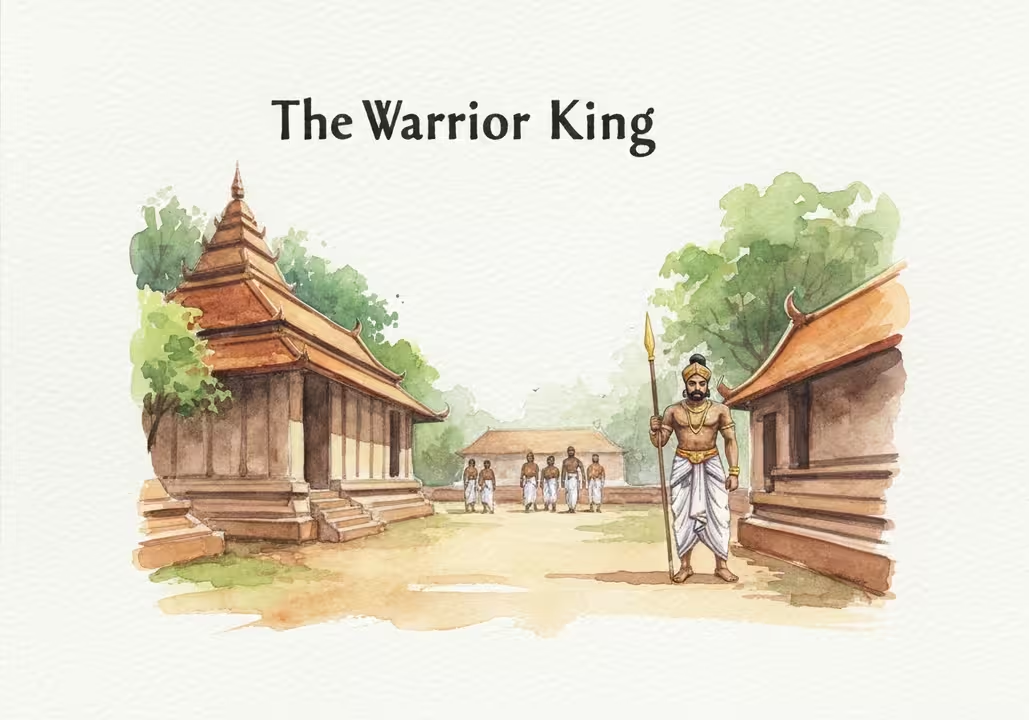
In the annals of Sri Lankan history, few figures loom as large as King Dutugemunu, the warrior king who unified the island in the 2nd century BCE. His story, meticulously chronicled in the ancient Pali text known as the Mahavamsa, represents one of the most dramatic chapters in the island’s past—a tale of defiance, determination, and ultimately, the birth of a unified nation.
The Disobedient Prince
Born around 161 BCE in the southern kingdom of Ruhuna, the young prince who would become Dutugemunu was known by a far less flattering name: Dutthagamani, meaning “the disobedient one.” His father, King Kavantissa, ruled a small kingdom in southeastern Sri Lanka, while far to the north, the great city of Anuradhapura lay under the control of King Elara, a Tamil ruler from the Chola dynasty who had seized power in 205 BCE.
The prince’s mother, Queen Viharamahadevi, had herself arrived in Ruhuna under extraordinary circumstances. As a young princess, she had been set adrift in the ocean by her father, King Kelanitissa of Kelaniya, as a sacrifice to appease the gods after he had cruelly executed an innocent monk. Her boat had washed ashore at Kirinda, where King Kavantissa, impressed by her courage and noble bearing, had made her his queen.
Growing up in the shadow of foreign occupation, young Dutugemunu burned with ambition to reclaim Anuradhapura and reunify the island. His father, however, counseled patience and diplomacy. The confrontation between father and son became legendary. In his frustration, the prince mocked Kavantissa’s reluctance to wage war, declaring “If he were a man, he would not speak thus.” He even sent his father a piece of women’s jewelry—a calculated insult that earned him his infamous nickname.
Gathering the Champions
Despite his son’s impetuousness, King Kavantissa had been preparing for the eventual confrontation. From across the island, he had recruited ten extraordinary warriors, each possessing legendary strength and skill. These men—Nandhimitra, Suranimala, Mahasona, Theraputtabhya, Gotaimbara, Bharana, Vasabha, Khanjadeva, Velusamanna, and Phussadeva—would become known to history as the Ten Giant Warriors.
The Mahavamsa records that these champions had sworn an oath to Kavantissa to remain impartial should his sons ever quarrel, but to serve wholeheartedly in the campaign against Elara. Alongside these warriors, Dutugemunu would rely on another crucial ally: Kandula, his war elephant. According to the chronicles, Kandula came to Ruhuna of his own accord around the time of the prince’s birth, a six-tusked elephant who would become inseparable from his master.
The March to War
When Kavantissa died, Dutugemunu finally had his chance. Ascending to the throne of Ruhuna, he immediately began preparations for the campaign that would define his legacy. From the capital at Mahagama (modern-day Tissamaharama), he assembled his forces and marched north, determined to liberate Anuradhapura and unify Sri Lanka under Sinhalese Buddhist rule.
The Mahavamsa presents Dutugemunu’s campaign in explicitly religious terms. Before departing, the king declared that his battles would be “for the sake of the sāsana [Buddhism], not for the pleasures of sovereignty.” He marched with Buddhist monks in his army and affixed a relic of the Buddha to his spear, framing his military conquest as a holy war to restore Buddhism to its rightful place in Sri Lanka.
The campaign northward was marked by a series of fortified positions held by Elara’s forces. Each stronghold fell to Dutugemunu’s combination of strategic brilliance and raw martial prowess, with his Ten Warriors and Kandula playing decisive roles in battle after battle.
The Siege of Vijithapura
The most challenging obstacle came at Vijithapura, a heavily fortified city whose exact location remains a matter of scholarly debate, though most historians place it somewhere between Polonnaruwa and the ancient capital. Here, Elara’s commanders had prepared extensive defenses, and Dutugemunu’s forces settled in for a grueling four-month siege.
The breakthrough came through Kandula’s courage. When conventional assaults failed to breach the walls, Dutugemunu ordered his elephant to charge the southern gate. Kandula was wounded in the attack, struck by weapons from the ramparts above. The king himself tended to his companion’s wounds, protecting the elephant with thick animal hides before encouraging him to charge once more. This time, the great beast smashed through the fortifications, and Dutugemunu’s forces poured into the city.
With Vijithapura taken, the road to Anuradhapura lay open.
Single Combat at Anuradhapura
The final confrontation unfolded at the eastern gate of Anuradhapura in 161 BCE, in a scene that has become one of the most iconic in Sri Lankan history. King Elara, now elderly after 44 years of rule, rode out on his own war elephant, Mahapabbata, to meet Dutugemunu in single combat.
The Mahavamsa describes the duel in vivid detail: two kings, two elephants, two visions for the island’s future, clashing in a battle that would determine Sri Lanka’s destiny. Dutugemunu, riding Kandula, wielded his spear with the Buddha’s relic attached. The combat was brief but decisive. Dutugemunu’s spear found its mark, and Elara fell.
With the Tamil king’s death, organized resistance collapsed. Dutugemunu entered Anuradhapura in triumph, ending 44 years of Tamil rule and achieving the unification he had dreamed of since youth.
Honoring a Worthy Foe
What followed the victory reveals perhaps the most remarkable aspect of Dutugemunu’s character. Rather than desecrating his enemy’s memory, the new king went to extraordinary lengths to honor Elara. He had the fallen king cremated with full royal honors and built a tomb for his ashes. Most significantly, Dutugemunu decreed that all travelers passing by Elara’s memorial must dismount and pay their respects.
This gesture reflected the chronicles’ portrayal of Elara himself. Despite being an “invader” in the Mahavamsa’s narrative, Elara was consistently described as “the Pious,” a just ruler who had governed fairly. One famous story tells of Elara’s commitment to justice: when his own son accidentally killed a calf belonging to a commoner by driving his chariot recklessly, Elara ordered his son to be executed according to the law, treating prince and peasant equally.
Dutugemunu’s respect for such a ruler, even in death, demonstrated a nuanced understanding that transcended simple conquest.
The Builder King
Though celebrated as a warrior, Dutugemunu’s legacy extended far beyond the battlefield. His reign from 161 to 137 BCE ushered in a golden age of Buddhist culture and monumental architecture. The crown jewel of his building program was the Ruwanwelisaya, a massive stupa in Anuradhapura that remains one of Sri Lanka’s most sacred Buddhist monuments.
The Mahavamsa records the construction of the Ruwanwelisaya in meticulous detail, describing how Dutugemunu oversaw every aspect of the project. According to legend, the site had been prophesied centuries earlier by the monk Mahinda Thero, who had brought Buddhism to Sri Lanka. A stone pillar erected by King Devanampiyatissa (307-267 BCE) marked the spot, bearing an inscription foretelling that a king named Dutugemunu would one day build a great stupa there.
Though Dutugemunu died before the stupa’s completion around 137 BCE, his brother and successor, King Saddhatissa, ensured the project was finished according to his vision. Archaeological excavations have uncovered numerous artifacts around the site—fragmented Buddha statues, carved stone panels, and ancient inscriptions—providing tangible evidence of the monument’s antiquity and grandeur.
Legacy and Historical Debate
The historical Dutugemunu presents scholars with fascinating challenges. The primary source, the Mahavamsa, was composed in the 5th century CE, some 600 years after the events it describes. The chronicle’s 861 verses devoted to Dutugemunu (compared to just 13 in the earlier Dipavamsa) suggest the incorporation of popular legends and vernacular epics into the historical record.
Yet archaeological evidence, including contemporary inscriptions from the 3rd to 2nd century BCE, confirms the basic outline of the story. These inscriptions document the transition from multiple regional principalities to a unified kingdom under Anuradhapura, precisely as the chronicles describe. While details may be embellished, historians generally accept that a king named Dutugemunu did defeat Elara and unify the island around 161 BCE.
The symbolic importance of Dutugemunu’s story has only grown over the centuries. He became the embodiment of Sinhalese resistance, Buddhist piety, and national unity—qualities that would be invoked repeatedly throughout Sri Lanka’s history. His story raises profound questions about the relationship between religious devotion and political violence, between just warfare and Buddhist ethics, between historical fact and national mythology.
Conclusion
King Dutugemunu’s unification of Sri Lanka in the 2nd century BCE marked a pivotal moment in the island’s history. The defiant prince who earned the nickname “disobedient one” became the warrior king who forged a unified nation, the military commander who honored his fallen enemy, and the pious Buddhist who built monuments that would endure for millennia.
His story, preserved in the Mahavamsa and confirmed by archaeological evidence, represents more than a tale of military conquest. It embodies the complex interplay of ambition and piety, violence and honor, history and legend that has shaped Sri Lankan identity for over two thousand years. Whether viewed as a national hero or a more complicated historical figure, Dutugemunu remains an enduring symbol of an ancient era when the fate of a nation was decided by two kings on elephants, meeting in single combat at the gates of a sacred city.