In the year 1215, darkness descended upon the ancient kingdom of Polonnaruwa. Kalinga Magha, a ruthless invader from eastern India, landed at Karainagar with an army of 24,000 mercenaries from Kerala and Tamil Nadu. What followed was described in chronicles as a reign of terror that would last for decades. The magnificent capital of Polonnaruwa, which had stood as the jewel of Sinhalese civilization, fell to the invader’s sword. Temples were desecrated, monasteries destroyed, and the Buddhist clergy scattered to the winds.
But from this catastrophe emerged one of the most remarkable chapters in Sri Lankan history—the Kingdom of Dambadeniya, a refuge that would not only preserve Sinhalese Buddhist civilization but also nurture it into a brilliant flowering of literature and culture.
A Kingdom Born of Necessity
As Kalinga Magha’s forces swept across the northern plains, a massive exodus began. Sinhalese people fled southward and westward, retreating into the mountainous interior to escape the invader’s reach. The traditional heartland of Sinhalese power, known as Rajarata, was so thoroughly devastated that never again would a major Sinhalese kingdom be established in the north.
Around 1220, King Vijayabahu III made a strategic decision that would shape the next century of Sri Lankan history. He chose Dambadeniya, a site approximately 70 miles southwest of Polonnaruwa, as his new capital. The location was chosen with military wisdom—the settlement centered on a massive rock outcrop that provided natural defenses against the foreign armies that threatened from the north.
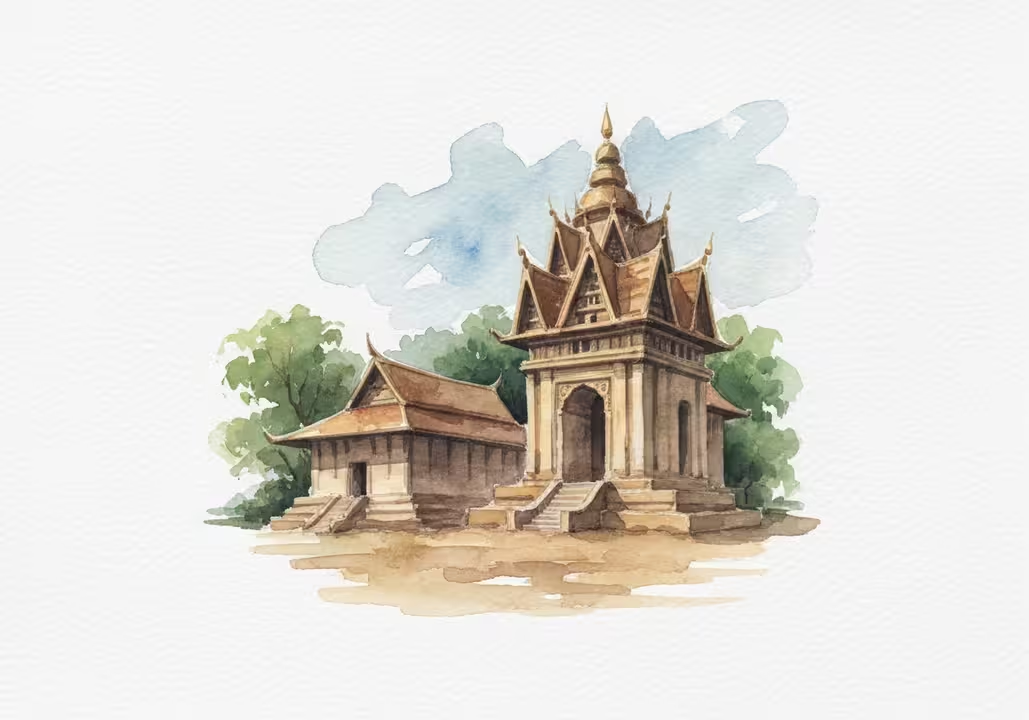
Vijayabahu III transformed this rocky prominence into a fortified stronghold. On the summit, which encompassed no less than six acres, he constructed a royal palace complex and a temple to house the Sacred Tooth Relic of the Buddha. The city was protected by sturdy walls and gates, with a moat and marshlands providing additional barriers against attack. Clay ramparts ringed the complex, their remains still visible to this day.
The king’s first priority was spiritual restoration. The Buddhist Sangha had been thrown into disarray, with monks fleeing in all directions to escape Kalinga Magha’s persecution. In 1226, Vijayabahu III achieved a remarkable feat—he convened a Buddhist convention that brought unity to the scattered clergy and reestablished the Buddha Sasana (Buddhist teachings) in the island. He also retrieved the Sacred Tooth Relic, which had been hidden in Kotmale during the invasion, and enshrined it in the Beligala Temple of the Tooth at Dambadeniya.
The Golden Age of Parakramabahu II
When Vijayabahu III died in 1236, his son ascended the throne as Parakramabahu II. The new king would prove to be not just a warrior, but also a scholar-king whose reign would mark the zenith of Dambadeniya’s glory. History would remember him by the honorary title “Kalikala Sahitya Sarvagna Pandita”—the Omniscient Scholar of Literature in the Age of Kali.
Parakramabahu II faced the same existential threat that had driven his father to Dambadeniya. Kalinga Magha still held Polonnaruwa, and his presence represented a dagger pointed at the heart of Sinhalese civilization. But the young king proved to be both strategically brilliant and diplomatically astute. He forged an alliance with the Pandyas of South India—traditional rivals of the Kalingas—and launched a campaign to drive out the invader.
The military campaign was a resounding success. By 1255, after Kalinga Magha’s forty-year occupation, Parakramabahu II had expelled him from Polonnaruwa and unified the three kingdoms that had fragmented across the island. The conquest of the Kalinga regime stands as one of the most distinguished achievements in Sri Lankan history, restoring dignity and sovereignty to the Sinhalese people.
But it was in the realm of culture and scholarship that Parakramabahu II truly immortalized his reign. The king himself was a gifted poet and prolific writer. His masterwork, the Kausilumina, is considered one of the greatest literary monuments of medieval Sri Lanka—a Maha-Kavya (great poem) that showcased the sophistication of Sinhala poetic tradition.
The Literary Renaissance
The court of Parakramabahu II became a magnet for scholars, poets, and religious writers. The king provided royal patronage for an explosion of literary creativity that would earn the Dambadeniya period its reputation as the golden age of Sinhala literature.
Under this royal sponsorship, numerous significant works were created in Sinhala, Pali, and Sanskrit. The bhikkhu Mayurapada Buddhaputta Thero compiled the Pujavaliya between 1266 and 1275 while residing at the Pathiraja Pirivena monastery at Palabathgala. This historical and religious text became one of the most important prose works of medieval Sri Lanka, serving both as a religious manual and a vital source for understanding the cultural context of the era.
Other major works produced during this period included the Pali Vishuddhi Margaya, Thupavamsa (a Sinhala chronicle of Buddhist stupas), Sidhath Sangarawa (a grammar text), Dalada Siritha (about the Sacred Tooth Relic), Saddharma Rathnawaliya (a collection of Buddhist stories), and Sarajothi Malai. The diversity of these works—spanning poetry, history, grammar, and religious instruction—demonstrates the comprehensive intellectual culture that flourished under royal patronage.
Parakramabahu II’s first act after his coronation had been to build a magnificent Temple of the Tooth in his capital—a symbol of both religious devotion and political legitimacy. He also undertook extensive restoration work throughout the island, repairing the Attanagalla Viharaya, Devinuwara Devalaya, Kelani Viharaya, and numerous other temples and monasteries that had fallen into disrepair during the years of invasion and upheaval.
The kingdom also maintained economic vitality. The copper coinage system that had begun during the Polonnaruwa period continued, with coins known as “Dambadeni Massa” minted bearing the names of Parakramabahu II, his successor Vijayabahu IV, and later Bhuvanekabahu I.
The Inevitable Decline
Parakramabahu II’s thirty-four-year reign ended in 1270. His son, Vijayabahu IV (also known as Bosath Vijayabahu), succeeded him but ruled for only two years before being assassinated in 1272. This violent transition marked the beginning of Dambadeniya’s decline.
Vijayabahu IV’s brother, Bhuvanekabahu I, took the throne but came to a troubling conclusion: Dambadeniya was no longer secure. The same geographic vulnerabilities that made it accessible also made it defensible only with great effort. In 1273, he made the fateful decision to relocate the capital to Yapahuwa, another rock fortress built in the style of Sigiriya, about 30 miles to the north.
The Sacred Tooth Relic was transferred to a temple built atop Yapahuwa’s 90-meter-high granite boulder. For eleven years, this new citadel served as Sri Lanka’s capital. But when Bhuvanekabahu I died in 1284, disaster struck. The Pandyas of South India—former allies against Kalinga Magha—invaded and captured the Sacred Tooth Relic, carrying it back to India.
This was more than a military defeat; it was a spiritual catastrophe. The Tooth Relic was the ultimate symbol of legitimate Buddhist kingship in Sri Lanka. Its loss was seen as a sign that the kingdom had lost divine favor. Yapahuwa was abandoned as a royal capital and left to Buddhist monks and religious ascetics.
In 1288, King Parakramabahu III managed to recover the precious relic, but he brought it to Polonnaruwa rather than returning to Yapahuwa or Dambadeniya. The era of Dambadeniya as a capital was over, though the kingdom officially lasted until 1345 as the capital continued to shift—to Kurunegala, Gampola, and eventually to Kotte.
Legacy in Stone and Word
Today, the ruins of Dambadeniya stand as testament to this pivotal era. Atop the rock called Maliga Gala, visitors can still see the remains of the royal palace and the ponds that served the court. Stone steps lead upward to what was once the temple complex. The clay walls that once defended the city remain partially visible, weathered by seven centuries but stubbornly persistent.
Stone inscriptions from the period—at Kevulgama, Narambadde Ududumbara, Rambukkana Dewala, Aluthnuwara Dewala, and Galapatha Viharaya—provide glimpses into the administrative and religious life of the kingdom. The Sri Wijayasundararamaya temple contains murals depicting the Tooth Relic and preserves a small granite platform where tradition holds the sacred relic was displayed during ceremonies.
But perhaps the most enduring legacy of Dambadeniya exists not in stone but in words. The literary works created during this period remain cornerstones of Sinhala literature. The Kausilumina, Pujavaliya, and other texts written under Parakramabahu II’s patronage continued to be read, copied, and studied for centuries, shaping the literary tradition and preserving the cultural memory of the Sinhalese people.
The Kingdom of Dambadeniya demonstrates that civilizations in crisis can not only survive but flourish. Born from catastrophe, this fortress kingdom became a crucible of cultural renaissance. In an age when foreign invasions threatened to erase Sinhalese Buddhist civilization, Dambadeniya preserved it, nurtured it, and passed it forward to future generations. The scholar-king Parakramabahu II and the writers who worked under his patronage ensured that this turbulent century would be remembered not for what was lost, but for what was created—a golden age of literature that emerged from the shadow of war.