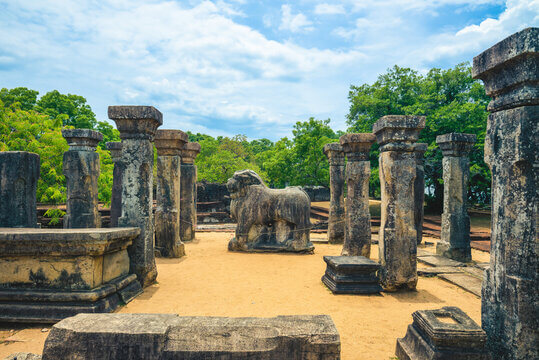
King Nissanka Malla (1187–1196 AD) is one of the most colorful characters of the Polonnaruwa period. Ascending the throne shortly after the great Parakramabahu I, he was determined to prove himself as a worthy successor—and perhaps even surpass the legacy of the “Great” king.
A Quest for Legitimacy
Nissanka Malla was of Kalinga origin (from present-day Odisha, India). To solidify his claim to the Sinhalese throne, he went to great lengths to assert his lineage, claiming descent from Prince Vijaya. He left behind more stone inscriptions than any other Sri Lankan king, proclaiming his greatness and warning that “non-Buddhists should not be placed in power.”
The Wandering King
He was known for his extensive travels throughout his kingdom, often accompanied by his army. These tours were not just for inspection but were grand displays of power and generosity. He distributed wealth to the poor and claimed to have eradicated crime, stating that a woman could carry a casket of jewels across the island without fear.
Architectural Legacy
Despite his short reign, Nissanka Malla was a prolific builder. He constructed the Nissanka Latha Mandapaya, a unique structure with lotus-stem pillars, and the Hatadage to house the Sacred Tooth Relic. He also claimed credit for many projects that were likely started by his predecessors, adding his own inscriptions to them.