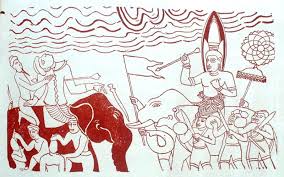
King Dutugemunu (161–137 BC) is perhaps the most celebrated hero in Sri Lankan history. His reign marked the first time the entire island was unified under a single Sinhalese monarch following a long period of foreign rule in the north. His story is one of youthful rebellion, military genius, and ultimate spiritual devotion.
The Prince of Ruhuna
Born as Gamini to King Kavantissa and Queen Viharamahadevi in the southern kingdom of Ruhuna, the young prince was raised with a singular ambition: to liberate the holy city of Anuradhapura from the Chola King Elara. Frustrated by his father’s cautious approach, Gamini famously sent him women’s ornaments, implying cowardice—an act that earned him the name Dutta (disobedient) Gamini.
The War for Unification
Upon his father’s death, Dutugemunu raised a formidable army, including the legendary “Ten Giant Warriors” (Dasa Maha Yodayo) and his war elephant, Kandula. The campaign was a grueling series of sieges and battles as he marched north, capturing fortress after fortress.
The war culminated in the Battle of Vijithapura and the final assault on Anuradhapura. In a moment of chivalry that defined the era, Dutugemunu challenged King Elara to single combat. Mounted on their elephants, the two kings fought near the southern gate of the city. Dutugemunu emerged victorious, slaying Elara with his spear.
Honoring his fallen foe, Dutugemunu decreed that Elara be cremated with royal honors and that all passersby, including royalty, must silence their music and dismount out of respect for the just Tamil king.
A Golden Age
The unification brought a golden age of peace and prosperity. Dutugemunu is best known today not just as a warrior, but as the greatest builder of ancient Sri Lanka. He constructed the Mirisawetiya Stupa, the massive Lovamahapaya (Brazen Palace) for the monks, and initiated the construction of the Ruwanwelisaya, the Great Stupa that remains a national symbol to this day.