King Valagamba, also known as Vattagamani Abhaya, is one of the most resilient and significant figures in Sri Lankan history. His reign is a dramatic tale of a king who lost his throne, lived in exile for fourteen years, and returned to liberate his country and secure the future of Buddhism.
The First Reign and Exile
Valagamba ascended the throne in 103 BC, a time of great instability. Just five months into his rule, the kingdom faced a dual threat: a rebellion in Ruhuna and an invasion by seven Tamil chieftains from South India. Defeated in battle at Kolambalaka, the king was forced to flee. As he retreated, a Jain ascetic named Giri mocked him, shouting, “The great black Sinhalese is fleeing!” Valagamba resolved then that if he ever regained his throne, he would build a temple on that very spot.
For the next fourteen years, the king lived in hiding, moving between caves and forests in the central mountains. This period was marked by a severe famine known as the Beminitiya Seya, which devastated the land. Despite these hardships, Valagamba slowly gathered support, raised an army, and systematically defeated the Tamil invaders, reclaiming Anuradhapura in 89 BC.
The Preservation of the Tipitaka
The most enduring legacy of King Valagamba is the preservation of the Buddhist scriptures. During the famine and war of his exile, many monks died, and the oral tradition of the Tripitaka (Pali Canon) was in danger of being lost forever.
Recognizing this existential threat, the king sponsored the Fourth Buddhist Council at the Aluvihara Rock Cave Temple in Matale. Here, for the first time in history, 500 scholarly monks committed the oral teachings of the Buddha to writing on ola (palm) leaves. This monumental act ensured the survival of Theravada Buddhism, not just for Sri Lanka, but for the entire world.
The Abhayagiri Vihara
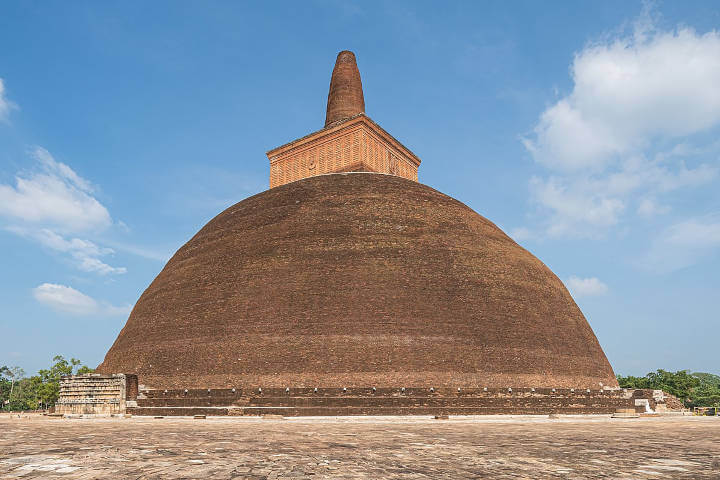
True to his vow, Valagamba demolished the hermitage of the ascetic Giri and built a massive stupa and monastery complex in its place—the Abhayagiri Vihara. He offered it to the monk Kupikkala Mahatissa, who had helped him during his exile.
This act was controversial, as it broke the tradition of royal patronage being exclusively for the Mahavihara. The Abhayagiri Vihara grew to become a rival center of learning, open to Mahayana influences and international scholars, fostering a rich intellectual tradition that lasted for centuries.
Legacy
King Valagamba’s second reign (89–77 BC) was a period of reconstruction and religious revival. He built numerous cave temples, including the famous Dambulla Cave Temple, which had sheltered him. His life stands as a testament to perseverance, and his patronage of the Aluvihara council remains one of the most critical contributions to the history of Buddhism.