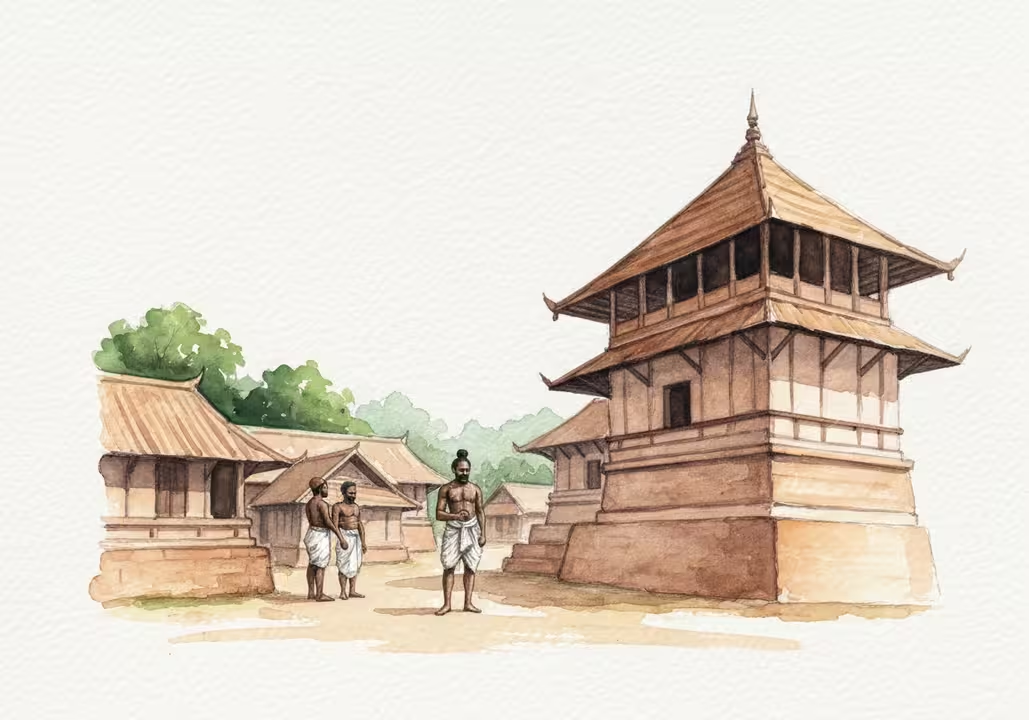
On a November morning in 1818, at the execution grounds near Bogambara tank in Kandy, a condemned man made an unusual request. Keppetipola Disawe, rebel leader and former British official, asked his executioner to behead him with a single stroke. He tied his hair atop his head, knelt down, and began reciting the supreme qualities of the Buddha. The executioner’s blade fell—but failed. It took a second stroke to end the life of one of Sri Lanka’s greatest freedom fighters. Even in death, Keppetipola’s resistance continued, as his unusually thick skull was taken to Edinburgh, Scotland, becoming an object of scientific curiosity before finally returning home 130 years later.
This was not how Keppetipola’s story was supposed to end. Just months earlier, he had been a trusted British administrator sent to crush a rebellion. Instead, he became its legendary leader.
The Broken Promise
The seeds of the 1817 uprising were sown in betrayal. Three years earlier, on March 2, 1815, the Kandyan Convention had transferred the Kingdom of Kandy to British control. The British made solemn promises: they would protect Buddhism, preserve the traditional privileges of Kandyan chiefs, and maintain the customs that had governed the kingdom for centuries.
It took the ruling families of Kandy less than two years to realize these promises were worthless.
The British began systematically dismantling the traditional power structure. Where Kandyan kings had governed through respected chiefs and time-honored customs, the British imposed their own rigid administrative system. Kandyan nobles, once powerful lords in their own territories, found themselves reduced to mere functionaries in a foreign bureaucracy. British officials of all ranks showed open contempt for high-ranking Kandyan chiefs and Buddhist priests, treating them as subjects rather than the aristocracy they had always been.
The breaking point came in September 1817. Governor Robert Brownrigg, on the recommendation of British Resident John D’Oyly, appointed Haji Marikkar Travala—a Moorish man from Wellassa—to the position of Madige Muhandiram. This post had been held for generations by families of Kandyan chiefs. It was not just an administrative appointment; it was a direct assault on tradition and an insult to the entire Kandyan nobility.
The appointment undermined the authority of the Millewa Dissawa and sent a clear message: British convenience mattered more than Kandyan tradition. Local chiefs in Badulla—including Kivulegedara Mohottala, Kohu Kumbure Rate Rala, Butawe Rate Rala, and Millawa Disawa—organized protests. Their anger spread like wildfire through the hills of Uva and Wellassa.
A Pretender and a Rising
Around the same time, a figure appeared in the Uva-Wellassa region who claimed to be Wilbawe Mudiyanse Doresami, a former priest who said he was a relative of the deposed king and a member of the Nayak dynasty. Whether his claims were genuine mattered less than what he represented: hope for the restoration of Kandyan sovereignty.
By late 1817, the rebellion had begun in earnest. Among its early leaders was Madugalle Uda Gabada Nilame, whose defiance had begun even earlier. In June 1816, he had proposed to the chief priest that they secretly remove the sacred Tooth Relic of the Buddha from Kandy, beyond British reach. In September 1816, he had publicly sent offerings to the deities at Bintenne and Kataragama, praying for the overthrow of British rule and the return of a native king.
The British had tried to neutralize Madugalle, trying him for treason, dismissing him from office, and exiling him to Colombo without even allowing him to bid farewell to his family. His walauwa (manor house) was publicly torched on Governor Brownrigg’s orders, his possessions confiscated and sold. But Madugalle escaped and joined the rebellion, becoming one of its key leaders alongside Pilima Talawa II.
As the uprising spread across Uva and Wellassa, Governor Brownrigg needed someone to crush it. He chose Keppetipola Disawe.
The Turning Point
Keppetipola Disawe was a high-ranking official who had served under King Sri Wikrama Rajasinghe and continued in British service after the 1815 conquest. He was appointed Disawe of Wellassa, replacing the elderly and ailing Millawa. The British trusted him. They gave him 500 men and ordered him to put down the rebellion.
What happened next would become legendary.
When Keppetipola arrived in Wellassa, he found the Sinhalese engaged in fierce battle with British soldiers. He had a choice: serve the foreign power that had broken its promises, or join his own people in their struggle for freedom. Keppetipola made his decision.
He sent back all his arms and ammunition to the British Agent, along with a message: he did not wish to destroy his own people with weapons supplied by their oppressors. Then he joined the rebels. The uprising had found its military leader.
On January 1, 1818, Governor Brownrigg declared Keppetipola and sixteen others as rebels, outlaws, and enemies to the crown. Their lands and property were confiscated. But Keppetipola was now beyond the reach of British administrative punishment—he was in the hills, leading an army.
The Siege of Fort MacDonald
Keppetipola understood the military reality he faced. The rebels were outnumbered and outgunned. Direct confrontation with British regular forces would be suicide. So he adopted guerrilla tactics, using ambushes and the difficult terrain of the Kandyan highlands to his advantage.
But there were moments when the rebels massed for major attacks. The most significant came at Fort MacDonald, a British stronghold established by Major MacDonald at Paranagama along the Kandy-Badulla road.
At daybreak on February 28, 1818, Keppetipola led a force of 5,000 to 6,000 men against the fort. Inside were just 80 British soldiers under Major MacDonald’s command—a ratio of more than 60 to 1. The siege began.
For eight days, from February 28 to March 7, Keppetipola’s forces maintained the attack. Inside the fort, supplies dwindled. MacDonald later admitted that had the siege continued, he would have been forced to surrender—there was hardly any food or drink left. The white flag was within days of being raised.
But on March 7, for reasons that remain unclear to historians, Keppetipola dispersed his forces and ended the siege. It was a critical moment in the rebellion. Had Fort MacDonald fallen, it would have severed a key British communication line between Badulla and Batticaloa, potentially changing the course of the uprising.
By this point, the British position in Uva-Wellassa had deteriorated significantly. They had abandoned all posts except those needed to keep the Badulla-Batticaloa line open. The rebellion was gaining momentum.
The British Strike Back
Recognizing the gravity of the situation, Governor Brownrigg requested assistance from the Madras Presidency in India. A relief force under Brigadier Shuldham was dispatched and landed in Ceylon, tilting the balance decisively in British favor.
But the British didn’t just want to defeat the rebellion militarily. They wanted to make resistance impossible. They adopted a scorched earth policy that would devastate Uva and Wellassa for generations.
Unable to catch the elusive rebels who fought using guerrilla tactics, the British decided to terrorize and starve the local population into submission. Wherever British forces went, they carried away or destroyed all cattle and stores of grain. Villages were wiped out. Houses were burned down. Crops were devastated. Fruit trees were cut down. The irrigation systems that had made Uva and Wellassa the rice bowl of Sri Lanka for centuries were systematically destroyed.
Stocks of salt—essential for food preservation—were confiscated and destroyed. Livestock were slaughtered en masse. Fields were deliberately ruined, rendering them useless for future cultivation. The British showed no mercy; by some accounts, they massacred the male population of Uva above the age of 14 or 18 years.
The death toll was staggering. British sources themselves put the number of fighters killed at 10,000, though this figure likely excludes civilian casualties. Some historians believe the true death toll, including civilians, was much higher—perhaps tens of thousands in Uva-Wellassa alone. The region became a wasteland, a devastation from which it would never fully recover.
The End Comes
As the rebellion dragged on through 1818, the rebels faced mounting difficulties. The scorched earth policy had destroyed their base of support. Supplies were running low. The British reinforcements from India were too strong to resist in direct combat.
Keppetipola fled north to Anuradhapura, hoping to continue the resistance. But on October 28, 1818, he was captured along with Pilima Talawa II by Lieutenant O’Neil, assisted by Native Lieutenant Cader-Boyet.
Five days later, on November 2, Ensign Shootbraid captured Madugalle in the jungles of Elahera.
The rebellion’s leaders were in British hands.
Final Acts of Defiance
Keppetipola and Madugalle were tried for high treason and sentenced to death. On the morning of November 26, 1818—though some sources say November 18 or 25—the condemned men made a final request. They asked to be brought to the Temple of the Tooth to pay their last respects to the sacred relic.
The British granted this request. The two rebel leaders, knowing they would die within hours, stood before the holiest site in Kandyan Buddhism and paid homage. Then they were taken to the execution grounds near Bogambara tank.
It was here that Keppetipola made his request for a single stroke beheading. He tied his hair, knelt, and began his final prayers. The executioner’s blade fell—but Keppetipola’s skull was so thick that the blade failed to sever his head completely. A second stroke was required.
Even after death, Keppetipola’s body became a subject of British curiosity and control. Henry Marshall, chief surgeon of the Kandyan Provinces from 1816 to 1821, took possession of Keppetipola’s skull and presented it to the Museum of the Phrenological Society of Edinburgh. The British wanted to study what had made this man so “incomprehensible”—what had driven a loyal British administrator to become their most dangerous enemy.
The Long Journey Home
For 130 years, Keppetipola’s skull remained in Edinburgh, a trophy of colonial conquest. But when Ceylon gained independence from Britain in 1948, one of the new nation’s first acts was to demand its return. Keppetipola, once declared a traitor and outlaw by British decree, was now officially recognized as a national hero.
On February 9, 1948—just days after independence—the skull was returned to Sri Lanka. On November 26, 1954, exactly 136 years after his execution, Keppetipola’s skull was transported on a gun carriage from Colombo port to Kandy and ceremonially interred with full military honors. A memorial was constructed at the Kandy Esplanade, opposite the sacred Temple of the Tooth where he had paid his final respects.
The British proclamation of January 10, 1818, which had declared Keppetipola and his fellow rebels as traitors, remained in effect for nearly two centuries. Finally, in recent years, President Maithripala Sirisena rescinded the colonial-era order, officially canceling the designation of these 19 patriots as traitors.
A Legacy Written in Devastation and Courage
The Uva Rebellion failed in its immediate objective. The British were not driven out, and Kandyan independence was not restored. The cost of the rebellion was devastating: thousands dead, an entire region laid waste, and traditional irrigation systems destroyed that would leave Uva-Wellassa impoverished for generations.
Yet the rebellion’s legacy is not measured in military victory or defeat. Keppetipola and his fellow rebels demonstrated that not all Kandyan leaders would accept foreign domination, regardless of the promises made or the consequences threatened. They showed that courage could lead a man to abandon safety and privilege to stand with his people.
The British may have won the battle, but they could never win the war for legitimacy. The memory of Keppetipola’s defiance—a British official who turned his back on empire to fight for freedom—became a powerful symbol that would inspire later generations of Sri Lankan independence activists.
Today, Keppetipola is remembered not as the traitor the British declared him to be, but as a national hero who chose principle over expediency, and his people over power. His memorial in Kandy stands as a reminder that the price of freedom is often paid in blood, but the example of courage endures long after the guns fall silent.
The Uva Rebellion of 1817-1818 was crushed, but the spirit of resistance it embodied could never be extinguished. In that sense, Keppetipola’s legacy lives on—not in the colonial archives that condemned him, but in the hearts of a nation that honors his sacrifice.