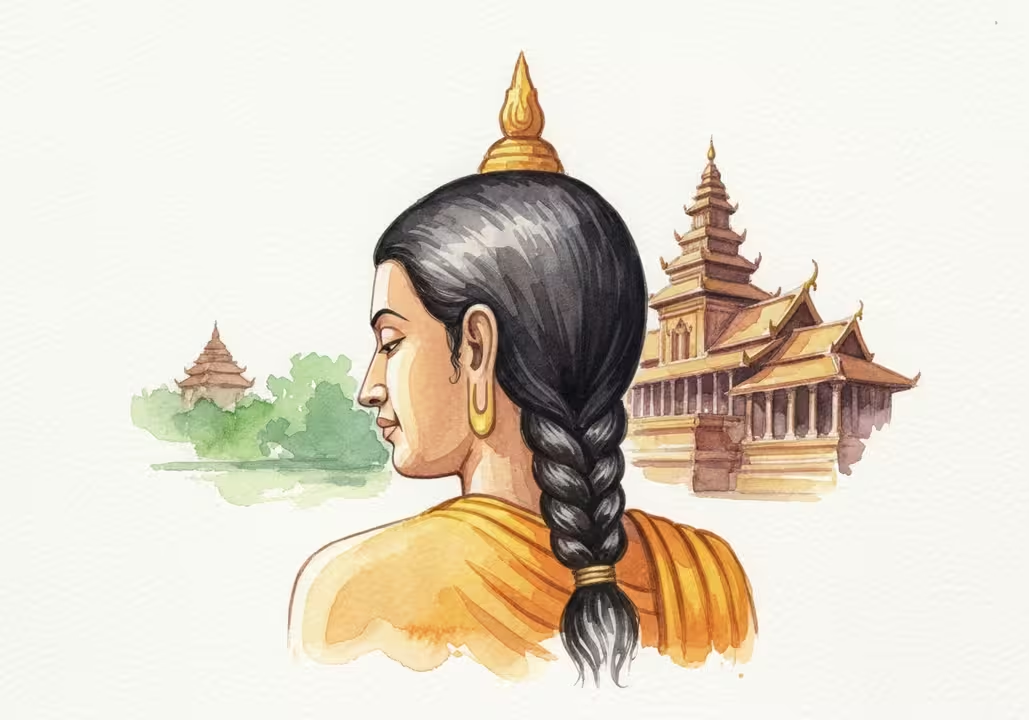
In the 4th century CE, as conflict raged across the Indian kingdom of Kalinga, a princess embarked on a perilous journey that would forever change the spiritual and political landscape of Sri Lanka. Hidden in her elaborately braided hair was one of Buddhism’s most precious treasures—a tooth of the Buddha himself. This is the extraordinary story of the Sacred Tooth Relic, a journey spanning seventeen centuries of devotion, danger, and divine sovereignty.
The Sacred Relic’s Origins
According to the ancient chronicles of the Mahavamsa and Dathavamsa, when the Buddha achieved parinirvana (final passing) around 543 BCE, his body was cremated on a sandalwood funeral pyre in Kusinara, India. From the sacred ashes, his disciple Khema retrieved the Buddha’s left canine tooth—a tangible connection to the Enlightened One. This precious relic was entrusted to King Brahmadatte of Kalinga, where it was enshrined at Dantapura and became an object of profound veneration.
For eight hundred years, the royal dynasty of Kalinga served as guardian kings of the Sacred Tooth Relic. The tooth was more than a religious artifact; it was believed to possess miraculous powers, including the ability to bring timely rains and bountiful harvests. Generation after generation of Kalinga rulers protected this sacred treasure, understanding that it represented both spiritual authority and earthly power.
A Kingdom Under Threat
By the 4th century CE, the relic had come into the possession of King Guhasiva of Kalinga. But the Buddhist kingdom faced an existential crisis. Brahmanical forces, opposed to Buddhism, were gaining strength, and fanatical rulers made repeated attempts to destroy the sacred relic. King Guhasiva faced an agonizing decision: remain and risk the relic’s destruction, or send it away to a land where it could be protected.
The king turned to his daughter, Princess Hemamala, and her husband, Prince Dantha. He entrusted them with a mission of utmost importance—to carry the Sacred Tooth Relic to the Buddhist kingdom of Sri Lanka, where it would find sanctuary under King Sirimeghavanna of Anuradhapura (301-328 CE).
The Perilous Journey
The journey that Princess Hemamala and Prince Dantha undertook was fraught with danger. Understanding that enemies would be watching for any attempt to smuggle the relic out of Kalinga, the royal couple devised an ingenious disguise. They dressed as ascetics, humble religious wanderers who would attract little attention. The Sacred Tooth Relic itself was concealed within the elaborate coils of Princess Hemamala’s hair—a hiding place so intimate and sacred that no one would dare to search it.
The couple traveled to Tamralipti, a port at the mouth of the Ganges River, where they boarded a vessel bound for the island of Lanka. The sea voyage brought its own perils, but eventually, the royal couple landed at Lankapattana (modern-day Ilankeiturei) on Sri Lanka’s shores. Their mission, however, was far from complete.
After being sheltered by a local Brahmin at a kovil, Princess Hemamala and Prince Dantha began the arduous overland journey to Anuradhapura, the ancient capital. The chronicles—the Dathavamsa, Daladasirita, and Mahavamsa—record the many vicissitudes the couple endured as they traveled on foot through dense jungles and along remote paths, safeguarding the precious relic every step of the way.
A Sacred Welcome
When Princess Hemamala and Prince Dantha finally reached Anuradhapura, they were received with great ceremony by King Sirimeghavanna. The king understood immediately the profound significance of what had been brought to his kingdom. This was not merely a religious artifact; it was a symbol of divine legitimacy, a tangible link to the Buddha himself.
King Sirimeghavanna ordered the construction of a special shrine to house the Sacred Tooth Relic—the Meghagiri Vihara, known today as Isurumuniya. The tooth was enshrined with elaborate rituals, and from that moment forward, a tradition took root in Sri Lankan soil: whoever held the Sacred Tooth Relic held the divine right to rule the land.
A Journey Through Capitals
For the next five centuries, the Sacred Tooth Relic remained in Anuradhapura, the spiritual and political heart of the island. But as kingdoms rose and fell, as capitals shifted and enemies invaded, the relic embarked on another journey—this time through the successive capitals of Sri Lanka.
When the seat of power moved to Polonnaruwa, the relic moved with it. But peace was fleeting. In 1215 CE, during the Kalinga Maaga invasion, Buddhist monks spirited the relic away to Kotmale in the central hills for safekeeping. Even more dramatically, in 1284 CE, a Pandyan army from South India captured the Sacred Tooth Relic and took it back to India. For four agonizing years, the symbol of Sri Lankan sovereignty remained in foreign hands until King Parakramabahu III managed to recover it.
The relic continued its island journey through Dambadeniya, Yapahuwa, and other capitals. Each time a new king established his seat of power, he ensured that the Sacred Tooth Relic was housed nearby—a physical manifestation of his legitimate authority.
Colonial Threats and Divine Protection
The arrival of European colonial powers in the 16th century brought new and unprecedented threats to the Sacred Tooth Relic. The Portuguese, who established control over much of coastal Sri Lanka, viewed the relic as a dangerous symbol of Sinhalese Buddhist resistance. In the 16th century, Portuguese forces claimed to have captured the tooth and publicly burned it in Goa in an attempt to break the spirit of the Buddhist population.
But the Portuguese had been deceived. The real Sacred Tooth Relic remained safely hidden in the island’s interior. During the reign of King Vimaladharmasuriya I (1592-1604 CE), when Portuguese forces attacked the Kandyan kingdom, the temple housing the relic was destroyed, but the tooth itself was saved. Buddhist monks and devoted laypeople had developed sophisticated strategies for protecting their most precious treasure.
When the Dutch succeeded the Portuguese in the 17th century, they too launched attacks. During the reign of King Rajasinghe II (1635-1687 CE), temples were destroyed and burned. Whenever the Udarata capital of Senkadagala (Kandy) came under attack, the Sangha (Buddhist monastic community) would quickly remove the relic and hide it in secret locations. Historical records tell of the tooth being concealed in Pansiyapattu in the Dumbara region during one such emergency.
Through war, invasion, and religious persecution, the Sacred Tooth Relic survived—a testament to the devotion of those who protected it.
The Temple of the Sacred Tooth
In the late 16th century, the Sacred Tooth Relic found its final home in Kandy, the last independent kingdom of Sri Lanka. King Vimaladharmasuriya I originally built a two-story temple to house the relic, though this structure was destroyed during Portuguese attacks. The temple was rebuilt and modified by successive kings, with King Rajasinghe II making significant additions even as he defended against Dutch invasions.
The present magnificent structure, known as Sri Dalada Maligawa (Temple of the Sacred Tooth Relic), largely dates from the reign of King Kirthi Sri Rajasinghe (1747-1781 CE). Built within the Royal Palace Complex of the Kingdom of Kandy, the temple was designed to reflect the supreme importance of the relic it housed.
Today, the Sacred Tooth Relic rests in the Vadahitina Maligawa chamber on the temple’s upper floor. The tooth itself lies on a solid gold lotus flower, encased within seven nested golden caskets, each studded with precious gems. These caskets rest upon a throne, fronted by two massive elephant tusks. The doorway to the chamber is richly adorned with gold, silver, and ivory, and the air is perpetually thick with the fragrance of incense and lotus flowers offered by thousands of devotees.
Living Tradition
The Sacred Tooth Relic is not a museum piece locked away from the world. It remains a vibrant center of living Buddhist practice. Three times each day—at dawn, noon, and evening—Buddhist monks perform elaborate rituals of veneration before the relic. The chamber doors are opened, drums sound, and offerings of flowers, incense, and food are made.
The relic is rarely displayed publicly, remaining protected within its golden caskets. However, during the annual Kandy Esala Perahera festival each July and August, a replica casket is paraded through the streets of Kandy in one of the world’s most spectacular religious processions. This tradition, which dates back over 1,500 years in various forms, draws hundreds of thousands of devotees and visitors.
The Esala Perahera as it exists today took shape during the reign of King Kirthi Sri Rajasinghe, who amalgamated the Dalada Perahera (procession of the tooth relic) with the processions of four Hindu deities. For ten nights, the streets of Kandy come alive with traditional dancers, fire performers, whip-crackers, and magnificently decorated elephants. The Maligawa Tusker, the elephant of honor, carries the sacred casket on his back, draped in elaborate cloth of gold.
Symbol of Sovereignty
The political significance of the Sacred Tooth Relic cannot be overstated. For seventeen centuries, Sri Lankan rulers have understood a fundamental truth: no matter how powerful a king might be, no matter how grand his coronation, without guardianship of the Sacred Tooth Relic, he could not be considered the legitimate sovereign in the eyes of his people.
This belief was so deeply embedded in Sri Lankan political culture that even after the fall of the Kandyan Kingdom to the British in 1815, special arrangements were made. The British, recognizing the relic’s importance, entrusted its custody to the Maha Sangha (the assembly of Buddhist monks). A new position—the Diyawadana Nilame, or chief lay custodian—was instituted to oversee the administrative functions relating to the relic, a position that continues to this day.
A Living Legacy
In 1988, UNESCO recognized the Temple of the Sacred Tooth Relic as a World Heritage Site, acknowledging both its architectural significance and its continuing role as a center of Buddhist devotion. The temple stands not merely as a monument to the past, but as a living testimony to faith that has endured through millennia.
The story of the Sacred Tooth Relic is ultimately a story of extraordinary devotion. From Princess Hemamala’s dangerous journey with the tooth hidden in her hair, to the countless monks who risked their lives to protect it from colonial armies, to the millions of pilgrims who have offered flowers before its shrine—the relic has inspired acts of remarkable courage and faith.
Today, as monks perform their daily rituals in the Vadahitina Maligawa chamber, as pilgrims queue to catch a glimpse of the golden casket, as the Esala Perahera elephants process through Kandy’s streets each summer, the Sacred Tooth Relic continues to fulfill the purpose for which it was brought to Sri Lanka seventeen centuries ago: to preserve a tangible connection to the Enlightened One, to inspire devotion, and to serve as a symbol of spiritual and temporal authority.
The journey of the Sacred Tooth Relic—from the cremation fires of Kusinara, through eight centuries in Kalinga, across treacherous seas, through the shifting capitals of Sri Lankan kingdoms, surviving invasions and colonial conquest, to its current home in Kandy—is perhaps one of the most remarkable stories in Buddhist history. It is a journey that continues still, not through physical space, but through time, carrying the light of the Buddha’s teachings into each new generation.