In 1870, Ceylon exported 118 million pounds of coffee, crowning the island as one of the world’s premier coffee producers. Just two decades later, by 1890, ninety percent of the island’s coffee cultivation lay abandoned, estates sold for a quarter of their former value, and prominent banking houses had collapsed. But from this catastrophic ruin emerged an industry that would define Ceylon’s identity for generations to come. The story of how a deadly fungus, a Scottish planter’s foresight, and the toil of thousands of Indian laborers transformed Ceylon into the world’s tea capital is a tale of devastation, adaptation, and ultimate triumph.
The Coffee Empire at Its Zenith
By the 1860s, Ceylon had established itself as a coffee powerhouse. Over 275,000 acres of the island’s central highlands had been cleared and planted with coffee, their emerald bushes cascading down mountain slopes in orderly rows. British planters had invested enormous capital in these estates, building sprawling bungalows, processing facilities, and the infrastructure necessary to transport their valuable crop to Colombo’s bustling port. The island’s coffee commanded premium prices in London’s markets, and fortunes were being made.
The transformation of Ceylon’s pristine highlands into coffee plantations had required massive investment and labor. Roads carved through mountain terrain connected remote estates to market towns. Processing facilities, or “factories” as they were called, dotted the landscape. The agrarian elite had used coffee wealth to invest in bank institutions, railways, and the commercial infrastructure that was modernizing the colony. Coffee wasn’t just an export commodity—it was the foundation of Ceylon’s colonial economy.
The Arrival of “Devastating Emily”
In 1869, orange-colored spots began appearing on coffee leaves at an estate in Madulsima. The planters didn’t immediately recognize the danger, but they soon would. The fungus Hemileia vastatrix—coffee leaf rust—had arrived in Ceylon, and it would prove utterly catastrophic. The planters gave it a grimly ironic nickname: “Devastating Emily.”
The disease spread with terrifying speed. Orange pustules erupted across coffee leaves, causing them to wither and fall. Weakened plants produced fewer berries, and those they did produce were of inferior quality. Planters tried everything—pruning infected branches, applying various treatments, even abandoning and replanting entire estates—but nothing worked. The fungus spread from estate to estate, carried by wind, rain, and the movement of workers and equipment.
The statistics tell a story of unrelenting devastation. Coffee production, which had peaked in 1870, began its precipitous decline. By 1886, coffee exports had plummeted by eighty percent. The financial impact was immediate and brutal. In 1884, the Oriental Bank Corporation, a major financier of coffee estates, failed, sending shockwaves through the colonial economy. Prominent mercantile firms, such as that of the Sabonadiere family, ceased operations the same year. The collapse left Ceylon’s export economy, which had foolishly failed to diversify, in utter ruin.
For individual planters, the crisis was personally catastrophic. Estates that had been worth thousands of pounds sold for pittances, if they sold at all. Many proprietors went through bankruptcy court and found themselves reduced to working as superintendents on estates that had once been their own property. Families that had lived in comfortable prosperity faced financial annihilation. The coffee blight didn’t just destroy crops—it destroyed lives, fortunes, and the economic foundation of British Ceylon.
A Scottish Pioneer’s Gamble
Amid this catastrophe, one man’s earlier experiment would prove providential. James Taylor, born in Kincardineshire, Scotland in 1835, had arrived in Ceylon as a seventeen-year-old in 1852, employed by the British firm Messrs. Harrison and Leake. He was assigned to Loolecondera Estate, a coffee plantation in the Kandy District, where he would spend the rest of his life.
Taylor was different from many planters—curious, methodical, and willing to experiment. As early as 1866, recognizing the growing threat that diseases posed to coffee cultivation, Taylor had traveled to India to learn about tea growing. The trip would change Ceylon’s history. Upon his return in 1867, Taylor cleared nineteen acres of land on Loolecondera Estate—designated as Field No. 7—and planted it with Assam hybrid tea seeds. It was an experiment, nothing more. Coffee was still profitable, and tea was largely unknown in Ceylon. But Taylor’s timing would prove remarkably prescient.
The work of establishing a tea plantation was intensive and required learning entirely new agricultural techniques. Taylor had to determine which elevations and soil conditions suited tea, how to prune the bushes to maximize leaf production, and most critically, how to process the harvested leaves into marketable tea. Unlike coffee, where the berries could be relatively simply dried and hulled, tea manufacturing required precise control of withering, rolling, oxidation, and firing.
In 1872, Taylor established a fully equipped tea factory on the Loolecondera estate. The setup was modest by later standards—the leaves were rolled by hand on tables, and the firing was done on clay stoves over charcoal fires. But it worked. In 1873, Taylor shipped his first consignment of Ceylon tea to London: a mere twenty-three pounds. By 1875, he managed to send a more substantial shipment to the London Tea Auction. The quality impressed British tea merchants. Ceylon could indeed produce excellent tea.
The Great Transformation
As the coffee blight intensified through the 1870s, desperate planters began to notice Taylor’s success. What had been an eccentric experiment became a lifeline. One by one, coffee estates across the central highlands began converting to tea cultivation. The transformation accelerated rapidly. Tea acreage expanded from Taylor’s initial ten acres in 1867 to 4,700 acres by 1878. By 1883, it had reached 32,000 acres. The momentum became unstoppable.
The conversion process was neither simple nor cheap. Tea bushes required three to five years to mature before they could be harvested commercially, meaning planters faced years without income. New factories had to be built or adapted to handle tea processing rather than coffee. Workers needed training in the delicate art of tea plucking—taking only the newest two leaves and a bud from each stem—and in the complex manufacturing process. Many estates had to be reorganized entirely, as tea cultivation required different labor arrangements than coffee.
But the results justified the investment. Export statistics reveal the dramatic shift. Exports of Ceylon tea to Britain rose from 282 pounds in 1875 to over 4.3 million pounds by 1885. By 1888, tea acreage had exceeded that of coffee, and exports reached 23 million pounds. The tea industry was growing to nearly 400,000 acres by 1899. Ceylon tea was conquering the world market.
The Lipton Factor and British Investment
The rapid expansion attracted major British investment. In 1890, Thomas Lipton, the Glasgow grocer who had built a retail empire in Britain, made a strategic decision that would make his name synonymous with tea. He traveled secretly to Ceylon, recognizing that the coffee blight had created an extraordinary opportunity. Land prices were depressed, and bankrupt coffee estates could be purchased for a fraction of their former value.
Lipton bought five bankrupt plantations initially, eventually acquiring about a dozen estates across the island. But he brought something revolutionary to the industry: vertical integration. Rather than selling his tea through the traditional network of middlemen and brokers, Lipton controlled the entire supply chain from plantation to retail shop. He imported his tea directly to Britain and sold it in his own stores at prices that undercut competitors. His slogan, “Direct from the Tea Garden to the Tea Pot,” promised consumers quality tea at affordable prices.
Lipton’s approach democratized tea consumption in Britain. What had once been a luxury became an everyday beverage for working-class families. And as demand grew, so did Ceylon’s tea industry. Other British companies followed Lipton’s lead, investing heavily in Ceylon estates and implementing modern machinery to increase production efficiency.
The Human Cost: Indian Labor and the Plantation System
The rapid expansion of tea cultivation required an enormous labor force, far larger than Ceylon’s local population could provide. The British solution was to import workers from South India—primarily from Tamil-speaking regions that were also under British colonial control. Between the 1830s and 1930s, hundreds of thousands of Tamil workers were brought to Ceylon as indentured laborers, a system that was exploitative in both design and practice.
These workers, known as Malaiyaha Tamils or Up-country Tamils, lived in line rooms on the estates—basic barracks that housed entire families in single rooms. They worked long days plucking tea or processing leaves in the factories, often in harsh conditions and for minimal wages. The feudal hierarchy of the plantation system lorded over them, prioritizing productivity, quality, and profit above worker welfare.
The contributions of these workers to Ceylon’s economic transformation cannot be overstated. Their labor made the tea industry possible. Yet their living and working conditions were not a consideration for the British estate owners and managers. They existed in a colonial underclass, essential to the economy but marginalized in society. This legacy of exploitation would have lasting consequences, as the descendants of these workers continue to face social and economic challenges in modern Sri Lanka.
The Legacy of Transformation
James Taylor never lived to see the full flowering of the industry he had pioneered. On May 2, 1892, at the age of fifty-seven, he died of dysentery while still in service at Loolecondera. The year before his death, the Planters Association had presented him with a tea and coffee service, its inscription reading: “to James Taylor, Loolecondera, in grateful appreciation of his successful efforts which laid the foundation of the Tea and Cinchona Industries in Ceylon.” He was buried at the Mahaiyawa cemetery near Kandy, far from his Scottish homeland but on the island whose economic destiny he had helped reshape.
The transformation from coffee to tea stands as one of the most remarkable agricultural transitions in colonial history. It was driven by crisis—the total collapse of coffee cultivation—but also by innovation, adaptation, and the willingness of planters to embrace a completely different crop. Within a single generation, Ceylon shifted from coffee exporter to the world’s leading producer of high-quality tea, a reputation the island maintains today.
The economic impact was profound and lasting. Tea exports became the mainstay of Ceylon’s economy throughout the twentieth century, generating the capital that funded railways, urban development, and colonial infrastructure. The distinctive flavor profile of Ceylon tea—bright, brisk, and full-bodied—made it prized in global markets. The island’s varied elevations produced teas with different characteristics: the delicate high-grown teas from estates above 4,000 feet, the medium-grown teas from the middle elevations, and the bold low-grown teas from coastal regions.
Today, Sri Lanka remains one of the world’s largest tea exporters, producing approximately 300 million kilograms annually. The names of tea-growing regions—Nuwara Eliya, Dimbula, Uva, Kandy—are recognized by tea connoisseurs worldwide. The industry employs hundreds of thousands of workers and remains a cornerstone of the national economy.
Yet the legacy is complex. The transformation from coffee to tea was not merely an agricultural success story—it was also a story of colonial exploitation, environmental transformation, and social disruption. The pristine forests of the central highlands were cleared to make way for plantations. The indigenous population was displaced or subordinated to colonial economic priorities. The Tamil workers who made the industry possible were treated as expendable labor and denied full participation in Ceylonese society.
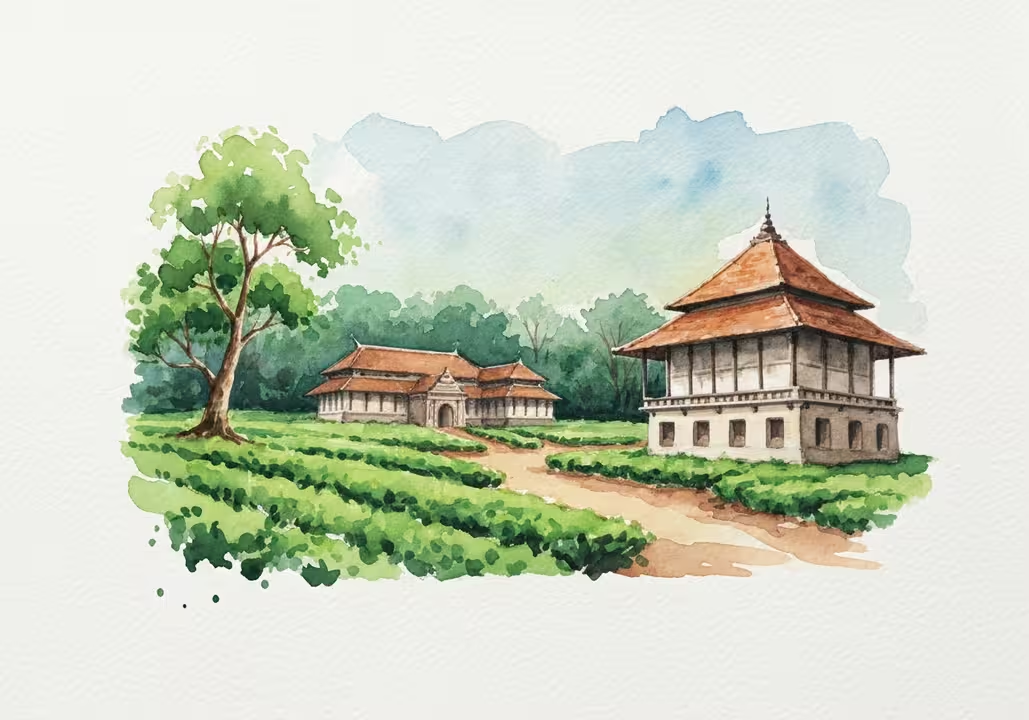
The tea estates themselves, with their colonial-era bungalows, factories, and manicured gardens, stand as physical reminders of this history. Loolecondera Estate, where James Taylor planted those first nineteen acres, has been preserved as a heritage site, attracting visitors who want to see where Ceylon tea began. The Ceylon Tea Museum in Kandy tells the story of the industry’s development, displaying the hand-rolling tables and clay stoves similar to those Taylor used.
When you drink a cup of Ceylon tea today—whether it’s a robust breakfast blend or a delicate afternoon tea—you’re participating in a story that began with catastrophe and experimentation. You’re tasting the result of a Scottish planter’s gamble, the resilience of British coffee planters who refused to accept ruin, and the labor of generations of workers who plucked the leaves and processed them into the world’s finest tea. The transformation from coffee to tea remade Ceylon’s economy, shaped its society, and created an industry that defines the island to this day.