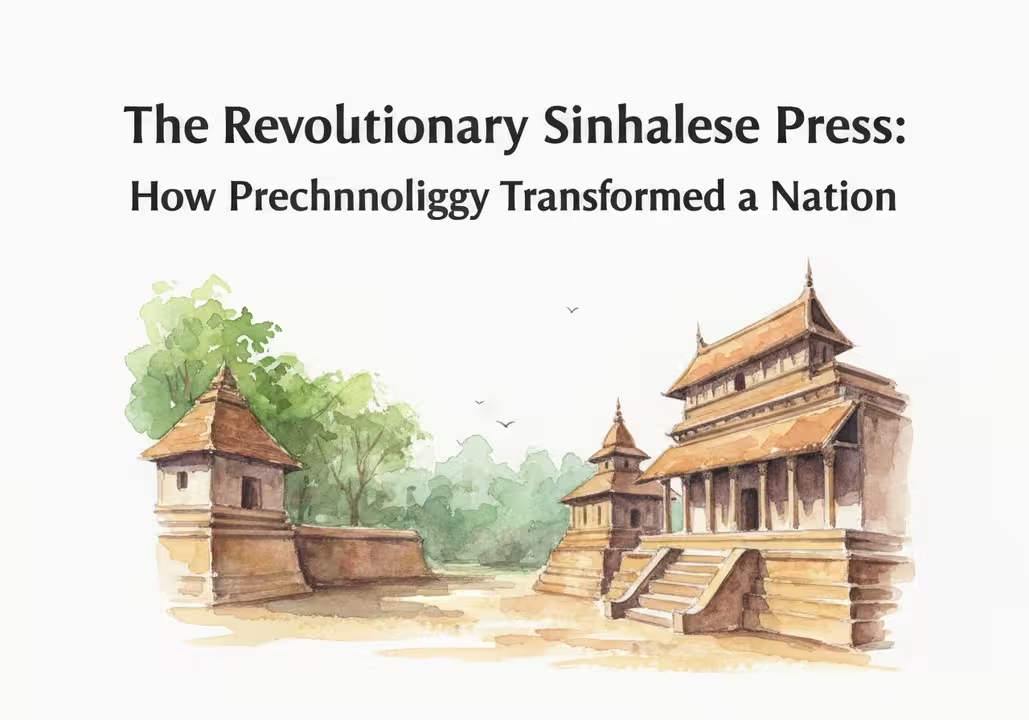
In the spring of 1737, in a workshop within the Dutch Fort in Colombo, an armorer named Gabriel Baas performed an extraordinary act of cultural engineering. Using his metalworking skills typically reserved for weapons, Baas meticulously crafted something far more powerful—the first set of movable Sinhalese type. This technological achievement, modest as it might have seemed at the time, would ultimately prove more revolutionary than any cannon in the Dutch arsenal. It marked the beginning of a transformation that would reshape Sinhalese society, education, and national consciousness over the next two centuries.
From Palm Leaf to Printing Press
For centuries, knowledge in Ceylon had been preserved on ola leaves—carefully prepared strips of talipot palm inscribed with iron styluses. This ancient manuscript tradition was both beautiful and limiting. By the 18th and 19th centuries, an estimated 75,000 ola leaf books existed across the island, containing Buddhist sutras, Ayurvedic medical texts, Jathaka stories, and literary works. Yet each manuscript required painstaking effort to create, and copies were rare and precious. Learning remained the province of Buddhist monks who taught privileged students at temple schools, while the majority of the population, though often literate, had limited access to written materials.
The Dutch, who had controlled the coastal regions of Ceylon since 1658, recognized that effective colonial administration required communication with the local population. In 1734, the Dutch Government established the first printing press in Sri Lanka, primarily to serve the needs of both missionaries and administrators. But it was the creation of Sinhalese movable type in 1737, through the collaboration of the Dutch Reformed Church and the Dutch East India Company, that truly marked the inception of Sinhalese typography.
The First Impressions
On April 5, 1737, the Dutch Government Press produced its first publication in Sinhalese—a government gazette on pepper plantation. The practical concerns of colonial commerce had given birth to a new medium of communication. A month later, in May 1737, a Sinhalese prayer book rolled off the press, representing the missionaries’ determination to spread Christianity in the local language. By 1739, all four Gospels—Matthew, Mark, Luke, and John—had been translated and published in Sinhalese.
These early publications reflected the colonial administration’s dual priorities: economic control and religious conversion. The press printed plakkaten (official notices), religious texts, and both educational and non-educational books in Sinhala. Yet for all their efforts, the Dutch produced only 22 books in Sinhalese during their entire rule, which lasted until 1796. The technology had arrived, but mass printing in the local language remained limited.
The British Era and Missionary Zeal
When the British captured Ceylon’s coastal areas in 1796 and took full control in 1802, they inherited the Dutch printing infrastructure. The Ceylon Government Gazette, established in 1802, would become the oldest continuously published newspaper in Sri Lanka. However, the British government’s takeover of the Dutch printing house did not immediately lead to a flourishing of Sinhalese publications. Instead, it was religious societies that became the true champions of Sinhalese printing.
Methodist missionaries arrived in Ceylon on June 29, 1814, bringing not just faith but practical skills. Reverend William Harvard, who arrived in Colombo in spring 1815, was a printer by profession. He established the famous Wesleyan Mission Press in Colombo, which would become a cornerstone of Sinhalese publishing. Under Harvard’s supervision, and later under Daniel Gogerly who took charge in October 1818, the press produced a steady stream of religious and educational materials.
The Wesleyan Mission Press’s output was remarkable. They printed the Gospel according to St. Matthew in Sinhalese (1813), the Sermon on the Mount (1816), John Wesley’s Instructions for Children in Sinhalese (1817), and John Callaway’s “A Vocabulary in Cingalese and English” (1820). The Colombo Auxiliary Bible Society, established in 1812, further accelerated translation and printing work. By 1818, reports from the society documented an expanding collection of Christian literature available in Sinhalese.
British observers of the early 19th century noted surprisingly high literacy levels among the Sinhalese. In 1807, James Cordiner wrote that “the greater part of the men can read and write.” John Davy observed in 1821 that reading and writing “are far from uncommon acquirements,” and William Knighton noted in 1845 that “it is rare to see a Ceylonese, even of the poorest class, who cannot read and write his own language.” While these observations reflected the legacy of temple-based education, they also indicated a population primed to benefit from increased access to printed materials.
The Birth of the Vernacular Press
The true revolution came in the second half of the 19th century with the emergence of Sinhalese newspapers and periodicals. In 1860, at Galle in the Southern Province, W. E. Eaton launched “Lanka Lokaya” (Light of Lanka)—the first Sinhalese newspaper. Though it was a fortnightly publication that soon ceased, it had opened a door that could never be closed.
Two years later, in 1862, “Lakmini Pahana” (Lamp of Lanka) commenced publication, becoming the first newspaper registered under the 1839 Newspaper Registration Ordinance. Its pioneers—Gunatilake Athapattu, Pandit Batuwantudawe, and Buddhist monk Ven. Walane Siddhartha—represented a crucial shift. For the first time, Sinhalese intellectuals and Buddhist religious leaders were using print technology not for colonial or missionary purposes, but for their own cultural and religious revival.
In 1863, “Lakrivikirana” (Rays of Sun of Lanka) appeared under V. S. Ranasinghe’s editorship, fighting “exclusively for the rights of the Buddhists.” This marked the beginning of a Buddhist print renaissance that would reshape Ceylon’s cultural landscape.
The Buddhist Revival and Print Culture
The arrival of Colonel Henry Steel Olcott in Ceylon in 1880 catalyzed a dramatic expansion of Buddhist publishing and education. When Olcott arrived, only three Buddhist schools existed in the entire island—a shocking statistic for a predominantly Buddhist nation that had possessed a sophisticated education system before European colonization. The Sinhalese Buddhist leaders and Olcott established the Buddhist Theosophical Society in 1880, with the explicit goal of creating Buddhist schools to counter the missionary educational dominance.
The Society launched its own publications to promote Buddhism, including the Sinhalese newspaper “Sarasavisandarasa” and its English counterpart, “The Buddhist.” These publications became platforms for articulating Buddhist identity, critiquing colonial oppression, and advocating for independence. Other influential publications followed: “Lanka Pradeepaya” (1895-1913), “Kavata Kathikaya,” the cartoon newspaper (1872-1913), “Swarajjaya” (1872-1928), and “Satbasa” (1894-1901).
By 1940, Ceylon had 429 Buddhist schools—a hundredfold increase from 1880. This educational revolution was inseparable from the printing press, which provided textbooks, religious materials, and periodicals that sustained both education and cultural revival.
A Cultural Transformation
The introduction of printing to Sri Lanka represented what scholars have called “a profound social event” that “changed the traditional social structures prevailing in Sri Lankan society.” The shift from ola leaf manuscripts to printed books altered not just how information was reproduced, but fundamentally changed the Sinhala script itself and who had access to knowledge.
What began in 1737 as a tool of colonial administration and missionary conversion became, by the late 19th century, a powerful instrument of cultural resistance and national awakening. Sinhalese newspapers specialized in communicating themes of anti-imperialism, documenting “the atrocities of imperial rule, oppression, secularization and the independence of the country.”
The printing press democratized knowledge in unprecedented ways. While the traditional system had confined learning to temple schools and privileged students, printed materials could reach across social classes and geographical distances. The vernacular press created a public sphere where Sinhalese intellectuals, Buddhist monks, and political activists could debate ideas, share information, and forge a common identity.
Legacy of Letters
From Gabriel Baas’s first Sinhalese type to the flourishing Buddhist press of the late 19th century, the story of printing in Ceylon demonstrates how technology, even when introduced for purposes of control, can become a tool of liberation. The 22 books printed by the Dutch grew into thousands of publications that educated millions, preserved culture, and ultimately contributed to the independence movement.
The revolutionary power of the Sinhalese printing press lay not in any single publication, but in its cumulative effect—the gradual building of a literate public, an informed citizenry, and a revitalized cultural identity. In workshops and mission presses, in newspaper offices and Buddhist schools, the printed word became the foundation for modern Sri Lankan society, transforming communication, education, and ultimately, the course of history itself.