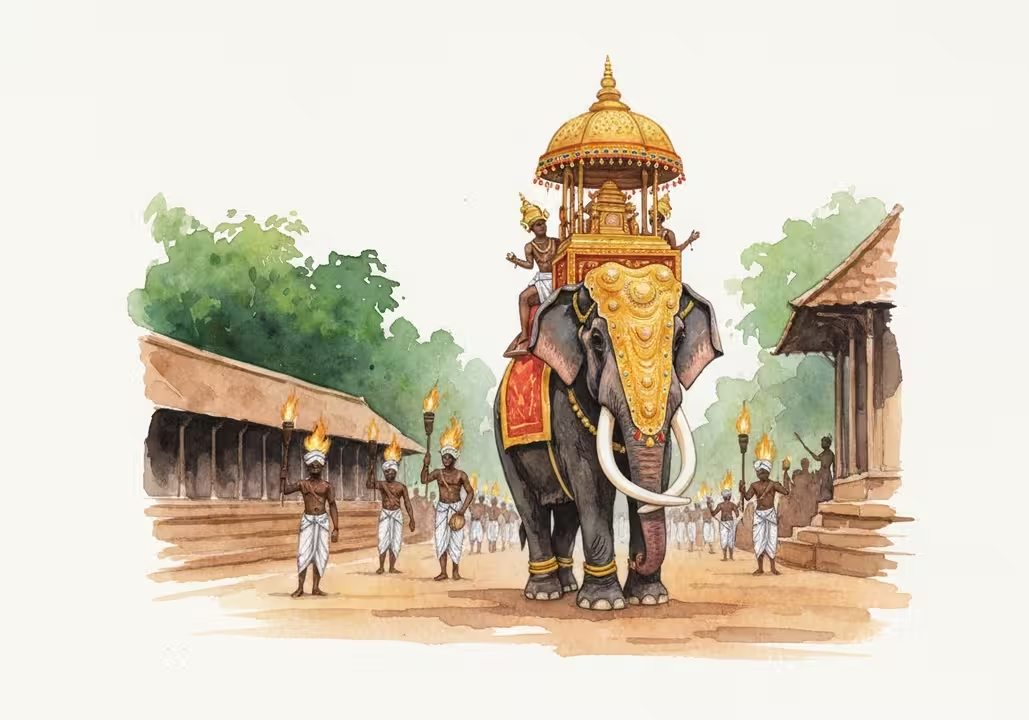
The night air trembles with the thunder of drums. Flames dance in the darkness as torchbearers light the ancient streets. Then, emerging from the sacred temple like a vision from another age, comes the majestic tusker elephant, adorned in golden cloth and precious jewels, bearing upon its back the most sacred object in the kingdom—the casket containing the Tooth Relic of the Buddha. This is the Perahera, a tradition that has captivated hearts and minds for over two millennia, weaving together threads of ancient kingship, Buddhist devotion, and cultural splendor into one of the world’s most spectacular living traditions.
The Ancient Roots: When Kings Called the Rains
Long before the arrival of Buddhism, the fertile plains of Sri Lanka depended upon the mercy of the monsoons. In those distant times, dating back to the 3rd century BCE, the ancient inhabitants developed elaborate rituals to invoke the blessings of the gods for timely rainfall and bountiful harvests. These were the original Esala processions, held during the month of Esala (July-August), when farmers anxiously awaited the life-giving rains that would determine their survival.
These early processions were spectacular demonstrations of communal faith and royal power. Kings and commoners alike participated in elaborate pageants designed to please the deities associated with fertility, rain, and prosperity. The processions featured offerings, music, dance, and displays of devotion that transformed entire cities into stages for sacred drama.
When Emperor Asoka’s son, Arhant Mahinda, brought Buddhism to Sri Lanka in the 3rd century BCE, he also introduced the Indian tradition of Buddhist processions to mark religious festivals and ceremonies. This marked the beginning of a remarkable fusion—ancient indigenous rain-invoking rituals began to merge with Buddhist religious observances, creating something entirely unique to the island.
The Sacred Tooth: Symbol of Divine Kingship
The transformation of royal processions took a dramatic turn in the 4th century CE with the arrival of the Sacred Tooth Relic of the Buddha from India. According to the chronicles, the Tooth Relic came to Lanka during a time of turmoil in the Indian kingdom of Kalinga, where it had been preserved and venerated for centuries. Princess Hemamali and her husband Prince Dantha smuggled the precious relic to Sri Lanka, hidden in the princess’s hair, to protect it from those who sought to possess or destroy it.
The impact of this arrival cannot be overstated. The Sacred Tooth Relic quickly became far more than a religious object—it became the ultimate symbol of legitimate rule. In the complex political landscape of medieval Sri Lanka, whoever possessed the Tooth Relic possessed the divine right to govern. Kings built magnificent temples to house it, and the relic moved with the capital as power shifted across the island, from Anuradhapura to Polonnaruwa, and eventually to Kandy.
The Dalada Perahera—the procession of the Tooth Relic—emerged as a distinct tradition following the relic’s arrival. Historical accounts from the 5th century provide vivid descriptions of these early processions. The chronicles record that “the Tooth of the Buddha was always brought forth in the middle of the third month, and ten days beforehand the king grandly caparisoned a large elephant on which he mounted a man dressed in royal robes.” This established a pattern that would endure for centuries: the sacred relic borne upon an elephant, preceded by elaborate preparation and accompanied by magnificent pageantry.
The Elephant: Living Symbol of Majesty
No element of the Perahera tradition is more iconic than the elephants, particularly the majestic tusker that bears the sacred casket. The elephant occupies a unique place in both Buddhist and Hindu cosmology, serving as a symbol that transcends religious boundaries. In Buddhist tradition, the white elephant is associated with mental clarity and wisdom—legend holds that the Buddha’s mother, Queen Maya, dreamt of a white elephant entering her womb before giving birth to Prince Siddhartha.
Beyond religious symbolism, the elephant represented the perfect fusion of natural majesty and royal power. Its size, strength, and dignified bearing made it the ideal bearer of sacred objects. In many ways, the elephant became a symbolic representation of the monarch himself—powerful yet controlled, magnificent yet devoted to dharma.
The selection of the elephant to bear the sacred casket was a matter of enormous importance. The chosen tusker had to possess not only physical perfection but also the right temperament—calm, steady, and dignified in the face of massive crowds and overwhelming sensory stimulation. Famous tuskers like Maligawa Tusker have become legendary figures in their own right, serving for decades and being mourned by the nation upon their passing.
When the Mahavamsa chronicles described the first Perahera after the Tooth Relic’s arrival 1,700 years ago, it specifically mentioned “an elephant assigned the honour of carrying the sacred object.” This tradition, established in antiquity, continues unbroken to the present day, creating a living link between ancient and modern Sri Lanka.
The Kandyan Transformation: Creating the Modern Perahera
While elements of the Perahera tradition existed for over a millennium, the spectacular festival we know today took its definitive form during the Kandyan Kingdom. The year 1754 CE marked a crucial turning point when the first formal Dalada Perahera of the Kandyan Kingdom was organized in the mountain capital of Kandy.
However, the most significant transformation came in 1775 CE under the reign of King Kirthi Sri Rajasinghe. This enlightened monarch, who ruled from 1747 to 1782, was a passionate patron of Buddhism and traditional culture. He made a revolutionary decision: the Sacred Tooth Relic, which had previously been considered the private property of the king, would now be taken in procession before the public so that ordinary people could worship and receive blessings.
King Kirthi Sri Rajasinghe formalized the structure that defines the modern Esala Perahera, decreeing that the procession of the Sacred Tooth Relic should lead a combined pageant that also honored the four guardian deities—Natha, Vishnu, Katharagama, and Pattini. This created a magnificent synthesis, uniting the ancient Esala traditions, Buddhist devotion to the Tooth Relic, and Hindu veneration of the guardian deities into one grand spectacle.
Under his patronage, traditional arts flourished. Kandyan dance, drumming, and music reached new heights of sophistication. The king encouraged the translation of Buddhist texts from Pali and Sanskrit into Sinhala, making sacred knowledge accessible to a broader population. The Perahera became a showcase for these cultural achievements, a living museum of Kandyan civilization.
The Sacred Spectacle: Rituals and Performers
The modern Esala Perahera follows a carefully choreographed structure that has been refined over centuries. The festival begins with the Kap Situweema ceremony, in which sanctified young jackfruit trees are cut and planted at the four Devales (shrines) dedicated to the guardian deities. This ancient ritual marks the beginning of the sacred time, creating a spiritual boundary between ordinary days and the period of the Perahera.
For the first five nights, processions are held within the precincts of each Devale, growing gradually in scale and splendor. Then comes the Kumbal Perahera, followed by the grand Randoli Perahera—the main event that draws hundreds of thousands of spectators. Each night’s procession grows more magnificent, building toward the climactic final night.
The performers represent a living archive of traditional arts. Whip-crackers march at the front, their sharp cracks clearing the path and announcing the procession’s approach. Fire dancers spin and toss blazing torches, creating wheels of flame in the darkness. Traditional drummers play the hypnotic rhythms on hevisi drums that have accompanied these processions for centuries.
The Kandyan dancers, in their elaborate costumes of silver and beads, perform ancient dance forms including the sacred Ves dance, originally performed only for royalty. Hundreds of performers, having trained for years to master their art, display their skill as the procession winds through the streets. Following them come the elephants—over a hundred in total—each caparisoned in colorful cloth and LED lights that have been added in recent decades, creating a bridge between tradition and modernity.
The festival concludes with the Diya Kepeema, the water-cutting ceremony held at the Mahaweli River, echoing the ancient purpose of the original Esala rituals: the invocation of water and fertility. The chief custodian of the Dalada Maligawa cuts the water of the river with a ceremonial sword, symbolically renewing the cosmic order and ensuring prosperity for the year to come.
A Living Tradition
Today, the Kandy Esala Perahera stands as one of the oldest continuously practiced rituals in all of Asia. It has survived the fall of kingdoms, colonial occupation, civil conflict, and the pressures of modernization. What makes it remarkable is not merely its age, but its vitality—this is not a museum piece or historical reenactment, but a living tradition that continues to evolve while maintaining its essential character.
The Perahera represents the remarkable ability of Sri Lankan culture to synthesize diverse elements into a harmonious whole. It combines pre-Buddhist animistic traditions with Buddhist devotion and Hindu worship. It unites royal pageantry with popular participation. It preserves ancient arts while adapting to contemporary contexts.
For ten nights each year, when the drums thunder and the flames dance, when the great tusker emerges bearing its sacred burden, the past becomes present. The ancient kings who first established these processions, the artisans who perfected the traditional arts, the countless generations who have participated as performers or devotees—all are present in spirit, their legacy carried forward by the living tradition.
The Perahera reminds us that culture is not static but dynamic, not preserved in amber but passed from hand to hand, generation to generation, constantly renewed yet essentially unchanged. In the procession of the Sacred Tooth Relic, we witness not merely a historical tradition but a continuing conversation between past and present, between the sacred and the secular, between individual devotion and collective celebration. It is, in every sense, a moment when the gods walk among us, when heaven touches earth, and when an entire civilization celebrates its identity, its faith, and its extraordinary cultural heritage.