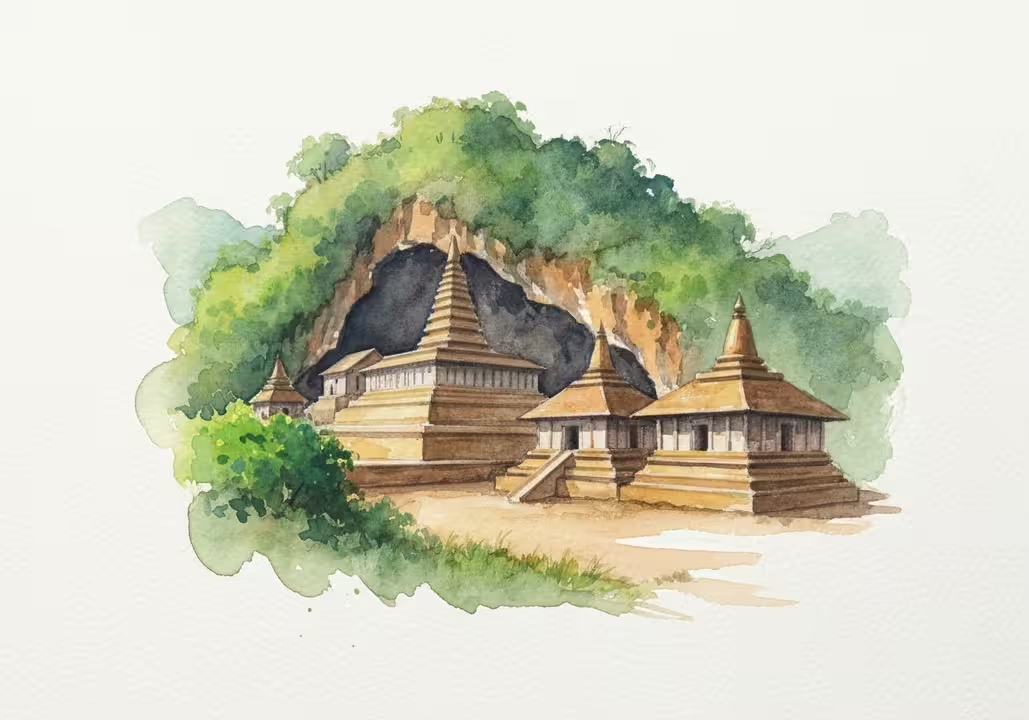
In the rugged hills northeast of what is now Kurunegala, where the Deduru Oya river winds through ancient valleys, a remarkable discovery over two millennia ago would change the course of Sri Lankan history. This is the story of Ridi Viharaya, the Silver Temple, where divine providence, royal ambition, and a merchant’s good fortune converged to create one of the island’s most sacred sites.
A King’s Grand Vision
In the 2nd century BCE, King Dutugemunu (161-137 BCE) ruled the Anuradhapura Kingdom with a vision that would outlast his lifetime. Having unified the island after defeating the South Indian king Elara, Dutugemunu set his sights on a monument that would stand as a testament to his faith and his reign—the magnificent Ruwanwelisaya stupa. This colossal structure, designed to be one of the largest stupas in all of Sri Lanka, would require unprecedented resources, skill, and most critically, wealth.
As the construction progressed, the king’s treasury faced a mounting crisis. The sheer scale of the Ruwanwelisaya demanded materials beyond the kingdom’s immediate means. Stone, labor, and decorative elements all required funding, but it was silver—precious silver to adorn and complete this architectural marvel—that proved most elusive. The king’s dream seemed destined to remain unfinished, a monument to ambition rather than achievement.
The Fateful Journey
According to the ancient chronicles Mahavamsa and Thupavamsa, destiny would intervene in the most unexpected way. Merchants traveling from the central highlands toward the royal capital of Anuradhapura followed an ancient trade route that passed through the village of Ridigama, known then as Emtota or Ambatthakola in Pali.
As the story goes, these weary travelers, their oxen laden with goods, paused to rest in this verdant area near the Deduru Oya. There, they spotted a sweet jackfruit tree, its branches heavy with ripe fruit. Following the Buddhist custom of offering the first portion of any meal to monks, the merchants plucked the jackfruit and cut it open, intending to share it with any holy men who might be nearby.
As if summoned by their piety, Buddhist monks appeared—first four Arahats, then four more. The final monk to arrive was Arhat Indragupta, a revered sage dwelling in the surrounding caves. After accepting and consuming the sweet fruit offering, the elderly Arhat blessed the merchants and pointed them toward a path to continue their journey.
The Discovery That Changed Everything
Following the monk’s directions, the lead merchant ventured along the indicated route. As he walked, he came upon a cave—one of many that dotted the hillside. Curiosity drew him inside, and in the dim light filtering through the cave entrance, something gleamed.
There, embedded in the rock, was a vein of pure silver ore.
The merchant could scarcely believe his fortune. He carefully extracted a piece of the precious metal and immediately altered his plans. Instead of continuing with his trade goods, he made directly for Anuradhapura, his heart racing with the knowledge that what he carried could change the fate of the kingdom.
Upon arriving at the royal palace, the merchant related his extraordinary tale to King Dutugemunu—how an offering of jackfruit to holy monks had led to a blessing, and how that blessing had revealed untold wealth hidden in a remote cave. The king, recognizing divine intervention when he saw it, immediately dispatched his ministers and surveyors to the site near Ridigama.
What they found exceeded even the merchant’s report. The cave contained a rich vein of silver ore, enough to provide the precious metal needed to complete the Ruwanwelisaya. The king’s great work could continue.
A Temple Born of Gratitude
King Dutugemunu was not a man to forget his debts, whether to humans or to the divine. Recognizing that the discovery of the silver had come through the blessing of Arhat Indragupta and his fellow monks, the king decided to commemorate the site in a manner befitting its sacred significance.
He commanded the construction of a temple complex at the very location where the silver had been found. To this massive undertaking, he assigned 300 master stone masons and 700 additional workers, including his chief artisan, Vishwakarma Prathiraja. These craftsmen would transform the natural cave system into a magnificent monastery worthy of the miracle that had occurred there.
The king also ordered a special Buddha statue to be brought from Dambadiva (India)—a gold-plated image that would serve as the temple’s centerpiece, a fitting tribute given with silver-earned wealth. Thus was born Ridi Viharaya, literally “Silver Temple,” a name that would endure through the centuries.
A Sacred Landscape
The temple complex that emerged was unlike any other in the kingdom. Built into and around approximately twenty-five natural caves, the monastery became home to a community of monks who traced their lineage back to the arrival of Arahat Mahinda, who had first brought Buddhism to Sri Lanka in the 3rd century BCE.
The caves themselves bore witness to the site’s ancient sanctity. Archaeological studies have revealed Brahmi inscriptions dating to the 2nd and 3rd centuries BCE carved into the cave walls, recording donations and establishing the site’s use even before King Dutugemunu’s grand construction. One particularly significant rock inscription from the reign of Amandagamini Abhaya in the 1st century CE records the donation of two villages—Padagaa and Kulagama—to support the monastery.
The artisans employed by Dutugemunu created architectural marvels within these natural formations. They carved a Gedige-type temple entirely from stone within a rock-cut cave, a structure that would later be dated to the Polonnaruwa era. They crafted a magnificent nine-meter recumbent Buddha statue, its serene face gazing out over the valley where the fateful discovery had occurred. And they incorporated the acclaimed “Pancha Nari Ghata”—an intricate ivory carving design featuring five maidens entwined, a masterpiece of ancient craftsmanship.
Centuries of Devotion
What makes Ridi Viharaya truly remarkable is not merely its legendary founding or its architectural splendor, but its unbroken continuity. For over two thousand years, this monastery has maintained an active community of monks, making it one of the longest continuously inhabited monasteries in the Buddhist world. Through the rise and fall of kingdoms, through invasions and periods of upheaval, through centuries of change, the Silver Temple has remained a beacon of Buddhist learning and practice.
The temple’s significance was recognized anew in the 18th century CE, when King Kirti Sri Rajasinha of Kandy (1746-1778 CE) initiated a revival of Buddhism across Sri Lanka. During his reign, the Uda Viharaya (Upper Temple) was added to the complex, ensuring that Ridi Viharaya would continue to serve pilgrims and practitioners for generations to come.
Legacy of Silver and Faith
Today, Ridi Viharaya stands in the peaceful countryside approximately eighteen kilometers northeast of Kurunegala, its caves and structures nestled among rolling hills much as they were when that anonymous merchant first stumbled upon silver ore. Pilgrims and visitors who make the journey there walk paths that echo with centuries of devotion, entering caves where monks have meditated since before the Common Era.
The silver that was discovered here served its purpose—King Dutugemunu’s Ruwanwelisaya was completed and stands to this day in Anuradhapura, one of the most sacred sites in Sri Lankan Buddhism. But the true treasure of Ridi Viharaya was never the metal extracted from its caves. Rather, it was the recognition that acts of simple piety—offering fruit to monks, following a sage’s guidance, honoring divine providence—could yield rewards beyond measure.
The legend of Ridi Viharaya reminds us that great monuments are built not just with precious metals and skilled labor, but with faith, gratitude, and the recognition of sacred moments in ordinary life. A merchant’s journey, a sweet jackfruit, a pointing finger, a gleam in a dark cave—these simple elements combined to create one of Sri Lanka’s most enduring religious sites.
In the Silver Temple, the material and the spiritual became one, and over two millennia later, that union continues to draw seekers to its ancient caves, where the line between legend and history blurs into something approaching the divine.