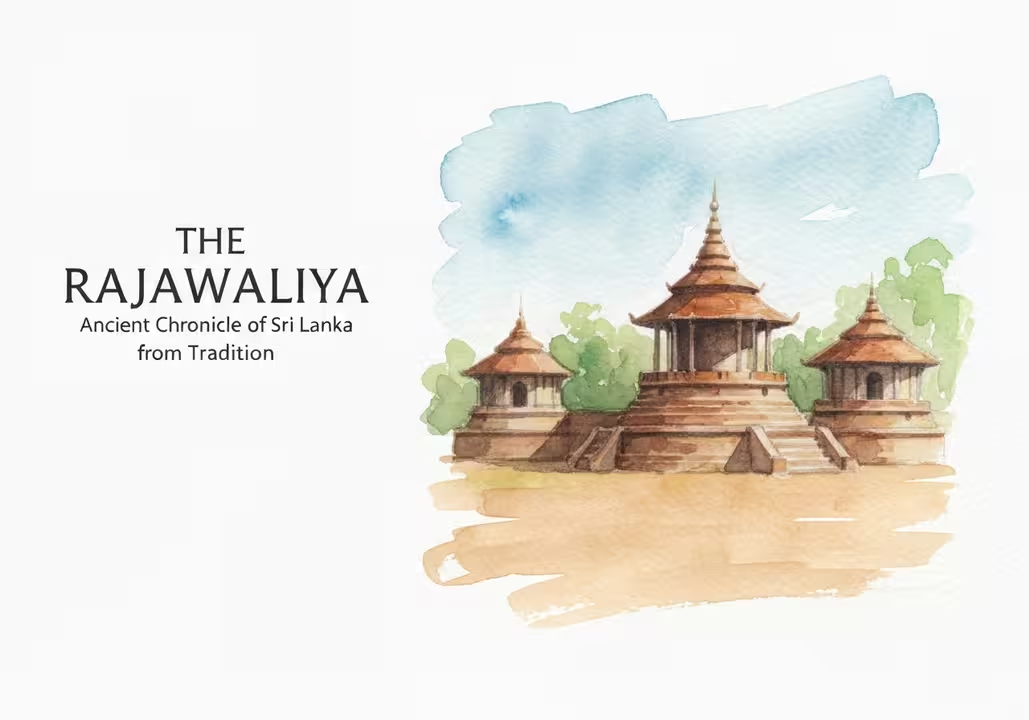
In the grand tradition of Sri Lankan historical record-keeping, the Rajawaliya stands as a unique testament to the island’s medieval literary heritage. Composed in the 17th century, this chronicle represents a pivotal moment when ancient Sinhala history, long preserved in the sacred Pali language of Buddhist monks, was finally rendered into the vernacular Sinhalese language for a broader audience. The Rajawaliya—literally meaning “Line of Kings”—bridges the gap between the scholarly religious chronicles and the linguistic reality of medieval Sri Lankan society.
A Chronicle Born from Tradition
Unlike the ancient Mahavamsa and Dipavamsa, which were composed by Buddhist monks in Pali during the first millennium CE, the Rajawaliya emerged in the 17th century during a period of significant upheaval in Sri Lankan history. By this time, the island had endured centuries of invasions, the arrival of European colonial powers, and the gradual migration of the Sinhala kingdoms from the dry zone heartlands of Anuradhapura and Polonnaruwa to the wet zone hill country of Kandy.
The exact author of the Rajawaliya remains unknown to history, shrouded in the same mystery that surrounds many medieval texts. What we do know is that the chronicle was composed during a time when the Kandyan Kingdom was establishing itself as the last bastion of independent Sinhala rule, resisting first Portuguese and then Dutch colonial expansion along the coastal regions.
The chronicle’s narrative spans from the mythical beginnings of Sinhala civilization—starting with the legendary arrival of Prince Vijaya from India in the 6th century BCE—and continues through the centuries, ultimately concluding with the accession of King Vimaladharmasuriya II in 1687. This extensive historical sweep, covering nearly two millennia, makes the Rajawaliya an invaluable source for understanding how medieval Sri Lankans conceived of their own history.
The Vernacular Revolution
The most significant aspect of the Rajawaliya is its language. While the Mahavamsa and other great chronicles were written in Pali—the liturgical language of Theravada Buddhism, accessible primarily to educated monks and scholars—the Rajawaliya was composed in Sinhalese, the language spoken by the common people. This represented a democratization of historical knowledge, making the story of Sri Lanka’s kings accessible to a much wider audience.
This shift from Pali to Sinhalese reflected broader changes in medieval Sri Lankan society. By the 17th century, Sinhalese had developed a rich literary tradition of its own, with sophisticated poetry, religious texts, and prose works. The creation of a comprehensive historical chronicle in Sinhalese was a natural evolution of this literary flowering.
The Rajawaliya is the only chronicle that provides a continuous historical narrative of Sri Lanka written in the Sinhalese language prior to the British colonial period. This makes it not just a historical document but also a linguistic treasure, preserving medieval Sinhalese prose and vocabulary that might otherwise have been lost.
Content and Structure
The Rajawaliya begins with cosmological and mythological material, describing the physical structure of the universe according to Buddhist cosmology before moving into what its authors considered historical narrative. This blend of myth and history was typical of premodern historical writing worldwide, where the boundaries between legend and fact were more fluid than in modern historiography.
The chronicle then proceeds chronologically through the reigns of Sri Lankan kings, covering:
- The arrival of Vijaya and the establishment of the first Sinhala kingdom
- The introduction of Buddhism under King Devanampiya Tissa
- The great building projects of Anuradhapura
- The heroic struggles of kings like Dutugemunu
- The shift to Polonnaruwa and subsequent capitals
- The invasions from South India
- The arrival of the Portuguese in 1505
- The resistance of the Sinhala kingdoms to colonial encroachment
One notable feature that sets the Rajawaliya apart is its coverage of the Portuguese period. The chronicle extends into the colonial era, even documenting the surrender of Colombo by the Portuguese to the Dutch in May 1656. This makes it an important source for understanding how contemporary Sinhalese observers viewed these dramatic political changes.
A Secondary Source with Primary Value
Modern historians classify the Rajawaliya as a secondary source because it was based primarily on earlier Pali chronicles—the Mahavamsa and Dipavamsa—rather than independent research or eyewitness accounts for most of its coverage. The Rajawaliya’s author essentially translated, adapted, and sometimes condensed the information from these earlier works, rendering them into Sinhalese while adding some additional material from other sources.
However, this “secondary” status does not diminish the Rajawaliya’s historical value. For the later medieval period and especially for the Portuguese and early Dutch periods, the chronicle provides information that may have been derived from contemporary accounts or local traditions not preserved elsewhere. Its perspective as a product of the Kandyan Kingdom offers insights into how the independent Sinhala state viewed its own history and its relationship with the colonial powers controlling the maritime regions.
Differences from the Mahavamsa
While both the Mahavamsa and Rajawaliya tell the story of Sri Lankan kings, several key differences distinguish these chronicles:
Language and Audience: The Mahavamsa was written in Pali for a scholarly Buddhist audience, while the Rajawaliya was composed in Sinhalese for a broader readership.
Literary Style: The Mahavamsa is an epic poem, carefully crafted in sophisticated Pali verse. The Rajawaliya is written in prose, making it more direct and accessible, though sometimes less elegant.
Chronological Scope: The original Mahavamsa, composed in the 5th or 6th century CE, covered history up to the 4th century CE, though it was later extended through the Culavamsa. The Rajawaliya, written as a unified work in the 17th century, covered the entire span from ancient times to its contemporary period.
Historical Reliability: Scholars debate certain aspects of the Rajawaliya’s historical accuracy, particularly regarding the dating of Portuguese arrival and events during the colonial period. Some researchers suggest that the chronicle may have been influenced by Portuguese historical accounts, potentially introducing errors into the chronology. The Mahavamsa, as an earlier and more primary source, is generally considered more reliable for ancient Sri Lankan history.
The Manuscript Tradition
Like other pre-colonial Sri Lankan texts, the Rajawaliya was preserved on palm leaf manuscripts (ola), written with a stylus that engraved letters into cured palm leaves. These manuscripts were then treated with protective oils and stored carefully to preserve them from Sri Lanka’s humid tropical climate.
Several manuscript copies of the Rajawaliya survive today, held in institutions including the Royal Asiatic Society and various temples in Sri Lanka. The chronicle was first translated into English in the 19th century by British administrators and scholars who recognized its value as a historical source. These translations made the Rajawaliya accessible to international scholarship and helped establish it as an important document for understanding Sri Lankan history.
Legacy and Significance
The Rajawaliya represents a crucial link in the chain of Sri Lankan historical consciousness. It demonstrates that historical writing in Sri Lanka was not confined to the Buddhist monastic tradition and the Pali language but could also flourish in the vernacular. This paved the way for later historical works in Sinhalese during the Dutch and British periods.
For modern scholars, the Rajawaliya provides several types of valuable information:
- Linguistic insights into medieval Sinhalese language, vocabulary, and prose style
- Historical perspectives on how 17th-century Kandyan society understood its past
- Supplementary details about events and personalities that may not appear in other sources
- Cultural context for the transmission of historical knowledge in medieval Sri Lanka
While it may not possess the scholarly prestige of the Mahavamsa or the antiquity of the Dipavamsa, the Rajawaliya holds its own special place in Sri Lankan historiography. It is the voice of the vernacular, the people’s history written in the people’s language, preserving for posterity not just the deeds of ancient kings but also the way medieval Sri Lankans told their own story.
Today, as scholars continue to study and translate Sri Lanka’s rich manuscript heritage, the Rajawaliya remains an essential text—a medieval chronicle that connects the ancient Buddhist tradition of historical writing with the emergence of modern Sinhalese literature, standing as a testament to the enduring importance Sri Lankans have placed on remembering and recording their remarkable history.