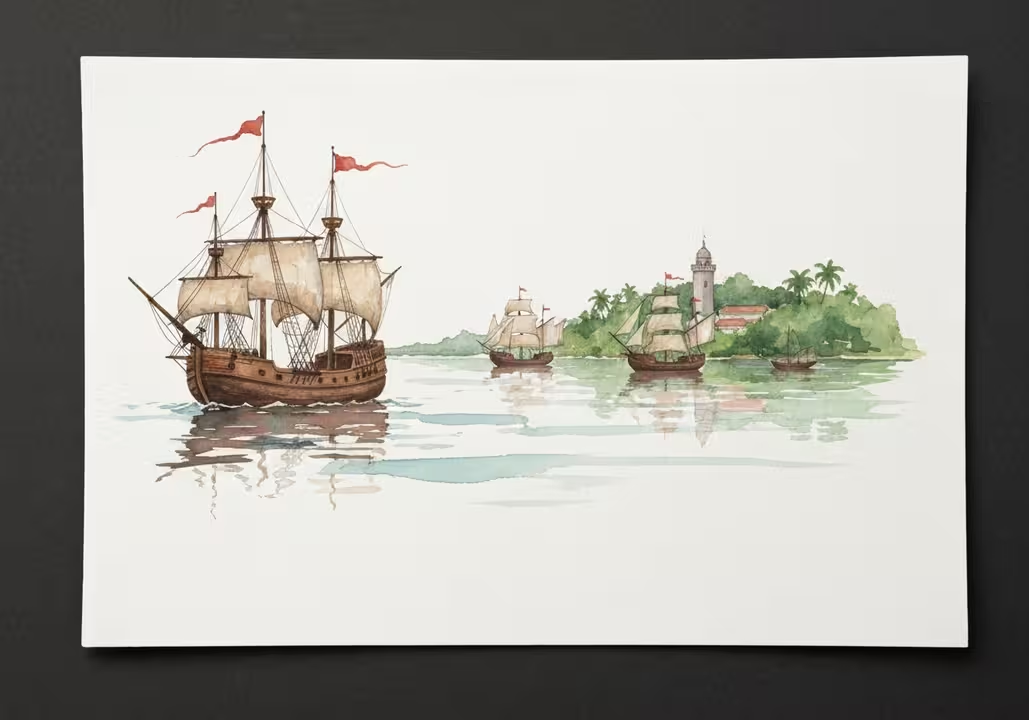
On a storm-tossed day in 1505, fate delivered an unexpected gift to Portugal’s expanding maritime empire. A fleet commanded by Dom Lourenço de Almeida, son of the Portuguese Viceroy of India, was sailing off the southwestern coast of Sri Lanka hunting for Moorish trading vessels when adverse winds forced his ships to seek shelter. The fleet dropped anchor at the natural harbor of Colombo on October 15, 1505, marking the beginning of what would become 153 years of Portuguese presence on the island—a period that would reshape Sri Lanka’s coast through military conquest, religious conversion, and economic exploitation.
The Accidental Empire Begins
When Lourenço de Almeida met with King Vira Parakrama Bahu of Kotte, the encounter was remarkably cordial. The Sinhalese chronicles record the king’s curiosity about these pale-skinned strangers who wore hats of iron and ate white stone—bread, hardened by their long sea voyage. Almeida, an experienced trader and diplomat, immediately recognized the island’s strategic and commercial value. The Kingdom of Kotte controlled a lucrative monopoly on cinnamon, which the Moorish merchants had dominated for centuries. To Portuguese eyes, this golden spice represented an opportunity too valuable to ignore.
The first Portuguese contact was largely peaceful and commercially focused. It wasn’t until 1518, thirteen years after that initial landing, that the Portuguese received permission to build their first fort at Colombo. Named Santa Barbara, this modest fortification marked the transition from trading partners to colonial occupiers. Though this initial fort was abandoned in 1524, the Portuguese returned in 1554 to construct a more substantial fortress, around which the city of Colombo would develop into the capital of Portuguese Ceylon.
Political Manipulation and the Fall of Kotte
The Portuguese employed a strategy of patient political manipulation rather than immediate military conquest. Their opportunity came through the internal divisions within the Sinhalese kingdoms. When King Vijayabahu VII died in 1521, his three sons partitioned the Kingdom of Kotte among themselves: Bhuvanekabahu ruled the main portion of Kotte, Pararajasingha received the Principality of Raigama, and Mayadunne was given the Kingdom of Sitawaka. Starting in 1527, the Portuguese began intervening in these rivalries, exploiting the brothers’ mutual suspicions and ambitions.
The Portuguese gradually increased their influence over Kotte through a combination of military support, religious conversion, and political pressure. When King Dharmapala of Kotte converted to Catholicism in 1557, it marked a turning point in Portuguese strategy. Many members of the Sinhalese nobility followed their king’s conversion, and in 1580, in a move that would seal his kingdom’s fate, Dharmapala was persuaded to deed his entire kingdom to the Portuguese crown. When the king died in 1597, the Portuguese formally annexed the Kingdom of Kotte, transforming their trading presence into direct territorial control.
The Fierce Resistance of Sitawaka
Not all Sinhalese rulers submitted to Portuguese expansion. The Kingdom of Sitawaka, under Kings Mayadunne (1521-1581) and his son Rajasinha I (1581-1593), mounted fierce resistance that would challenge Portuguese dominance for nearly seventy years. Mayadunne, one of the three brothers who had divided Vijayabahu’s kingdom, recognized early the threat posed by the Portuguese and dedicated his long reign to opposing their expansion.
The defining moment of this resistance came at the Battle of Mulleriyawa in 1562. This engagement is considered one of the most decisive battles in Sri Lankan history and the worst defeat suffered by the Portuguese during their entire occupation. According to Sinhalese chronicles, the marshlands of Mulleriyawa turned red with Portuguese blood as Sitawaka forces annihilated the colonial army. This stunning victory established Sitawaka as a military power capable of challenging Portuguese expansion and earned Mayadunne’s son his royal name—Rajasinha, meaning “Lion King.”
When Rajasinha I succeeded his father in 1581, he escalated the conflict with even greater ferocity. His most ambitious campaign came in 1587-1588 when he laid siege to Colombo itself, appearing before the Portuguese stronghold on June 4 with a massive army of 50,000 men, 2,200 pack elephants, 40,000 oxen, and 150 small-caliber bronze cannon. For months, the Portuguese garrison endured bombardment and starvation, their survival hanging by a thread. Yet despite Rajasinha’s overwhelming force, the Portuguese managed to hold Colombo, repulsing the Sitawaka army with heavy losses.
Rajasinha I’s sudden death in 1593 brought Sitawaka’s resistance to an abrupt end. Within less than a year, the kingdom that had defied Portuguese power for seven decades disintegrated into chaos and ceased to function as a cohesive political entity. With their most formidable opponent eliminated, the Portuguese moved to consolidate their coastal holdings.
The Conquest of Jaffna
The northern Tamil Kingdom of Jaffna proved another stubborn obstacle to Portuguese ambitions. The conquest required multiple military expeditions spanning six decades. An initial Portuguese expedition to Jaffna in 1560 achieved no lasting success. A second invasion in 1591, undertaken partly at the urging of Christian missionaries eager to convert the Hindu population, succeeded in installing a Portuguese protégé on the throne.
However, continued unrest and succession disputes plagued this arrangement. When a usurper named Cankili II resisted Portuguese overlordship, the colonial power responded with decisive force. In 1619, a Portuguese expedition under Phillippe de Oliveira captured Cankili II, who was subsequently hanged. The Kingdom of Jaffna was formally annexed, completing Portuguese control over Sri Lanka’s coastal regions from the southwest to the far north.
The Architecture of Colonial Control
Portuguese Ceylon became part of the Estado da India, the Portuguese empire in Asia nominally governed by the Viceroy in Goa who represented the Portuguese king. However, real power resided with the Captain-General, who ruled from Colombo with all the trappings of royalty once reserved for Sinhalese monarchs. Under him, the Captain Major of the Field, headquartered at Menikkadawara, commanded Portuguese military forces across the territory.
The Portuguese established a network of fortified strongholds along the coast. Colombo, the capital, was encircled by walls and bastions and contained numerous churches, Portuguese houses, a hospital, convents, and a customs house. The fortress at Galle, called Santa Cruz, was fortified around 1589 and commanded the southern coast. Jaffna anchored Portuguese power in the north. Additional forts at Kalutara, Negombo, and Mannar created a ring of Portuguese military control around the island’s coastline, though the highland Kingdom of Kandy remained independent and hostile.
This fortress network, however, came at tremendous cost. In one catastrophic expedition in 1630, Kandyan forces ambushed and massacred an entire Portuguese army, including the Captain-General himself—a stark reminder that Portuguese power extended only as far as their cannon could fire from coastal strongholds.
Religious Conversion and Cultural Transformation
The Portuguese period witnessed intense Roman Catholic missionary activity that would leave a lasting imprint on Sri Lankan society. Franciscan missionaries established centers across Portuguese-controlled territory from 1543 onward. Jesuits focused their efforts in the northern regions. Toward the century’s end, Dominican and Augustinian orders joined the missionary enterprise.
The conversion of King Dharmapala and much of the Kotte nobility opened the floodgates for mass conversions, particularly among the fishing castes living along the coast who saw economic and social advantages in adopting the colonizers’ religion. The Portuguese actively encouraged these conversions through a combination of inducements and pressure, creating Catholic communities that persist to this day.
The cultural legacy of Portuguese colonialism extended beyond religion. Portuguese loanwords entered both Sinhala and Tamil languages, influencing everyday vocabulary. Most visibly, Portuguese surnames became permanently embedded in Sri Lankan society. Names like Fernando, Silva, Perera, de Silva, and Rodrigo—still carried by thousands of Sri Lankan families, particularly Catholics—testify to the deep cultural penetration of Portuguese influence during this period.
The Cinnamon Trade: Economic Exploitation
Beneath the religious and political transformation lay naked economic exploitation. The Portuguese established strict monopolies over cinnamon and elephants, which provided enormous profits alongside trade in pepper and betel nuts. Sri Lankan cinnamon, considered the finest in the world, became an essential asset for Portuguese traders seeking to dominate global spice markets. The Portuguese ended the centuries-old monopoly of Moorish merchants, redirecting this lucrative trade through their own commercial networks.
The cinnamon monopoly required extensive control over the coastal regions where the precious spice grew. Portuguese administrators enforced collection quotas, regulated harvesting, and severely punished anyone who traded cinnamon outside official channels. This economic control became as important as military domination in maintaining Portuguese power, generating the revenue needed to sustain their expensive network of forts and garrisons.
The Fall: Dutch Conquest and Portuguese Surrender
By the mid-17th century, Portuguese power in Sri Lanka faced multiple challenges. The Kingdom of Kandy remained unconquered in the highlands, continually harassing Portuguese positions. More ominously, the Dutch—Portugal’s rival for control of Asian trade—had allied with Kandy against the Portuguese. The Dutch East India Company, with superior naval power and commercial resources, systematically targeted Portuguese strongholds.
In 1655, the Dutch placed Colombo under siege. For six months and twenty-seven days, the Portuguese garrison endured bombardment and starvation as supplies dwindled and relief failed to arrive. On May 12, 1656, after 150 years of Portuguese presence, Colombo surrendered. The starving garrison marched out of the fortress they could no longer defend.
The fall of Colombo effectively ended Portuguese power in Sri Lanka, though scattered strongholds held out longer. In a betrayal that would poison Kandyan-European relations for generations, when Colombo’s gates finally opened, the Dutch immediately closed them against their Kandyan allies, refusing to hand over the territory to King Rajasinghe II as promised. Instead, the Dutch simply replaced Portuguese colonialism with their own.
The final chapter came in 1658 when Dutch forces advanced northward and captured Jaffna and Mannar, the last Portuguese strongholds on the island. After 153 years, Portuguese colonial rule in Sri Lanka ended—but the Portuguese legacy endured in the Catholic faith practiced by coastal communities, in surnames passed down through generations, and in the cultural memory of an island transformed by Europe’s Age of Discovery.
The Portuguese conquest of coastal Sri Lanka stands as a case study in early European colonialism: arriving by accident, staying for profit, ruling through a combination of military force and political manipulation, converting souls while extracting wealth, and ultimately falling to a rival European power employing the same colonial playbook. The cinnamon that drew them to the island outlasted their empire, but the changes they wrought—religious, cultural, and political—shaped Sri Lanka’s trajectory for centuries to come.