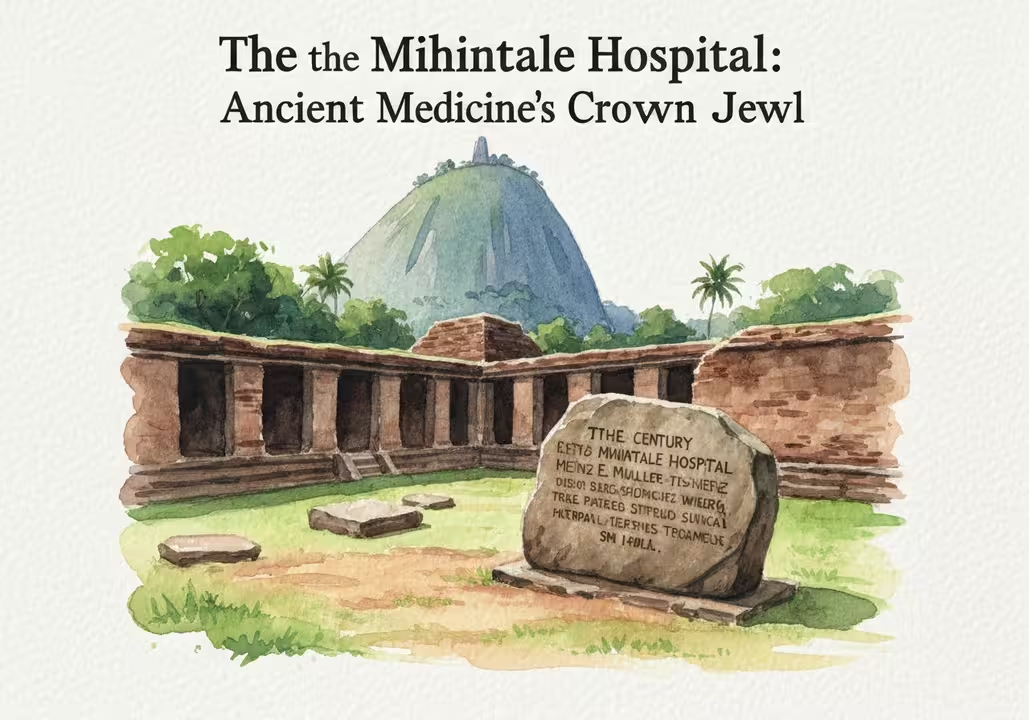
In the shadow of the sacred mountain of Mihintale, where Buddhism first took root in Sri Lanka, lies evidence of a medical revolution that predated European hospitals by centuries. The ruins of the Mihintale Hospital, built during the reign of King Sena II (853-887 CE), stand as testament to an ancient civilization that understood not just the science of healing, but its art.
The World’s Oldest Hospital?
When Archaeological Commissioner H.C.P. Bell excavated the site in 1910, he uncovered what scholars like Heinz E. Muller-Dietz would later describe as possibly the oldest archaeological evidence of a hospital in the world. The inscription-laden stone pillars of King Udaya II (887-898 CE) and King Kassapa IV (909-914 CE), discovered at the site, confirmed this was indeed the hospital mentioned in the ancient chronicle Mahavamsa.
But Mihintale’s medical heritage stretched even further back. The hospital King Sena II built was believed to stand on the grounds of an earlier healing institution, part of a remarkable tradition dating to the 4th century BCE when King Pandukabhaya established lying-in homes and hospitals throughout his kingdom after fortifying Anuradhapura as his capital.
A Royal Lineage of Healing
Sri Lanka’s ancient kings weren’t merely patrons of medicine—many were practitioners themselves. The most celebrated was King Buddhadasa (340-368 CE), whose name literally means “Servant of Buddha.” This remarkable monarch was adept in general medicine, surgery, midwifery, and even veterinary medicine.
The ancient chronicles record extraordinary surgical achievements that seem almost miraculous for the 4th century. King Buddhadasa performed a caesarean section on an outcaste woman to save both mother and child—a procedure that wouldn’t become common in Europe until the 19th century. He conducted cephalotomy, opening a patient’s skull to remove a cerebral cyst causing severe headaches. Perhaps most astonishingly, he performed abdominal surgery on a snake to remove a tumor, then sutured and treated the wound until the creature recovered.
The king carried surgical instruments with him wherever he traveled, always prepared to offer his medical expertise. He authored the “Sarartha Sangraha,” a comprehensive medical treatise in Sanskrit covering drug preparation, clinical diagnosis, surgical instruments and operations, diseases of the ear, nose, throat, and eyes, tuberculosis, insanity, epilepsy, and obstetrics. King Buddhadasa established hospitals in every village, appointed physicians, and built refuges for the disabled and blind, creating what may have been the world’s first comprehensive healthcare system.
Architecture of Compassion
The Mihintale Hospital was an architectural marvel measuring 118.6 meters in length and 97.6 meters in width. The complex was thoughtfully divided into two main sections: an outer court and an inner court, each serving distinct purposes in the healing process.
The outer courtyard at the entrance housed four essential rooms: a consulting room where physicians would examine patients, a preparation room for compounding medicines, a storage area for medicinal supplies, and a room equipped with hot water baths for therapeutic treatments.
The inner sanctum of the hospital was designed with profound spiritual and practical wisdom. Thirty-one patient rooms, each approximately 10 by 10 feet, were arranged around a central Buddha shrine on a raised platform. Each room could accommodate about two patients, giving the hospital a capacity of roughly 60 patients. Every room’s entrance faced the Buddha shrine, allowing patients to find spiritual solace even in their suffering—a recognition that healing encompasses both body and spirit.
The design prioritized ventilation and natural light, featuring two open courts in addition to windows that allowed free circulation of air. This attention to environmental factors demonstrates that ancient Sri Lankan physicians understood the psychological and environmental aspects of therapeutics—principles that modern medicine would not formally recognize for more than a millennium.
The Stone Trough: An Engineering Marvel
In the northeast corner of the hospital complex stood one of the most remarkable therapeutic devices of the ancient world: a medicinal trough hewn from a single piece of stone. Measuring 2.16 meters in length, 0.76 meters in width, and 0.59 meters in height, this monolithic basin was carved with an indentation in the shape of a human body.
This was no ordinary bath. Patients would climb into the stone trough and be completely immersed in healing oils infused with medicinal herbs. The immersion therapy, known in Ayurvedic practice as “Sneha Pana,” was particularly effective for treating snake bites—one of the most common medical emergencies in the tropical island. The carved human shape ensured that the patient’s entire body could be submerged evenly, allowing the medicinal oils to penetrate the skin and draw out toxins.
Similar stone troughs have been discovered at other ancient hospital sites across Sri Lanka—Medirigiriya, Dighavapi, and Polonnaruwa—suggesting that immersion therapy was a standard and highly valued treatment protocol throughout the island’s medical system.
The Surgeon’s Arsenal
Archaeological excavations at Mihintale have revealed a sophisticated array of medical and surgical instruments that would seem familiar in a modern operating room. Forceps of varying sizes, specialized for handling everything from delicate tissues to bone, were discovered alongside steel and copper scalpels with precision cutting edges. Probes for examining wounds, scissors for surgical procedures, lancets for draining pus, and needles for suturing were all part of the ancient surgeon’s toolkit.
The discovery of herb-grinding stones and micro-balances reveals the meticulous precision with which medicines were prepared. These weren’t crude approximations—ancient Sri Lankan physicians understood that dosage mattered, and they had the tools to measure ingredients with remarkable accuracy.
Storage jars made of ceramic and several blue glass flasks from Persia indicate an extensive pharmacopeia and international trade in medical supplies. The presence of spoons suggests careful administration of liquid medicines, with doses measured rather than estimated.
These instruments align closely with those described in ancient Ayurvedic texts like the Sushruta-Samhita and Charaka-Samhita, demonstrating that Sri Lankan medicine was not isolated but part of a broader South Asian medical tradition while also developing its own innovations.
A Sophisticated Medical System
The inscriptions found at Mihintale reveal a healthcare system of remarkable complexity and specialization. The hospital employed specific types of specialists, including the “mandova”—experts in treating bones and muscles—and the “puhunda vedek,” or leech doctors, who practiced a form of bloodletting therapy that was believed to balance the body’s humors and treat various ailments.
The hospital practiced Ayurvedic medicine, a holistic healing system that viewed health as a balance between body, mind, and spirit. But ancient Sri Lankan medicine wasn’t limited to indigenous traditions. Archaeological evidence and historical texts confirm that acupuncture, the healing art from 4th-century China, was also known and practiced in these monastic hospitals, demonstrating the remarkable cultural exchange along ancient trade routes that connected Sri Lanka to South Asia, China, and beyond.
The use of approximately 2,000 plant species in Ayurvedic preparations and about 500 in the indigenous Deshiya Chikitsa system meant that hospital physicians had an extensive materia medica at their disposal. The lush tropical environment surrounding Mihintale provided an abundant natural pharmacy, and Buddhist monks—who maintained the hospital—cultivated medicinal gardens and possessed deep knowledge of botanical therapeutics passed down through generations.
The Buddhist Connection
The location of the hospital at Mihintale was no accident. This was the sacred mountain where Mahinda, son of the great Indian Emperor Ashoka, first preached Buddhism to King Devanampiyatissa in the 3rd century BCE, converting the monarch and establishing Buddhism as the island’s predominant faith.
Buddhist philosophy placed enormous emphasis on compassion and the relief of suffering. The Buddha himself taught that health was among the most precious possessions a person could have, and caring for the sick was considered one of the highest forms of merit. Buddhist monks in ancient Sri Lanka took this teaching to heart, not just maintaining hospitals but actively practicing medicine.
The monastic hospitals were centers of learning as well as healing. Young monks studied medical texts, learned to identify and prepare medicinal plants, and trained under experienced physician-monks. This tradition of monk-physicians continued for centuries, with medical knowledge carefully preserved and transmitted through both written texts and oral teaching within the monastery walls.
Advanced Understanding of Public Health
The Mihintale Hospital, like other ancient Sri Lankan medical facilities, included sophisticated sanitation systems. Excavations revealed toilets and baths attached to patient living quarters—an amenity that many European hospitals would lack until the 19th century. The presence of drainage systems indicates an understanding of the importance of cleanliness and waste management in preventing disease spread.
The ventilation design, with its open courts and strategic window placement, suggests knowledge of airborne disease transmission or at least an understanding that fresh air aided recovery. The stone-paved floors were easy to clean and maintain, another practical consideration that modern hospitals would later adopt.
The heated water systems for therapeutic baths demonstrated engineering sophistication, requiring not just construction expertise but an understanding of thermodynamics and the therapeutic value of temperature-controlled water treatments.
Legacy and Recognition
The Mihintale Hospital system represents more than just ancient medical achievement—it embodies a civilization that placed human welfare at the center of its values. This wasn’t healthcare for the elite; inscriptions and historical accounts suggest that these hospitals treated all who needed care, regardless of social status.
UNESCO has recognized the ancient monastic hospital system of Sri Lanka as part of the cultural heritage of the Silk Roads, acknowledging its role in the exchange of medical knowledge between South Asia, Southeast Asia, and China. The hospitals stand as evidence of how Buddhist monasteries served as nodes in a vast network of cultural and scientific exchange.
Today, the ruins at Mihintale attract archaeologists, medical historians, and curious visitors from around the world. The stone trough still sits where it was placed over a millennium ago, silent witness to countless healings. The foundations of the thirty-one patient rooms remain visible, their doorways still facing the spot where the Buddha shrine once stood.
A Model for the Ages
What makes the Mihintale Hospital truly remarkable isn’t just its age or architectural sophistication—it’s the holistic philosophy that informed every aspect of its design and operation. Ancient Sri Lankan physicians understood that healing required more than just treating symptoms. They recognized the importance of environment, cleanliness, mental state, spiritual comfort, and specialized care.
The integration of surgery, herbal medicine, immersion therapy, and spiritual healing created a comprehensive approach that anticipated modern concepts of holistic and integrative medicine. The presence of specialists indicates an understanding that medical expertise required focused training and experience. The careful measurement of medicines showed respect for the power of therapeutic substances and the importance of proper dosage.
The Mihintale Hospital system emerged from a culture that valued knowledge, compassion, and innovation. It was maintained by a religious community committed to service and learning. It was supported by rulers who understood that a healthy population was a prosperous one. And it was part of an international network that freely shared medical knowledge across cultural and geographical boundaries.
As modern medicine grapples with questions about healthcare access, the balance between technology and human touch, and the integration of traditional and contemporary healing practices, the ancient hospital at Mihintale offers valuable lessons. It reminds us that medical innovation and compassionate care are not modern inventions but timeless human pursuits—and that sometimes, the wisdom of the past can illuminate the path forward.
The ruins may be weathered by time, but the vision they represent—of healthcare as a fundamental right, healing as both science and art, and medicine as a sacred service to humanity—remains as relevant today as it was twelve centuries ago when the first patients walked through those ancient doorways seeking relief from suffering.