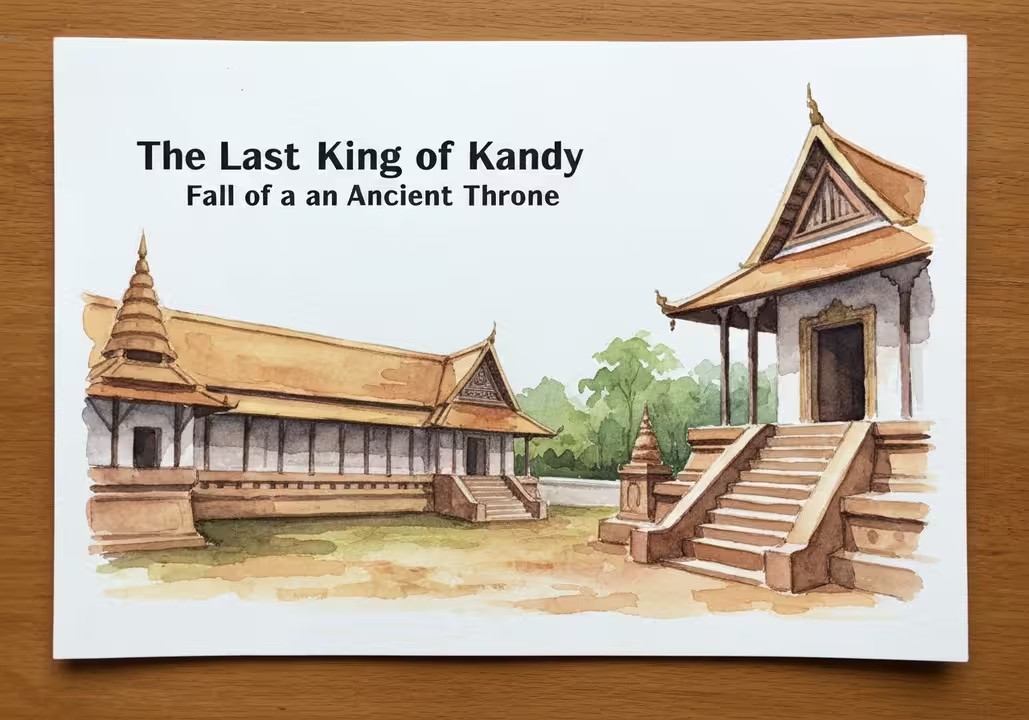
On February 18, 1815, near the village of Medamahanuwara in the mountains of Kandy, a king was captured. Sri Vikrama Rajasinha, the last sovereign ruler of the Kingdom of Kandy, was taken prisoner by his own chiefs and handed over to British forces. Seventeen days later, in a ceremony at the Royal Audience Hall adjacent to the Temple of the Sacred Tooth Relic, a document would be signed that ended more than 2,300 years of continuous monarchy in Sri Lanka. The young Telugu prince who had ascended the throne with such promise in 1798 would spend his final seventeen years in exile, a captive king who never stopped believing he would one day return to his mountain kingdom.
A Foreign Prince on an Ancient Throne
Sri Vikrama Rajasinha was born into the Nayakkar Dynasty, Telugu-speaking rulers of South Indian origin who had governed the Kingdom of Kandy since 1739. When Rajadhi Rajasinha died in 1798, the succession fell to his young brother-in-law, a prince from the Madurai royal family. The eighteen-year-old assumed the throne as Sri Vikrama Rajasinha, becoming the fourth and final Nayakkar monarch.
His ascension was orchestrated by the powerful First Adigar, Pilimathalawe, who saw in the young foreign prince an opportunity to consolidate his own influence. For the Kandyan nobility, the Nayakkar kings had always been acceptable precisely because they were outsiders—Tamil-speaking Hindus who owed their throne not to ancestral right but to the support of Sinhalese Buddhist chiefs. This made them, in theory, more dependent on and deferential to the traditional aristocracy.
But Sri Vikrama Rajasinha would prove to be a very different ruler from his predecessors. Young, inexperienced, and perhaps sensing the fragility of his position, he became increasingly suspicious of the very nobles who had placed him on the throne.
The Kingdom Under Siege
The Kingdom of Kandy that Sri Vikrama Rajasinha inherited in 1798 was the last bastion of independence on an island increasingly dominated by European colonial powers. For over two centuries, the mountain kingdom had successfully repelled Portuguese and Dutch invasions. But now the British had replaced the Dutch in the coastal lowlands, and they were more determined—and more powerful—than any previous colonial force.
In 1803, the British launched their first invasion of Kandy. A force of over 3,000 troops marched into the capital, established a garrison, and even crowned a puppet king. But Sri Vikrama Rajasinha, implementing the traditional Kandyan strategy of tactical withdrawal and guerrilla warfare, turned the British triumph into a catastrophe. Supply lines were cut, disease ravaged the garrison, and Kandyan forces struck repeatedly. On June 24, 1803, the British garrison was overwhelmed. Of the 3,387 troops who had entered Kandy, 1,091 died. Only one man from the main garrison survived to tell the tale.
The young king had won a stunning victory. He had proven that the Kingdom of Kandy, under his leadership, could still defend itself against European military might. It should have been his finest hour. Instead, it marked the beginning of his descent into paranoia and tyranny.
The Descent Into Darkness
The sources of Sri Vikrama Rajasinha’s transformation from successful defender of the kingdom to increasingly brutal autocrat remain debated by historians. Some attribute it to the inherent challenges of his position—a foreign-born ruler constantly aware that the nobility who had elevated him could just as easily depose him. Others point to the influence of ambitious advisors who encouraged him to strike against potential rivals before they could strike against him.
Whatever the causes, the king’s relationship with his nobles deteriorated steadily. The man who had helped place him on the throne, the powerful Pilimathalawe Adikaram, began plotting to establish his own dynasty. When the conspiracy was discovered, Pilimathalawe was executed. The message was clear: not even the kingdom’s most powerful noble was beyond the king’s reach.
But it was Sri Vikrama Rajasinha’s conflict with another high-ranking minister, Ehelepola, the First Adigar, that would ultimately seal his fate. Ehelepola had been involved in various intrigues against the increasingly unpopular king. When his plots were revealed in 1814, the minister fled to British-controlled territory, seeking protection from the very colonial power the kingdom had fought for generations.
The furious king demanded Ehelepola’s return to face justice. When the minister refused, Sri Vikrama Rajasinha took a terrible revenge.
The Execution That Doomed a Kingdom
On May 17, 1814, the king ordered the execution of Ehelepola’s entire family. The minister’s wife, Kumarihamy, was drowned. His eldest son, Loku Bandara, was beheaded. Then came an execution that would become legendary in Sri Lankan history and provide the British with the moral pretext they needed for intervention.
Madduma Bandara, Ehelepola’s youngest son, was still a child. As he was led to his execution, the boy showed extraordinary courage, asking his executioners to test their blade on a plantain tree first to ensure a clean stroke. The child’s bravery in the face of death moved even his executioners, but the king’s orders were absolute. Madduma Bandara was beheaded.
The king’s men also killed Ehelepola’s daughters and forty-seven chiefs from Sabaragamuwa who were deemed complicit in the minister’s rebellion. The brutality of these executions shocked the Kandyan aristocracy and common people alike. Riots broke out across the kingdom. For the first time, significant numbers of the king’s subjects began to openly question his right to rule.
From the safety of British territory, Ehelepola launched a propaganda campaign, portraying Sri Vikrama Rajasinha as a cruel tyrant whose reign was a betrayal of everything the Kingdom of Kandy stood for. The British, who had long coveted complete control of Ceylon, listened with great interest.
Then came another incident that gave the British their final justification. Sri Vikrama Rajasinha, suspecting British merchants of espionage, ordered them detained and subjected to torture. Several died. For the British Empire, this was an intolerable affront that demanded a military response.
The Bloodless Conquest
What the British achieved next was not a military victory but a masterpiece of intelligence and subversion. John D’Oyly, the British Resident’s chief translator, had spent years mastering Sinhala, studying Kandyan customs, and cultivating relationships with disaffected nobles. From 1810 to 1815, he maintained detailed diaries documenting his systematic undermining of the kingdom—what scholar Gananath Obeyesekere would later describe as “the gradual undermining of the Kandyan Kingdom without the use of weapons until the right moment arrived.”
D’Oyly served as the crucial intermediary between the British Governor and Kandyan chiefs who were being persuaded to betray their king. The message was carefully crafted: the problem was not the Kingdom of Kandy or its independence, but rather this particular foreign-born, tyrannical king. Remove him, the British suggested, and the kingdom’s traditional rights and privileges would be protected. Buddhism would remain inviolable. The chiefs would maintain their positions and authority.
It was a lie, but it was a lie the Kandyan nobility wanted to believe.
In December 1814, Governor Sir Robert Brownrigg assembled his forces: the 19th and 73rd British regiments along with four Ceylon regiments, totaling about 3,000 men. The invasion began in early 1815. What should have been a fierce military campaign through mountainous terrain that had defeated European armies for centuries instead became a leisurely march. The Kandyan chiefs offered no resistance. Some actively assisted the British advance.
On February 10, 1815, British forces reached Kandy. Four days later, they occupied the city without firing a shot. The king had fled to the mountains, hoping to implement the same guerrilla strategy that had destroyed the British invasion in 1803. But this time, there would be no resistance. His own people had abandoned him.
The Capture
For four days, Sri Vikrama Rajasinha remained at large, moving through the mountains with a handful of loyal followers. Then, on February 18, near Medamahanuwara, a group led by Kandyan chiefs surrounded him. There was no battle, no last stand, no dramatic final defense of the throne. The last king of Kandy was simply arrested by his own nobles and handed over to the British.
Accounts of the king’s demeanor at his capture vary. Some describe him as defiant, declaring that the chiefs who betrayed him would soon learn the true nature of British promises. Others portray him as resigned, perhaps even relieved that the constant struggle to maintain his position was finally over. What is certain is that the young prince who had ascended the throne seventeen years earlier was now a prisoner, his kingdom about to be formally surrendered by the very men sworn to defend it.
The Convention and the End of Sovereignty
On March 2, 1815, the great and powerful of the Kandyan Kingdom assembled in the Magul Maduwa, the Royal Audience Hall adjacent to the Temple of the Sacred Tooth Relic. Governor Brownrigg represented the British Crown. The Kandyan side included the kingdom’s leading chiefs: Molligoda (the First Adigar), Pilimatalawe (the Second Adigar), Monarawila Keppetipola, and others—including the exiled Ehelepola, whose family’s blood had watered the seeds of this moment.
Notably absent was the king himself. Sri Vikrama Rajasinha was not asked to sign his own abdication. The Kandyan Convention was an agreement between the British and the Kandyan nobility, treating the king not as a sovereign but as a problem to be solved.
The first clause of the Convention stripped Sri Vikrama Rajasinha of all claims to the throne, declaring him deposed. The second vested sovereignty of the entire island in the British Crown. For the first time in recorded history, a foreign power had gained sovereignty over all of Ceylon.
The Convention contained promises meant to reassure the Kandyan elite: Buddhism would be declared inviolable, traditional customs would be maintained, and the chiefs’ privileges would be protected. These promises would prove to be as ephemeral as morning mist over the Mahaweli River. Within two years, British violations of the treaty would spark the Great Rebellion of 1817-1818, led ironically by Keppetipola, one of the very men who had signed the Convention.
Exile in Vellore
Sri Vikrama Rajasinha was transported to Vellore Fort in southern India, where he would spend the remaining seventeen years of his life. The British granted him a privy purse—a pension befitting his former status—but kept him under constant surveillance.
Little is known of the deposed king’s life in exile. He maintained a small court and continued to insist on the royal prerogatives he believed were his by right. British records suggest he never accepted the legitimacy of his deposition, always referring to himself as the King of Kandy and expecting to be addressed as such. There were rumors of escape attempts and plots to restore him to the throne, but none came to fruition.
In exile, Sri Vikrama Rajasinha had time to reflect on what had been lost. He had been born into royalty, elevated to a throne that commanded the last independent kingdom on the island, successfully defended that kingdom against British invasion, and then lost everything—not through military defeat but through the betrayal of his own nobles.
Did he understand, in those final years, how his own actions had contributed to his downfall? Did he recognize that the brutal execution of Ehelepola’s family had turned the Kandyan nobility against him? Or did he see himself purely as a victim of British intrigue and aristocratic treachery? The historical record provides no answers.
What is known is that he died on January 30, 1832, at the age of 52, far from the mountain kingdom he had ruled. The cause of death was listed as dropsy (edema). He was buried in Vellore, though his body was later moved to the tomb of his father-in-law, Rajadhi Rajasinha, in a gesture of recognition that, whatever his failings, he had been the last king of an ancient lineage.
The Last King and the Weight of History
Sri Vikrama Rajasinha’s legacy is complex and contested. Traditional Sinhalese nationalist historiography has often portrayed him unsympathetically—a foreign-born tyrant whose cruelty gave the British the pretext they needed to complete their conquest of the island. In this telling, he is the villain whose failings ended 2,300 years of Sri Lankan independence.
But more nuanced modern scholarship suggests a more tragic figure: a young man placed on a throne he was ill-equipped to manage, ruling a kingdom under existential threat from the most powerful empire in the world, surrounded by nobles whose loyalty was always conditional. His descent into paranoid brutality was a response—however destructive—to very real threats to his authority and his kingdom’s survival.
It is worth noting that the Kandyan chiefs who betrayed him in 1815, believing British promises about preserving their privileges, were themselves betrayed within months. The British had no intention of maintaining a quasi-independent Kandyan aristocracy. The scorched-earth campaign against the 1817-1818 rebellion killed over 10,000 people and devastated entire regions. The promises of the Kandyan Convention were systematically violated and eventually formally abandoned.
Perhaps the most fitting epitaph for Sri Vikrama Rajasinha is that he was the last obstacle—however flawed—to British colonial domination of Sri Lanka. His execution of Ehelepola’s family provided the moral pretext, but the British intention to conquer Kandy predated that atrocity and would have found another justification if necessary. The systematic intelligence work of John D’Oyly made the conquest bloodless, but the conquest itself was inevitable once the British decided to complete their control of Ceylon.
The End of an Era
With Sri Vikrama Rajasinha’s capture and exile, more than two millennia of continuous monarchy in Sri Lanka came to an end. Since the legendary King Vijaya had arrived from India and established the first Sinhalese kingdom around 543 BCE, there had always been a native king ruling at least some portion of the island—whether in Anuradhapura, Polonnaruwa, Dambadeniya, Gampola, Kotte, or finally Kandy.
That unbroken chain ended on March 2, 1815. For the next 133 years, until independence on February 4, 1948, Sri Lanka would be governed from London. The proud kingdom that had successfully resisted Portuguese and Dutch colonial ambitions for over two centuries had fallen not through military conquest but through internal division and the betrayal of its own aristocracy.
The privy purse granted to Sri Vikrama Rajasinha was continued to his descendants by the Government of Ceylon until 1965, a small financial acknowledgment of a lost sovereignty. But no amount of money could restore what had been taken: the independence of a kingdom, the continuity of a royal lineage, and the dignity of a people who had governed themselves since time immemorial.
Sri Vikrama Rajasinha died in exile believing he was still the rightful King of Kandy. In the eyes of the law and the reality of power, he was merely a pensioner of the British Empire. But in the sweep of history, he remains what he was on that February day in 1815 when he was captured near Medamahanuwara: the last king of Sri Lanka, the final sovereign of an ancient throne, and the man whose fall marked the end of an era that would never return.