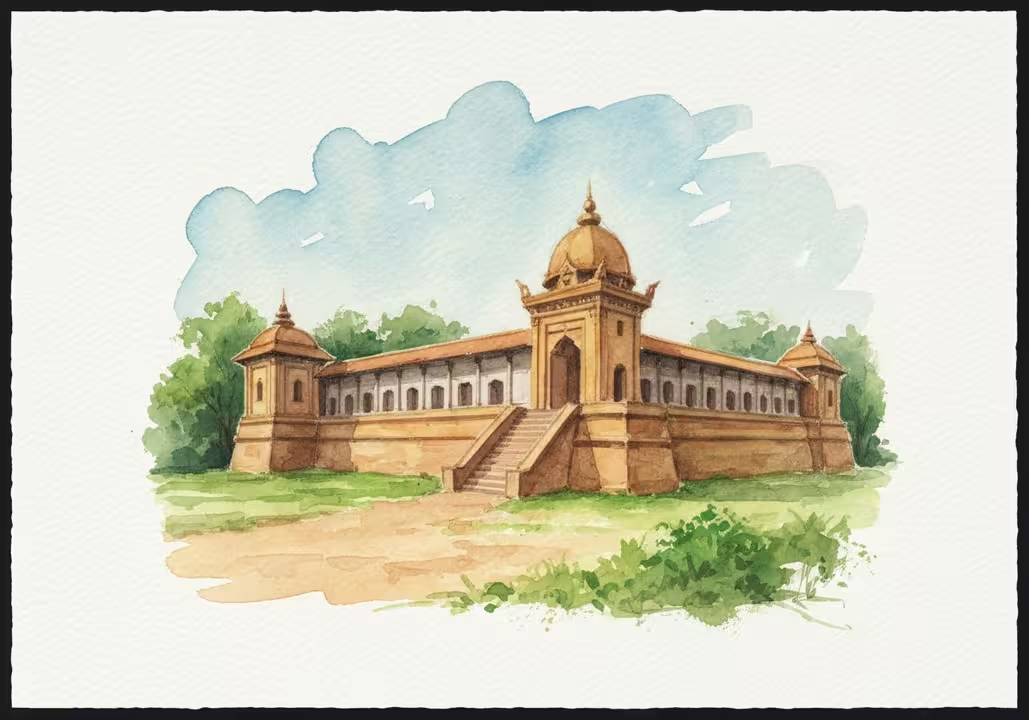
In the heart of modern Sri Lanka’s administrative capital lies buried the remnants of a once-magnificent kingdom—a testament to the last great flowering of independent Sinhalese civilization before the arrival of European colonial powers forever altered the island’s destiny. The Kingdom of Kotte, which flourished from 1415 to 1597, represents both the pinnacle of medieval Sinhalese achievement and the tragic beginning of colonial subjugation.
The Fortress That Became a Kingdom
The story of Kotte begins not with kings and palaces, but with military necessity. In the late 14th century, during the reign of the Gampola Kingdom, a powerful minister named Nissanka Alagakkonara—a Tamil military leader who had risen to prominence—established a fortress at Kotte around 1370-1385. The location was chosen for its strategic brilliance: surrounded by marshlands and positioned near the western coast, it served as an ideal defensive position for launching attacks against the Aryacakravarti kingdom of Jaffna to the north.
What began as a military outpost would soon become the seat of the last unified Sinhalese kingdom. In 1412, a young prince named Parakramabahu came to power as king of Gampola. Within three years, recognizing Kotte’s superior fortifications and strategic advantages, he made a momentous decision: in 1415, Parakramabahu VI established Kotte as his capital, transforming the fortress into a city destined for greatness.
The city that emerged was a marvel of medieval engineering and urban planning. Kotte was surrounded by formidable ramparts, with walls so high they seemed insurmountable to would-be invaders. Around these walls ran a moat of extraordinary dimensions—approximately 55 feet deep and 35 feet wide—filled with crocodiles as living sentinels. The earthen dam of the moat stood some 20 feet high, creating a triple barrier of wall, water, and beast that made Kotte one of the most defensible capitals in South Asian history.
The Golden Age of Parakramabahu VI
Under Parakramabahu VI, who reigned from 1412 to 1467, Kotte did not merely survive—it flourished into what historians now recognize as the golden age of late medieval Sinhalese civilization. The king’s greatest achievement came in 1450, when his armies conquered the Kingdom of Jaffna in the north, an accomplishment that made him the last native sovereign to unify all of Ceylon under a single banner. This unification was not merely a military triumph; it brought economic windfall as Kotte gained control of the lucrative pearl trade, filling the royal coffers with wealth from across the Indian Ocean trading network.
Within the fortified city, Parakramabahu VI built monuments that would define Kotte’s splendor. A magnificent three-storied Temple of the Tooth Relic was constructed near the royal palace to house Buddhism’s most sacred artifact, while the king himself resided in a five-storied palace that towered over the capital. At each corner of the great rampart stood devalas—shrines dedicated to the four guardian deities: Natha, Vishnu, Kataragama, and Pattini—symbolizing the synthesis of Buddhist and Hindu traditions that characterized Sinhalese culture.
But Parakramabahu VI’s legacy extended far beyond military conquest and architectural grandeur. His reign witnessed what scholars call the golden era of Sinhalese literature, particularly the flourishing of “Sandesha Kavya” (messenger poetry). Royal patronage attracted brilliant Buddhist monks and poets to the court, including the celebrated Totagamuwe Sri Rahula Thero, Veedagama Maitree Thero, and Karagala Wanarathana Thero. These literary masters created works that would influence Sinhalese culture for centuries to come.
The kingdom also maintained sophisticated diplomatic and trade relations with distant powers. Economic ties with Ming dynasty China strengthened, bringing not only wealth but also cultural exchange. Merchants and emissaries from across Asia found their way to Kotte, making it a cosmopolitan center where goods, ideas, and religions mingled freely.
Seeds of Destruction: The Vijayaba Kollaya
The death of Parakramabahu VI in 1467 marked the beginning of Kotte’s long decline, though the kingdom’s doom would not become apparent for another half-century. Successive rulers struggled to maintain the unity their great predecessor had forged, and internal tensions simmered beneath the surface of royal stability.
The catastrophe came in 1521, in an event known as the Vijayaba Kollaya—the “Spoiling of Vijayabahu.” King Vijayabahu VI had three sons from his first marriage: Bhuvanekabahu, Pararajasingha, and Mayadunne. When the king took a second wife, Queen Kiravella, who brought her own son Deva Rajasingha from a previous marriage, palace intrigue turned deadly. The three princes, believing their father intended to name Deva Rajasingha as heir at their stepmother’s urging, made a terrible decision. They hired an assassin to murder their father in his own palace.
The parricide fractured not just a family but an entire kingdom. The three brothers divided their father’s realm in a partition that would prove fatal to Sinhalese independence. Bhuvanekabahu VII, the eldest, took Kotte and the coastal regions, claiming the title of emperor. Pararajasingha established the principality of Raigama. And Mayadunne, the youngest but most ambitious, created the Kingdom of Sitawaka—a realm that would soon become Kotte’s most dangerous rival. Additionally, the highland Kingdom of Kandy, which had been nominally subject to Kotte, seized this moment to assert its independence.
The Portuguese Shadow
The Portuguese had arrived in Sri Lanka in 1505, landing at Galle Harbour somewhat by accident as their ships were blown off course while sailing from Cochin to the Maldives. Initially, they sought commercial advantages rather than territorial conquest, focusing on controlling the lucrative cinnamon and spice trade. But the division of Kotte in 1521 created an opportunity they could not resist.
Bhuvanekabahu VII of Kotte, weak and fearful of his brother Mayadunne’s ambitions, made a fateful choice: he sought Portuguese military assistance. The Portuguese, who had already built a fort at Colombo in 1517, were eager to oblige. What began as a defensive alliance gradually transformed into Portuguese control over Kotte’s sovereignty.
Mayadunne of Sitawaka, in contrast, positioned himself as a fierce defender of Sinhalese independence. Between 1521 and his death in 1581, he launched multiple invasions of Kotte, each time seeking to oust both his brother and the Portuguese presence. In 1537, his forces were defeated by Portuguese captain-major Afonso de Souza. In 1538, after annexing Raigama following his brother’s death, Mayadunne invaded again, only to be repelled by combined Portuguese and Kotte forces.
The most dramatic confrontation came during the Siege of Kotte in 1557-1558, when Mayadunne assembled a massive army of 50,000 soldiers and besieged the capital for twelve months. Though the city held, the siege demonstrated Kotte’s utter dependence on Portuguese military power for survival. Then came the Battle of Mulleriyawa in 1562, a devastating Portuguese defeat that emboldened Sitawaka and exposed the vulnerability of the colonial forces.
The Final Betrayal
The end of Kotte came not with dramatic military defeat but through a quieter, more insidious process of cultural and religious transformation. Bhuvanekabahu VII’s grandson, who became King Dharmapala, was raised under direct Portuguese supervision. Franciscan monks educated the young prince, and in 1556 or 1557, his conversion to Christianity was publicly announced. He was baptized as Dom João Dharmapala Peria Bandara—the first Christian king in Sri Lankan history.
For a Buddhist kingdom whose legitimacy rested on protecting the Tooth Relic and the Dharma, this conversion was catastrophic. Dharmapala’s abandonment of Buddhism undermined the Kotte dynasty in the eyes of the Sinhalese people, who saw their king as a puppet of foreign interests. The Portuguese tightened their grip, and by 1565, unable to hold Kotte against continued Sitawaka pressure, they abandoned the capital entirely, relocating with their puppet king to the better-fortified Colombo.
The final act came in 1580, when Portuguese pressure convinced Dharmapala to sign a deed of gift transferring the Kingdom of Kotte to Portugal upon his death. When he died on May 27, 1597, without an heir, the Portuguese Crown formally took possession of his kingdom. The last great Sinhalese kingdom of the lowlands had ceased to exist—not through conquest in battle, but through legal documents signed by a converted king who had lost touch with his people and their faith.
Legacy in Ruins
Today, little remains of Kotte’s former glory. The Portuguese demolished most of the city’s buildings in the late 16th century, using the materials to expand Colombo. What survives are fragments: tunnels beneath the modern city, portions of the ancient moats and ramparts, the Veherakanda ruins, and scattered archaeological sites yielding pottery, coins, and building materials. The magnificent three-storied Temple of the Tooth Relic and the five-storied royal palace exist only in historical records and collective memory.
Yet the Kingdom of Kotte’s significance extends far beyond its physical ruins. It represents the last time the Sinhalese people of Sri Lanka’s lowlands lived under an independent Buddhist kingdom unified from coast to coast. Its fall marked the beginning of 443 years of continuous European colonial rule. The story of Kotte—from the military genius of its founding, through the cultural brilliance of Parakramabahu VI’s reign, to the fratricidal violence of 1521 and the slow strangulation by Portuguese influence—remains a powerful reminder of how internal division can destroy even the mightiest kingdoms, and how cultural identity, once surrendered, may never be fully reclaimed.
In the modern administrative capital of Sri Jayawardenepura Kotte, buses and cars rush past the few remaining traces of ramparts and moats, most citizens unaware they traverse the grounds of their nation’s last great medieval kingdom. But for those who know its history, every buried foundation stone whispers of an age when Sinhalese kings ruled an independent island, poets flourished under royal patronage, and the future seemed to promise eternal glory rather than colonial subjugation. The Kingdom of Kotte stands as both an inspiration and a warning—a testament to what Sinhalese civilization achieved at its height, and what it lost through division, foreign intervention, and the abandonment of the very traditions that had sustained it for over two millennia.