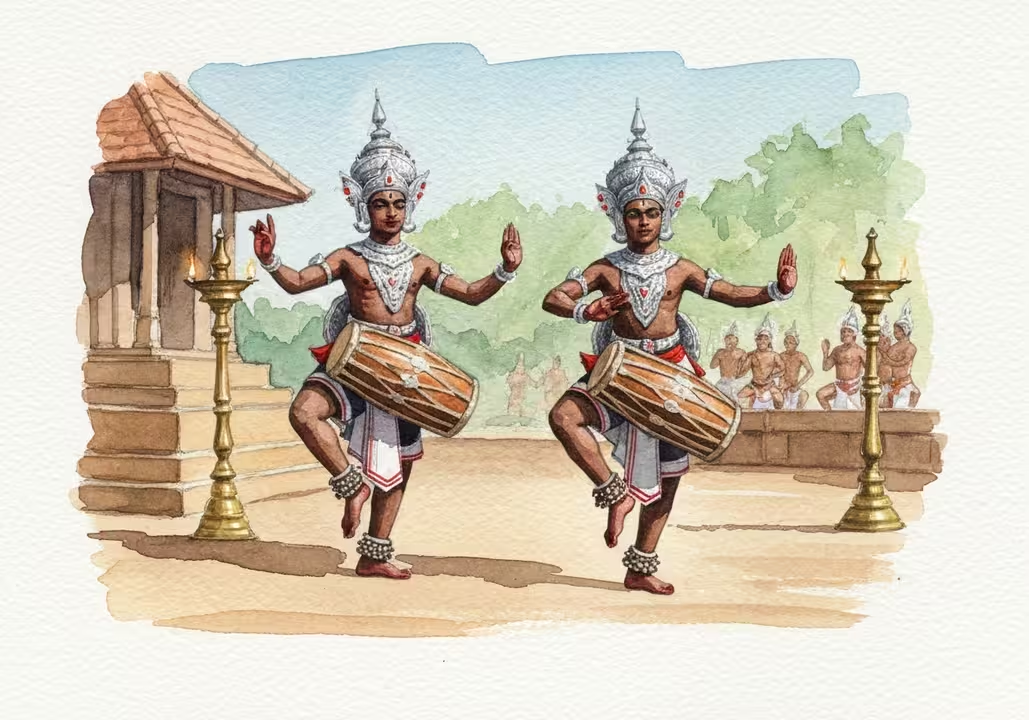
In the flickering light of oil lamps, dancers adorned in elaborate silver ornaments moved through intricate footwork, their ankle bells creating rhythmic patterns that had echoed through the hills of Kandy for centuries. This was the Kohomba Kankariya, a sacred ritual that gave birth to what would become Sri Lanka’s national dance—a tradition that would face its greatest test under British colonial rule.
The Ancient Roots of a Sacred Art
The origins of Kandyan dance lie deep in the mists of Sri Lankan legend. According to ancient tradition, the first Kohomba Kankariya was performed by a king from “Malaya Rata” and his two brothers, who journeyed to the island to cure King Panduwasdev of a mysterious illness. This ritual, named for the deity Kohomba, evolved into a highly elaborate ceremony involving months of meticulous preparation and culminating in an all-night performance from sundown to dawn.
The dance flourished under the patronage of the Kandyan kings from the 16th through the 19th centuries, developing into a sophisticated art form that combined dance, drumming, chanting, and dramatic performances. The ritual itself consisted of more than thirty discrete acts, each with its own significance in invoking the blessings of twelve deities. In the early 18th century, the cultural tapestry grew richer when the King of Kandy invited dancers and musicians from Kerala in South India to his court, adding new dimensions to the existing traditions.
Under the Kandyan feudal system, dancers occupied a unique position in society. They were identified as a separate caste, aligned specifically with the Temple of the Tooth—Buddhism’s most sacred site in Sri Lanka. Their role in the annual Dalada Perahera procession was not merely entertainment but a sacred duty, essential to the proper veneration of the Buddha’s tooth relic.
The Five Sacred Styles
Kandyan dance developed into five distinct types, each with its own purpose and costume. The most revered is the Ves dance, which originated from the ancient purification ritual of the Kohomba Yakuma. This dance was never secular—always propitiatory and performed exclusively by males who had undergone years of rigorous training.
The path to becoming a Ves dancer was arduous and sacred. Students had to master all eighteen vannams—descriptive dances that praised and imitated the behaviors of animals. The word vannam derives from the Sinhala varnana, meaning “descriptive praise.” The poetry for these eighteen principal vannams was composed by an ancient sage named Ganithalankara, working with a Buddhist priest from the Kandy temple. Among the most celebrated were the gajaga vannama (elephant), hanuma vannama (monkey), and ukusa vannama (eagle). Only after mastering all eighteen would a dancer be deemed worthy to receive the elaborate Ves costume—a symbol of achievement and spiritual dedication.
The other dance forms each had their place in the ceremonial landscape. The Naiyandi dance was performed during the initial preparations of the Kohomba Kankariya festival, particularly during the lighting of lamps and preparation of offerings. The uddekki, pantheru, and additional vannams rounded out the repertoire, creating a comprehensive system of ritualistic expression.
Colonial Conquest and Cultural Suppression
The year 1815 marked a watershed moment in Sri Lankan history. The British, having controlled the coastal regions for years, finally conquered the Kingdom of Kandy, establishing colonial rule that would last 132 years. For Kandyan dance, the implications were devastating. The royal patronage that had sustained generations of dancers evaporated overnight. The intricate feudal system that had maintained dance schools and supported practitioners collapsed.
The dance that had once commanded reverence in royal courts and temple precincts soon waned in popularity. Without support from the Kandyan kings, many traditional dance schools closed. The knowledge passed down through generations faced the threat of extinction. Even more troubling, the British colonizers fundamentally misunderstood what they encountered. In nineteenth-century historical records, they dismissively labeled the sacred art form as “Singhalese devil dance”—a term that revealed their inability or unwillingness to comprehend the spiritual significance of the performances.
Between the 1870s and 1930s, what scholars would later term “colonial choreography” reshaped the Kandyan dance landscape. British authorities displaced, mobilized, manipulated, staged, and displayed performers for their own purposes—processions honoring British royal dignitaries, colonial exhibitions meant to showcase the “exotic” cultures under British rule, photographs for European consumption, and travel films that presented distorted images of Sri Lankan culture to Western audiences. This process defined new aesthetic parameters and repertoire for Kandyan dance, often stripping it of its sacred context.
The costumes themselves transformed. As festivals moved from ritualistic temple spaces to public events designed to impress colonial authorities, the traditional dress was updated to suit Western tastes and sensibilities. The colonizers demanded performances that appeared “authentic” enough to be interesting yet refined enough not to offend Victorian sensibilities. This cultural tightrope walk forced dancers to modify centuries-old traditions.
Visual evidence from temple reliefs suggests that the female dance tradition, which had existed during the pre-colonial period, was abandoned entirely during the late Kandyan period following European arrival. The reasons remain complex, likely involving both colonial Victorian morality and the disruption of traditional patronage systems that had supported female performers.
Seeds of Revival in Adversity
Yet even in this dark period, the sacred drums continued to beat. In villages throughout the Kandyan highlands, traditional practitioners maintained their art in secret, passing knowledge from master to student far from colonial eyes. These local communities became the repositories of authentic tradition, preserving not just movements and rhythms but the spiritual understanding that gave them meaning.
A significant shift occurred toward the end of the 19th century when Ves dancers were first invited to perform outside the precincts of temple ceremonies at the annual Kandy Perahera festival. This marked a crucial transition—the dance was beginning to reclaim public space, though now in a different context. In 1916, Kandyan dances were formally added to the annual Perahera procession of the holy Tooth Relic, reconnecting the art form with its sacred origins while adapting to new social realities.
The 1920s brought unexpected allies to the preservation effort. A group of Sri Lankan artists and intellectuals—including George Keyt, Harold Peiris, Lionel Wendt, and John de Silva—recognized the cultural treasure at risk of being lost. They worked to document, promote, and popularize traditional dance forms, creating new audiences among the urban elite who had begun to view traditional arts as backward under colonial influence.
The Revolutionary Vision of Chitrasena
The true renaissance of Kandyan dance, however, would wait for a visionary named Chitrasena Dias. After fifty years of colonial rule that had left traditional dance impoverished and marginalized, Chitrasena saw both the crisis and the opportunity. In 1943, he founded the Chitrasena Dance Company, and in 1944, he established the first school of National Dance—the Chitrasena Kalayathanaya—in Colombo at Kollupitiya.
Chitrasena’s genius lay in understanding that preservation didn’t mean fossilization. He took the dance that had been confined to rustic ritual grounds and adapted it for the modern theatre. From the 1940s through the 1970s, he and his fellow innovators searched for new vistas in the aesthetic field, creating contemporary works that honored traditional forms while making them accessible to modern audiences. In the 1970s, he became one of the main pioneers of bringing Kandyan dance onto the stage, incorporating it into ballets that told stories relevant to contemporary Sri Lankan society.
His work went beyond mere performance. Chitrasena is credited with reviving all three major forms of Sri Lankan traditional dance—Kandyan, Low-Country, and Sabaragamu. Perhaps most importantly, his popularity and success helped reduce the caste barriers that had historically surrounded the dance, making it accessible to students from all backgrounds and palatable to urban, contemporary audiences who might otherwise have dismissed it as primitive or outdated.
By the mid-1950s, a standardized teaching method had been formulated, including twelve foot bar exercises and twelve exercises without the bar. This systematization helped ensure consistent training while preserving core techniques. The tradition that had once only allowed male dancers began to evolve. While originally restricted to men, several schools now train women in the Kandyan dance form, expanding participation while maintaining technical rigor.
A Living Tradition in Modern Times
Today, Kandyan dance stands as Sri Lanka’s primary cultural export and is recognized as the national dance. The legacy of preservation efforts continues through institutions like the Chitrasena Dance School, one of the largest schools for Kandyan dance, alongside traditional village dance schools such as Madyama Lanka Nritya Mandalaya in the Kandy area that maintain links to the ritual origins.
The training process remains rigorous, demanding both physical and mental strength. Dancers undergo years of practice to master the intricate movements, with the traditional requirement that serious students learn all eighteen vannams before being considered fully trained. What was once taught exclusively through local Buddhist temples is now also offered through cultural institutions, universities, and private schools, ensuring multiple pathways for transmission of knowledge.
The dance is performed at secular social festivities and tourist shows, yes, but it has maintained its sacred connections as well. Many dances continue to be performed as part of rituals and festivals held at temples. Most significantly, the traditional form is still performed each year at the Dalada Perahera in Kandy, maintaining an unbroken link—however strained by colonial intervention—to the dance’s origins in the Temple of the Tooth.
The Enduring Spirit
The story of Kandyan dance through the colonial period is ultimately one of resilience and adaptation. It is a testament to the power of cultural memory, the dedication of traditional practitioners who preserved knowledge through adversity, and the vision of innovators who understood that living traditions must evolve to survive.
What the British colonizers could not destroy through neglect or appropriation, the Sri Lankan people protected and eventually revitalized. The sacred drums that once beat only in temple precincts and village ritual grounds now resound on stages around the world. The elaborate Ves costume, once worn only by a select hereditary caste, now adorns dancers from diverse backgrounds. The eighteen vannams, their poetry composed by an ancient sage, continue to be mastered by each new generation.
Yet this transformation has not meant the loss of the sacred. While Kandyan dance has become more accessible and more widely performed, its spiritual heart remains in rituals like the Kohomba Kankariya, still practiced in traditional communities. The dance exists simultaneously as sacred ritual, cultural heritage, national symbol, and living art form—a multiplicity that speaks to its depth and vitality.
As modern Sri Lanka grapples with questions of identity, globalization, and cultural preservation, Kandyan dance offers a model of how traditions can maintain their essence while adapting to changing times. The ankle bells that ring out today in training schools across the island carry echoes of those that sounded in King Panduwasdev’s court, in colonial-era resistance, and in mid-century revival. They remind us that culture, like the human spirit, is remarkably resilient—capable of surviving conquest, transforming through adversity, and emerging stronger in the light of new dawns.