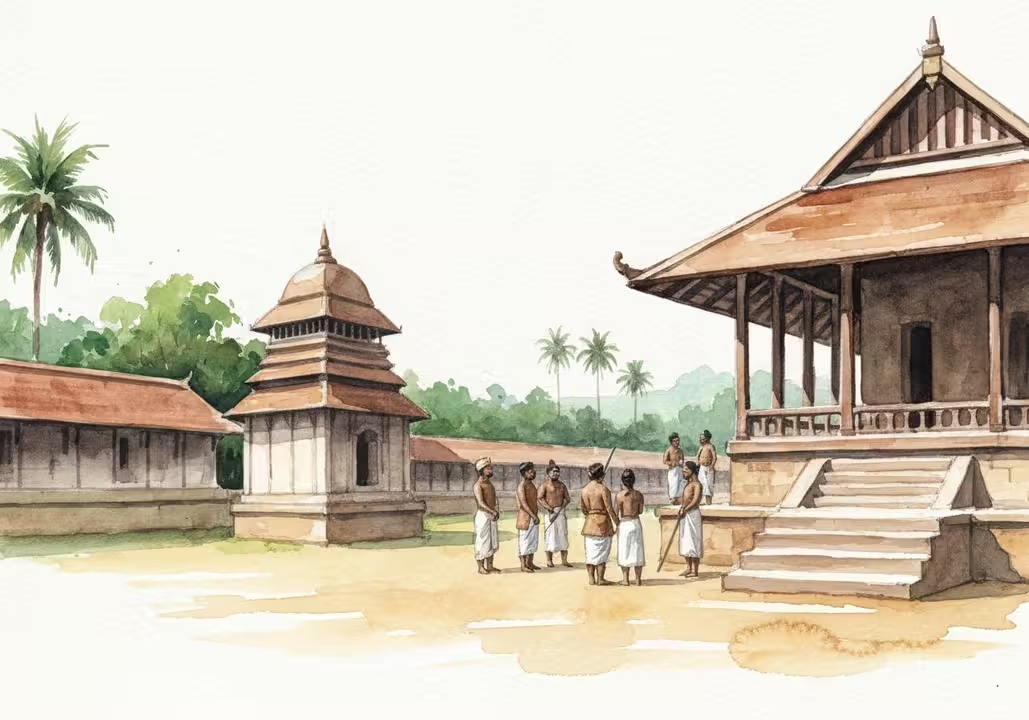
The morning of March 2, 1815, dawned like any other in the ancient hill capital of Kandy. But by nightfall, the Kingdom of Kandy—the last bastion of independence on the island of Ceylon—would cease to exist. In the hallowed Magul Maduwa, the Royal Audience Hall adjacent to the Temple of the Sacred Tooth Relic, a document would be signed that ended more than two millennia of Sinhalese sovereignty. The Kandyan Convention, as it came to be known, marked the darkest day in Sri Lankan history.
The Descent into Tyranny
To understand how the unconquerable Kingdom of Kandy fell not to British arms but to British intrigue, one must first understand the man who wore its crown. Sri Wickrama Rajasinghe, a Telugu prince from South India, had ascended to the Kandyan throne in 1798 with the backing of the powerful Pilimathalawe Adikaram. For over three centuries, the Kingdom of Kandy had successfully repelled Portuguese and Dutch invasions, maintaining its independence while coastal Ceylon changed hands between European powers.
But Sri Wickrama Rajasinghe proved to be a very different ruler from his predecessors. His reign became increasingly marked by suspicion, paranoia, and brutality. The breaking point came in 1814, when the king’s relationship with one of his chief ministers, Ehelepola, the First Adigar, deteriorated completely. Ehelepola had been involved in various intrigues against the increasingly unpopular king, and when his actions were revealed in 1814, he fled to British-controlled territory seeking protection.
What happened next would forever seal the king’s fate and provide the British with the moral pretext they needed for intervention.
The Execution That Doomed a Kingdom
The furious king demanded that Ehelepola return to face justice. When the minister refused, Sri Wickrama Rajasinghe took a terrible revenge. On May 17, 1814, he ordered the execution of Ehelepola’s entire family. The minister’s wife, Kumarihamy, was drowned. His eldest son, Loku Bandara, was beheaded. His younger son, Madduma Bandara—a child whose bravery in the face of death would make him a legendary figure in Sri Lankan history—was also executed. The king’s men killed Ehelepola’s daughters and forty-seven chiefs from Sabaragamuwa who were deemed complicit in the minister’s rebellion.
The brutality of these executions shocked the Kandyan aristocracy and common people alike. Riots broke out across the kingdom. The king had lost the support of his subjects and, crucially, the loyalty of his remaining chiefs. From the safety of British territory, Ehelepola began his campaign of persuasion, arguing that the tyrannical king’s reign must be ended through British intervention.
The British needed little convincing. They had long coveted complete control of Ceylon, and the king’s atrocities provided the perfect justification. But there was also another incident that sealed the matter: Sri Wickrama Rajasinghe had detained British merchants on suspicion of spying and subjected them to torture, killing several. For the British Empire, this was an intolerable affront.
The Master of Intrigue
Behind the scenes, one man was orchestrating the downfall of the Kandyan Kingdom with methodical precision. John D’Oyly, the British Resident’s chief translator, was far more than a mere linguist. He was the Empire’s master spy in Ceylon.
D’Oyly had spent years mastering the Sinhalese language under the tutelage of the learned Buddhist monk Karathota Dhammarama Nayake Thera. His fluency in Sinhala, combined with his deep understanding of Kandyan customs and society, made him the perfect agent for British intelligence operations. From 1810 to 1815, D’Oyly maintained detailed diaries documenting his systematic surveillance and gradual undermining of the Kandyan Kingdom.
The scholar Gananath Obeyesekere, who later studied these diaries, found them to be a remarkable record of how the British achieved the “gradual undermining of the Kandyan Kingdom without the use of weapons until the right moment arrived.” D’Oyly served as the crucial intermediary between the British Governor and the disaffected Kandyan chiefs who were being cultivated to “sell out” their king.
His work was so effective that when the time came for military action, there would be no resistance at all.
The Bloodless Conquest
In December 1814, Governor Sir Robert Brownrigg assembled his forces: the 19th and 73rd British regiments along with four Ceylon regiments, totaling about three thousand men. He organized them into three divisions and assumed personal command of the expedition.
The British advance began in early 1815. What should have been a fierce military campaign through the mountainous terrain that had defeated European armies for centuries instead became a leisurely march. Not a single shot was fired in anger. The Kandyan chiefs, already turned against their king by D’Oyly’s careful cultivation, offered no resistance. Some actively assisted the British advance.
On February 10, 1815, British forces reached Kandy. Four days later, on February 14, they occupied the city. The king had fled, but his freedom was short-lived. On February 18, Sri Wickrama Rajasinghe was captured near the village of Medamahanuwara and taken prisoner. The last king of Kandy was now a British captive.
The Convention
With the king in custody, D’Oyly now turned to his masterwork: drafting a treaty that would legitimize British rule while maintaining the facade that the Kandyan chiefs had voluntarily ceded their kingdom. The Kandyan Convention was a carefully constructed document that balanced British imperial ambitions with enough concessions to make it palatable to the Kandyan aristocracy.
On March 2, 1815, the great and powerful of the Kandyan Kingdom assembled in the Magul Maduwa. Governor Brownrigg represented the British Crown. The Kandyan side was represented by the kingdom’s leading chiefs: Molligoda (the First Adigar), Pilimatalawe (the Second Adigar and Dissawe of Sabaragamuwa), Monarawila Keppetipola (who would later lead a rebellion against these very same British), Dullewe Ratwatte, and others including the exiled Ehelepola, whose family’s blood had watered the seeds of this moment.
The Convention contained twelve clauses. The first stripped Sri Wickrama Rajasinghe of all claims to the throne. The second vested the sovereignty of the entire island in the British Crown, specifically in King George III of the United Kingdom. The British now controlled all of Ceylon—the first time in history that a foreign power had gained sovereignty over the entire island.
But the Convention also contained promises meant to reassure the Kandyan elite. Civil and criminal justice would continue to be administered according to established Kandyan norms and customs. The proclamation that had previously annexed the Three and Four Korales and Sabaragamuwa was repealed, returning these territories to Kandyan jurisdiction. Traditional dues and revenues would be collected as before, though now for the British Crown.
Most significantly, the Fifth Article declared: “The religion of Buddhoo, professed by the chiefs and inhabitants of these provinces is declared inviolable and its rites and ministers and places of worship are to be maintained and protected.” This promise—that Buddhism would remain inviolable and that the British Crown would serve as protector of the Buddhist faith—was the crucial inducement that secured the chiefs’ cooperation.
The document was signed by the chiefs and witnessed by John D’Oyly and Deputy Secretary James Sutherland. Or was it? Historical controversy would later emerge over whether all the signatures were genuine. Some scholars allege that Ehelepola’s signature was forged by D’Oyly, pointing to discrepancies between the signature on the Convention and Ehelepola’s later correspondence from Mauritius. D’Oyly himself reportedly went to each chieftain individually with a copy of the Convention in his pocket, personally persuading them to sign.
Broken Promises
The ink on the Kandyan Convention was barely dry before the British began violating its terms. The chiefs who had signed the treaty believing their traditional privileges would be protected soon discovered they had been deceived.
In September 1817, an incident occurred that directly challenged the traditional rights the British had promised to maintain. John D’Oyly, now the British Resident in Kandy, recommended the appointment of Haji Marikkar Travala, a Moor from Wellasse, as Madige Muhandiram. The post of Madige Muhandiram had traditionally been held by families of Kandyan chiefs. This appointment was seen as a deliberate insult that undermined the authority of the Millewa Dissawa and violated the Convention’s promise to respect Kandyan customs.
This was not an isolated incident. The British systematically eroded the privileges and authority of the Kandyan aristocracy. The chiefs who had believed British promises of protection for their religion, customs, and rights began to realize they had been duped.
The Great Rebellion
By 1817, resentment had reached a breaking point. What began as scattered resistance in the Uva and Wellassa regions quickly spread into a full-scale rebellion. Ironically, one of its leaders would be Monarawila Keppetipola, the very man who had signed the Kandyan Convention just two years earlier.
When rebellion broke out in Wellassa, D’Oyly dispatched Keppetipola, the Dissawe of Uva, from Kandy to Badulla with instructions to crush the rebels. But when Keppetipola reached Alupotha and heard the grievances of the people, he made a fateful decision. He joined the rebellion and was immediately recognized as its leader. His presence and prestige transformed what might have been a local uprising into a serious threat to British rule.
The rebels captured Matale and advanced toward Kandy. For a moment, it seemed possible that the Kandyan Kingdom might be restored. But the rebellion suffered from fatal divisions. Not all the Kandyan chiefs who had signed the Convention joined the uprising. Molligoda, the First Adigar, and Ekneligoda remained loyal to the British. With their assistance, Governor Brownrigg established field headquarters in Kandy and directed a brutal counterinsurgency campaign.
The British response was merciless. Brownrigg adopted a scorched earth policy designed to starve the rebellion into submission. British forces burned rice paddies, destroyed homes and private property, confiscated stocks of salt, and slaughtered cattle and livestock. Villages suspected of supporting the rebels were razed. More than ten thousand Sinhalese perished in the fighting and the famine that followed.
The rebellion’s leaders were hunted down one by one. Keppetipola, who had switched from British agent to rebel commander, fell ill and was captured. He was taken to Kandy, where he was publicly beheaded—a warning to any who might contemplate further resistance.
The Final Betrayal
Having crushed the rebellion by 1818, the British felt no further need to maintain even the pretense of honoring the Kandyan Convention. On November 21, 1818, they unilaterally issued a Royal Proclamation that fundamentally altered the terms of the treaty.
The word “inviolable” was dropped from the clause protecting Buddhism. The promises to maintain Kandyan customs and the traditional privileges of the chiefs were effectively nullified. The proclamation consolidated direct British rule and eliminated the special status of the Kandyan provinces. The Convention that had been sold to the Kandyan chiefs as a guarantee of their rights and religious protections was revealed to have been a temporary expedient, to be discarded as soon as British power was secure.
The British government’s abandonment of its obligations reached its culmination in 1853, when the government formally dissociated itself from any responsibility for Buddhism. The promise that had been the cornerstone of the Convention—that the British Crown would serve as protector of the Buddhist faith—was simply abandoned.
Legacy and Consequences
The Kandyan Convention of 1815 ended more than 2,300 years of continuous Sinhalese sovereignty over at least some portion of the island of Ceylon. For the first time in recorded history, the entire island came under foreign rule. The ancient kingdom that had repelled the Portuguese for over a century and frustrated Dutch ambitions for another century had fallen not through military conquest but through the careful exploitation of internal divisions and the betrayal of its own aristocracy.
Sri Wickrama Rajasinghe, the deposed king, was taken to exile in India. The British granted him a privy purse, which his descendants continued to receive from the Government of Ceylon until 1965. He died in Vellore Fort in 1830, far from the kingdom he had lost.
For the Kandyan chiefs who had signed the Convention, the aftermath brought bitter lessons. Some, like Molligoda, who remained loyal to the British, maintained positions of limited authority under colonial rule. Others, like Keppetipola, who recognized their error too late, paid with their lives. The Kandyan aristocracy as a class never recovered its former power and prestige.
The broken promises of the Kandyan Convention created a legacy of resentment that would fuel resistance to British rule for the next century and a half. The rebellion of 1817-1818 was followed by another major uprising in 1848. A succession of smaller revolts and acts of resistance continued throughout the British period, each rooted in the sense that the Kandyan people had been cheated of their sovereignty through duplicity and broken promises.
The Convention also established a troubled relationship between the Sri Lankan state and Buddhism that would persist long after independence. The promise to make Buddhism inviolable and to protect its institutions was unique in British colonial governance—nowhere else did the Crown explicitly take on such a role. The subsequent British abandonment of this commitment left a lasting sense of betrayal and created complications that would affect Sri Lankan politics well into the modern era.
When Ceylon finally achieved independence on February 4, 1948, it came not through armed struggle but through negotiation and constitutional development—a peaceful transition that might have seemed unthinkable to those who witnessed the bloodshed of the 1818 rebellion. Yet the memory of the Kandyan Convention remained vivid. Sri Lanka’s post-independence constitutions grappled with the question of Buddhism’s place in the state, a question that traced directly back to the broken promises of March 2, 1815.
The document signed that day in the Magul Maduwa remains one of the most controversial in Sri Lankan history. To some, it represents the diplomatic skill of John D’Oyly and the inevitable triumph of British power. To others, it stands as a symbol of betrayal—both the betrayal of the Kandyan chiefs who sold their kingdom and the betrayal of the British who dishonored their promises. The Kandyan Convention ended Sri Lankan independence, but it also planted the seeds of resistance that would eventually lead to its restoration.
In the Royal Palace of Kandy today, visitors can still see the Magul Maduwa where the Convention was signed. The building stands as a monument to a pivotal moment when the course of Sri Lankan history turned, when centuries of independence ended with the stroke of a pen, and when promises made in the shadow of the Sacred Tooth Relic proved as ephemeral as morning mist over the Mahaweli River.