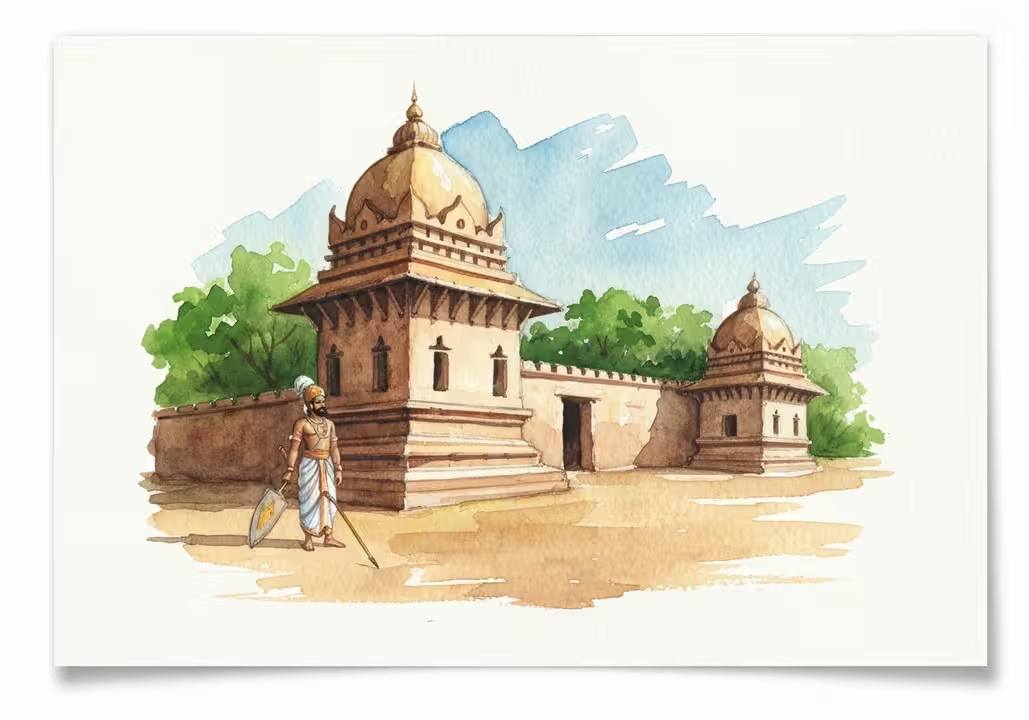
In the northern reaches of Sri Lanka, where the Jaffna Peninsula extends into the Palk Strait, a powerful Tamil kingdom flourished for over four centuries. The Kingdom of Jaffna, ruled by the legendary Aryacakravarti dynasty, stood as a testament to Tamil culture, Hindu civilization, and maritime prowess. From its turbulent founding in the 13th century to its dramatic conquest by Portuguese forces in 1619, this kingdom’s story interweaves South Indian politics, international trade, religious devotion, and ultimately, colonial conquest.
A Kingdom Born from Chaos
The origins of the Jaffna Kingdom lie in one of the most tumultuous periods of Sri Lankan history. In 1215 CE, a mysterious chieftain named Magha from Kalinga (modern-day Odisha, India) invaded Sri Lanka with a powerful military force, disrupting the established Sinhalese kingdoms and reshaping the island’s political landscape. Magha’s invasion sent shockwaves through the island, but it was what followed that would establish the Jaffna Kingdom.
The true founding of the kingdom came around 1270 CE, when a Pandyan general named Aryacakravarti arrived from South India. According to historical accounts, when a ruler named Chandrabhanu launched a second invasion of southern Sri Lanka, the powerful Pandyan Empire of South India intervened. The Pandyas killed Chandrabhanu in 1262 and installed their trusted general, Aryacakravarti, as the king of the northern territories. Thus began the Aryacakravarti dynasty, which would rule Jaffna for the next three and a half centuries.
The dynasty’s origins reflected the deep connections between northern Sri Lanka and South India. The Aryacakravartis claimed descent from the prominent Hindu pilgrimage center of Rameswaram and identified themselves as Brahma-Kshatriyas—Brahmins who had taken up the martial life. This dual identity as both warriors and learned men would shape their kingdom’s character for generations.
Nallur: A Glittering Capital
The heart of the Jaffna Kingdom beat in Nallur, a name that appropriately means “Good City.” This capital was no humble settlement but a sophisticated urban center that rivaled any South Asian city of its time. Nallur was heavily fortified with massive ramparts, defensive towers, and imposing gates that protected the kingdom’s treasures within.
Inside the fortifications, the city presented a carefully planned layout that reflected both military necessity and aesthetic grandeur. The royal palace stood near the great temple, symbolizing the close relationship between temporal and spiritual power. Magnificent mansions housed ministers and nobles, while dedicated quarters accommodated the kingdom’s diverse population: Brahmin scholars, fierce warriors, eloquent court poets, wealthy traders, and skilled artisans. The city featured halls of justice where disputes were settled, sprawling marketplaces where goods from across the Indian Ocean changed hands, public baths, elaborate stables for the kingdom’s prized elephants and horses, and beautiful gardens where the royal family could find respite.
Hindu temples stood at each of the four main gateways, serving both as places of worship and symbolic guardians of the city. These included the Veyilukantha Pillaiyar Kovil on the east, Veeramakali Amman Kovil on the west, Kailaya Vinayagar Kovil on the south, and the Sattanathar Kovil complex on the north. The Portuguese would later claim that over 500 Hindu temples dotted the kingdom—a testament to the deep religious devotion that characterized Jaffna society.
An Empire of Trade and Prosperity
What set the Jaffna Kingdom apart from other Sri Lankan kingdoms was its remarkable commercial sophistication. When the renowned Moroccan traveler Ibn Battuta visited in 1344, he was astonished to observe 100 ships of varying sizes belonging to the King of Jaffna transiting off the coast of Kerala. This was no isolated observation—the Jaffna Kingdom had positioned itself as a major player in the vast Indian Ocean trading network.
The kingdom’s economy was remarkably diverse and heavily monetized. Unlike the more feudal Sinhalese kingdoms to the south, Jaffna ran on cash transactions rather than land-based exchanges—a sophistication that Portuguese records would later document with surprise. The kingdom exported elephants to India through the port of Kayts, controlled the lucrative pearl fisheries around Mannar, and maintained a thriving dairy industry on Delft Island. Jaffna merchants traded actively with Ming Dynasty China, as evidenced by Chinese porcelain excavated in archaeological sites, and maintained brisk commerce with Yemen and the Horn of Africa—14th century Jaffna Tamil coins discovered on the East African coast testify to these far-reaching connections.
The kingdom sought to monopolize Sri Lankan trade in cinnamon, spices, and precious gems with West Asia. This commercial ambition, combined with strategic control over the Palk Strait, made Jaffna wealthy and influential far beyond its geographic size.
The Golden Age and Its Challenges
The early 15th century marked the kingdom’s zenith. During this period, Jaffna exercised dominant control over not just the peninsula but also the Vanni region to the south and extended its influence to Puttalam and Chilaw on the western coast. Regional kingdoms paid tribute to Jaffna, acknowledging its military and economic superiority.
However, this golden age attracted dangerous attention. The kingdom found itself caught between two expanding powers: the mighty Vijayanagar Empire ruling from South India and the resurgent Kingdom of Kotte in southern Sri Lanka. By the early 15th century, Jaffna had become a tributary to Vijayanagar, which extended its sovereignty northward from the Indian subcontinent.
The real crisis came when Parakramabahu VI of Kotte, one of Sri Lanka’s most formidable rulers, set his sights on conquering the north. Waiting until ties between Vijayanagar and Jaffna weakened, he launched a series of military campaigns between 1449 and 1454. The wars devastated the kingdom, and from 1450 to 1467, Jaffna lost its independence, becoming a vassal of Kotte. Though the kingdom eventually regained autonomy, it would never quite recover its former dominance.
A Flourishing Culture
Despite political challenges, Jaffna remained a beacon of Tamil Hindu culture. Saivism (devotion to Lord Shiva) was the state religion, and temples dedicated to Shiva, Murugan, and Pillaiyar received royal patronage. The kingdom established an academy for Tamil language development, fostering a rich literary tradition. Both Tamil and Sanskrit flourished in Jaffna’s courts and temples.
Society was organized along South Indian caste lines, with the Karaiyar caste providing naval and military leadership and controlling the pearl trade, while the Vellalar caste supplied agricultural landlords and village headmen. Despite this hierarchical structure, the kingdom maintained a pluralistic economy that balanced agriculture, maritime activities, commerce, and handicraft production.
The Portuguese Shadow
The arrival of the Portuguese in the Indian Ocean in the early 16th century marked the beginning of the end. Initially, the kingdom tried to maintain its independence while navigating the new colonial reality. However, resistance proved costly and ultimately futile.
Cankili I, who ruled until 1565, became the most defiant of the late kings. He resisted Portuguese encroachment fiercely and, in a brutal demonstration of power, massacred 600-700 Parava Catholics on Mannar Island who had been brought from India to take over the pearl fisheries. His resistance eventually led to his overthrow in a local uprising.
By 1591, the Portuguese had installed their puppet, Ethirimanna Cinkam, as king. But the death throes of the kingdom came with Cankili II, a usurper who seized the throne in 1617 through a palace massacre of the rightful prince and regent. When he attempted to confront Portuguese power, he faced the full might of colonial military force.
The Final Fall
In June 1619, two Portuguese expeditions converged on Jaffna. A naval force was repulsed by the fierce Karaiyar warriors, but a land army of 5,000 soldiers under Filipe de Oliveira proved unstoppable. Cankili II was defeated, captured, and taken to Goa along with every surviving member of the royal family. In 1621, after trial by a Portuguese court, he was executed by beheading, ending the Aryacakravarti line forever. The remaining captives were pressured into joining Catholic religious orders, effectively eliminating any future claimants to the throne.
The aftermath was devastating. Captain-Major Filipe de Oliveira ordered the destruction of all royal palaces and over 500 Hindu temples. The famous Saraswathy Mahal library in Nallur, repository of centuries of Tamil literary works, was burned to the ground. Excessive Portuguese taxation caused the population to flee—many to Ramanathapuram in India, others to the Vanni districts. The vibrant commerce that had made Jaffna prosperous collapsed.
Though brave rebels like Migapulle Arachchi attempted to restore the kingdom with help from the Thanjavur Nayak kingdom, and six major rebellions erupted over the next 40 years, the Portuguese grip held firm until the Dutch conquered Jaffna Fort in 1658.
Legacy in Stone and Memory
Today, archaeological excavations continue to reveal the kingdom’s glory. Ming Dynasty porcelain, Roman coins, Greco-Roman and Persian currency, early Pandyan coins, and punch-marked coins from the 5th and 6th centuries BCE testify to Jaffna’s role as a cosmopolitan trading center. The ruins of temples and fortifications whisper of a sophisticated civilization that once flourished on the peninsula.
The Jaffna Kingdom remains a powerful symbol in Sri Lankan Tamil consciousness—a reminder of a time when a Tamil Hindu state prospered on the island, when Nallur’s temples gleamed in the tropical sun, when ships bearing Jaffna’s flag sailed to China and Africa, and when the Aryacakravarti kings ruled from their magnificent capital. Though the Portuguese destroyed much, they could not erase the memory of four centuries of Tamil sovereignty in northern Sri Lanka.