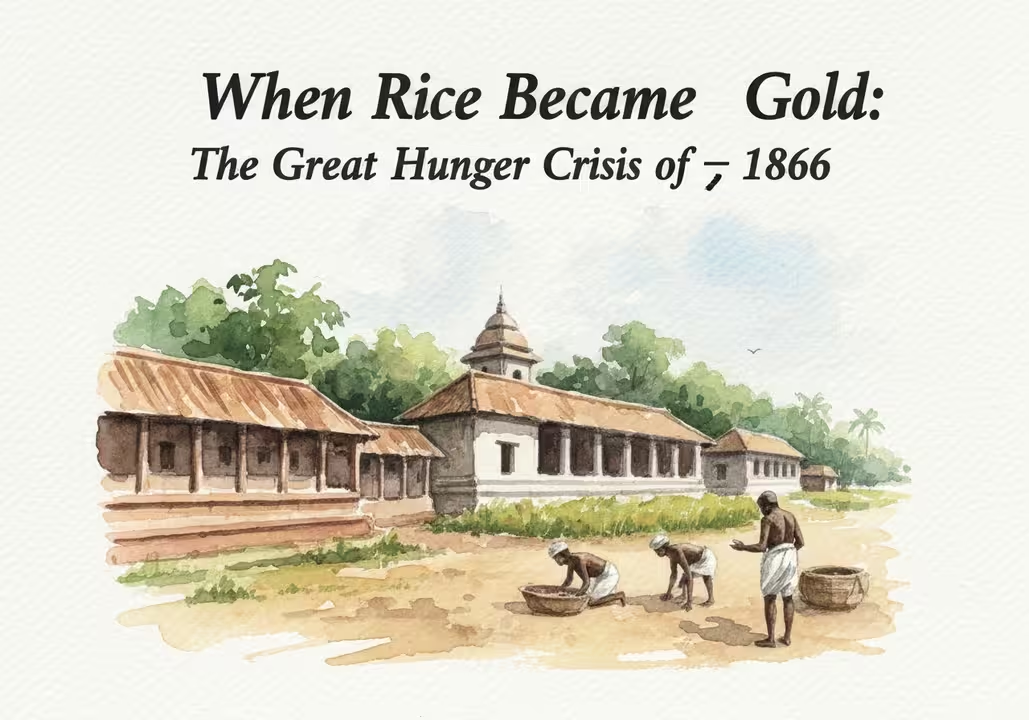
In the autumn of 1866, a crisis unlike any Ceylon had experienced under British rule descended upon the island. Rice—the staple that sustained millions—vanished from market stalls. Prices skyrocketed beyond the reach of ordinary people. Desperate crowds took to the streets, and the colonial government watched, unmoved by the suffering unfolding before them. This was not merely a food shortage; it was a reckoning with an economic system that had transformed the island’s verdant highlands into coffee plantations while sacrificing the food security of its people.
The Seeds of Vulnerability
By the 1860s, Ceylon had become one of the world’s three largest coffee producers, alongside Brazil and Indonesia. The transformation had been dramatic and ruthless. Between 1838 and 1843 alone, nearly 250,000 acres of land were sold to British investors for coffee plantations. Around 100,000 hectares of pristine rainforest in the central highlands—once the domain of the ancient Kingdom of Kandy—fell to the axe and saw.
A contemporary observer noted that the most striking aspect of the island’s scenery came from “a lamentable devastation, caused by coffee and its cultivators.” During the 1850s and 1860s, a genuine “coffee mania” gripped investors and colonial administrators alike. Coffee was king, and everything else was expendable.
The cost of this monoculture fixation was profound. Traditional rice paddy cultivation, which had sustained Ceylonese communities for centuries, was systematically undermined. Planters and civil servants propagated the notion that paddy cultivation was wasteful and undeserving of government encouragement. The Governors agreed. While the ancient kings had used the Rajakariya labor system to maintain irrigation works essential for rice cultivation, the British diverted this labor to military needs and commercial agriculture. The result was catastrophic: rice production plummeted to just 50% of the island’s requirements, and imports from India increased threefold.
Ceylon had become dangerously dependent on a single thread—rice imports from the Indian subcontinent. When that thread snapped, the island would hang in the balance.
The Storm Breaks: India’s Catastrophe Becomes Ceylon’s Crisis
In 1865, the monsoon rains that millions depended upon arrived late and departed early across India’s eastern coast. The winter rice crop failed. What began as drought transformed into one of the nineteenth century’s most devastating famines—the Orissa famine of 1866. At least one million people perished in Odisha alone, roughly one-third of the region’s population. The catastrophe affected 47.5 million people from Madras northward.
For Ceylon, the implications were immediate and dire. The Famine Commissioners’ Report grimly noted that without absolutely stopping rice exportation from India to other countries, “Mauritius, Ceylon, and other places would have starved.” As Indian rice vanished from export markets, Ceylon’s rice prices began their deadly ascent.
By mid-1866, rice that had cost 6 shillings now commanded 20 shillings—a tripling of prices that strained poor village communities to the breaking point. The bulk of Ceylon’s indigenous population survived through subsistence agriculture, growing just enough to feed themselves. They had no reserves, no buffer against such violent price shocks. As weeks passed and prices continued to climb, hunger stalked the villages.
A Government That Would Not Act
As suffering spread, the British colonial government made a fateful choice: it would do nothing. Adhering rigidly to laissez-faire economic doctrine—the theories of Adam Smith and David Ricardo that dominated mid-19th century British thinking—colonial administrators refused to intervene in grain markets. Prices, they insisted, must adjust themselves “by the influence of the natural laws of supply and demand.”
The Ceylon Times newspaper condemned this approach as “very incredulous” given the government’s “ample income.” Local officials even dismissed private relief efforts, fearing they might create “public alarm.” While the people starved, the bureaucracy prioritized ideological purity over humanitarian necessity.
By October, rice prices had spiraled to an unconscionable 36 shillings—equivalent to paying $100 for rice today. For laborers earning a few shillings per week, this was an impossible sum. Children cried with hunger. Families skipped meals. The desperation became palpable in every marketplace.
The October Riots: When Patience Broke
On October 21, 1866, patience shattered. In Colombo and other towns, crowds gathered at shops and market stalls. What began as demands for rice at a “just” or “customary” price escalated into full-scale grain riots. People looted shops while desperate owners armed themselves in defense. The disturbances continued through late October and into November, with colonial records documenting the chaos on October 14, October 25, November 9, November 16, and November 20.
These were not mindless acts of violence but calculated protests—what scholars would later recognize as “market riots,” where crowds contested not just the availability of grain but the moral legitimacy of exploitative pricing during crisis. Newspapers in both English and Sinhala extensively documented the unrest. The Ceylon Examiner, Ceylon Times, Observer, and Sinhala-language papers like Lakrivikirana and Nanartha Pradipaya chronicled a society in turmoil.
Faced with colonial government inaction, Colombo’s residents organized independent relief efforts, raising thousands of pounds to purchase and distribute rice to the most desperate. It was a remarkable display of community solidarity in the face of administrative callousness.
Resolution Without Justice
The crisis eventually subsided, not through government intervention but through voluntary price controls adopted by some traders and increased police presence to suppress the riots. As the immediate shock of the Orissa famine eased and rice shipments from India gradually resumed, prices began to stabilize.
But the resolution brought no reckoning, no accountability, no reform. The underlying colonial policies that had created the vulnerability—the prioritization of coffee exports over food security, the dependence on imported rice, the dismantling of traditional irrigation systems—remained unchanged. The British government even criticized the local relief efforts that had prevented worse suffering, complaining they had created unnecessary alarm among the population.
A Legacy of Structural Hunger
The food crisis of 1866 was not Ceylon’s last encounter with hunger under colonial rule. By the end of the 19th century, famine had become a common feature in many villages, compounded by endemic malaria and continued neglect of subsistence agriculture. The plantation economy that Britain had engineered meant that “the growing of staples like rice was no longer adequate for the island’s consumption and a large proportion of basic foodstuffs had to be imported.”
The events of 1866 laid bare a fundamental truth about colonial economics: the system was designed to extract wealth, not to ensure the welfare of colonized peoples. When coffee and tea plantations generated profits for distant shareholders, the system worked as intended. When the people who actually lived on the land went hungry, that too was within acceptable parameters—a regrettable side effect of market forces.
The Great Hunger Crisis of 1866 demonstrated that food security is not merely an agricultural question but a political one. It revealed how economic policies made in distant colonial offices could transform abundance into scarcity, how the pursuit of export crops could undermine subsistence, and how rigid adherence to economic ideology could prove more deadly than any drought.
For Ceylon’s people, the lesson was bitter but clear: under a system that valued coffee beans more than human lives, survival itself had become precarious. The rice riots of 1866 were not just protests against high prices—they were a moral indictment of a colonial order that had made its priorities devastatingly clear.