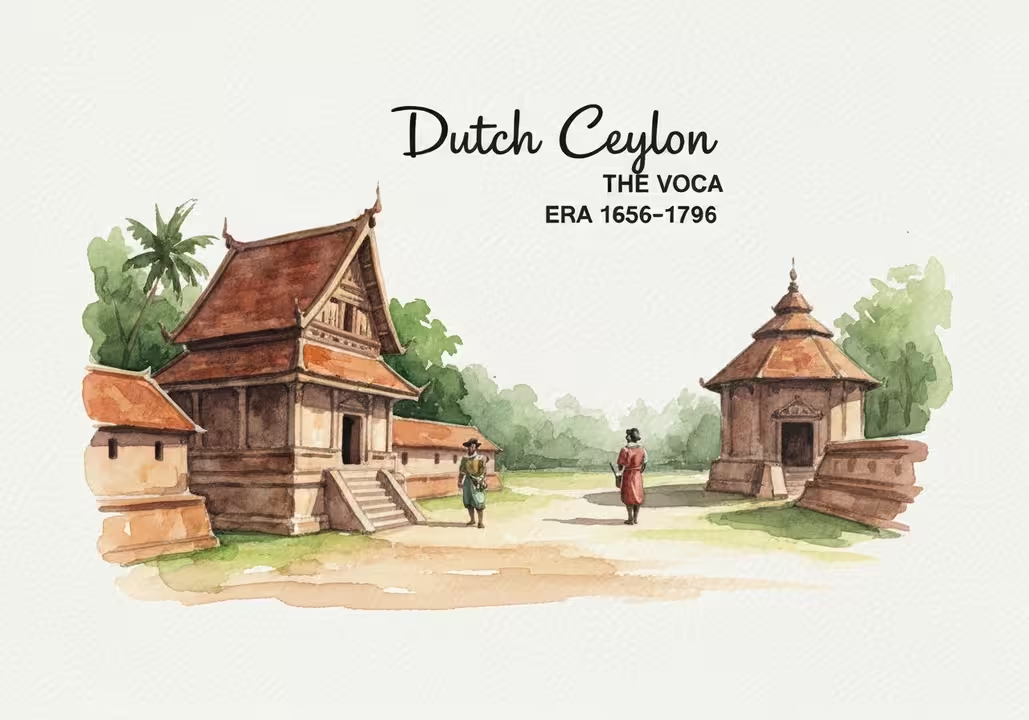
In the spring of 1638, representatives of the Dutch East India Company—the Vereenigde Oostindische Compagnie, or VOC—sat across from King Rajasinghe II of Kandy in the highlands of Ceylon, negotiating an alliance that would reshape the island’s destiny. The Dutch promised military assistance to expel the Portuguese colonizers who had dominated the coast for over a century. In exchange, they sought a monopoly on Ceylon’s precious cinnamon and reimbursement for military expenses. On May 23, 1638, the Kandyan Treaty was signed. What began as a partnership against a common enemy would evolve into 140 years of Dutch colonial dominance—an era that would leave an indelible mark on Sri Lanka’s legal system, economy, architecture, and culture that endures to this day.
The Alliance Against Portugal: Partners in Conquest
The Dutch arrival in Ceylon was not accidental but strategic. By the early 17th century, the Dutch Republic had emerged as Europe’s premier maritime and commercial power, and the VOC, established in 1602, was its primary instrument for projecting power across the Indian Ocean. The company’s directors in Amsterdam and their operatives in Batavia (modern Jakarta) had long coveted Ceylon’s cinnamon—considered the finest in the world—which the Portuguese had monopolized since their conquest of the coastal kingdoms.
King Rajasinghe II, ruling from his mountain stronghold of Kandy, had watched the Portuguese consolidate their control over the lowlands and cinnamon-growing regions. His kingdom remained unconquered but isolated, cut off from the sea and the lucrative maritime trade. The arrival of the Dutch, enemies of Portugal locked in their own struggle for Asian commerce, presented an opportunity too valuable to ignore. The enemy of his enemy, Rajasinghe calculated, could become a useful ally.
The military partnership proved remarkably effective. In coalition with Kandyan forces, Dutch troops captured the Portuguese fort at Batticaloa on the eastern coast on May 18, 1638, just days before the treaty was formally signed. This initial victory was followed by a methodical campaign against Portuguese strongholds. The defining moment came on March 13, 1640, when combined Dutch and Kandyan forces captured Galle, the strategic southern port that controlled access to the richest cinnamon lands. The Portuguese fort of Santa Cruz, which had stood since 1589, fell to Dutch cannon and Kandyan assault.
For the next eighteen years, the Dutch systematically reduced Portuguese positions along the coast. Their superior naval power allowed them to blockade Portuguese forts while Kandyan armies cut off their supply routes from the interior. In 1655, the Dutch placed Colombo—the Portuguese capital—under siege. For six months and twenty-seven days, the garrison endured bombardment and starvation. On May 12, 1656, Colombo’s gates opened in surrender. The final Portuguese strongholds of Jaffna and Mannar fell in 1658. After 153 years, Portuguese rule in Ceylon had ended.
The Great Betrayal: From Allies to Adversaries
The moment of victory, however, marked the beginning of a profound betrayal that would poison Kandyan-Dutch relations for more than a century. According to the 1638 treaty, territories captured from the Portuguese were to be returned to the Kingdom of Kandy. The Dutch had explicitly promised to act as liberators, not conquerors. But when Colombo’s gates finally opened in 1656, the Dutch immediately closed them against their Kandyan allies.
King Rajasinghe II arrived at Colombo expecting to reclaim the ancient territories of his kingdom. Instead, he found Dutch soldiers manning the Portuguese fortifications, Dutch administrators settling into Portuguese houses, and VOC officials claiming ownership over the very cinnamon lands they had promised to restore. The treaty’s crucial clause—“as the king thought fit”—had been included in the Sinhala version but conspicuously omitted from the Dutch text, a deliberate deception that gave the VOC legal cover for their duplicity.
The alliance of 1638 came to an abrupt and bitter end. Rajasinghe II realized too late that he had simply exchanged one European colonizer for another—and perhaps a more formidable one. The Dutch had no intention of departing. They had invested too much blood and treasure in conquering the coast to hand it over to a local monarch. The war against the Portuguese had merely been the opening act in establishing Dutch Ceylon, a profitable governorate of the VOC’s sprawling commercial empire.
The betrayal sparked intermittent warfare between Kandy and the VOC that would continue for generations. The most significant conflict erupted in 1764-1766, when mounting tensions over trade restrictions and territorial disputes exploded into open war. Dutch forces actually managed to capture and briefly occupy Kandy itself in 1765, a humiliation that stung the highland kingdom. However, maintaining an occupation so far inland proved impossible. After one year, the Dutch withdrew and signed the Treaty of Batticaloa in 1766, though its terms were harsh: Kandy was forced to acknowledge Dutch sovereignty over all coastal areas, effectively becoming landlocked and dependent on VOC goodwill for access to the sea.
The VOC System: Commercial Empire and Administrative Control
Dutch Ceylon was never a colony in the traditional sense of settlement and permanent occupation. It was a governorate—a commercial operation run by the world’s first multinational corporation. The VOC’s primary purpose was profit, not governance, and every administrative decision reflected this commercial imperative.
From Batavia, where the Governor-General ruled over the VOC’s Asian operations, Ceylon was administered by a Governor based in Colombo who wielded powers comparable to those of the Sinhalese kings he had displaced. Under him, the territorial holdings were divided into three major commanderies: Colombo Commandery controlled the western and southwestern regions; Galle Commandery governed the south; and Jaffna Commandery administered the northern peninsula and eastern coast (after Dutch expansion there in 1766).
Each commandery was subdivided into smaller administrative units called disawanies, often following traditional Sinhalese administrative divisions. The Dutch were pragmatic colonizers who understood that governing required local knowledge and cooperation. They retained many existing Sinhalese and Tamil officials, particularly the mudaliyars (headmen) who served as intermediaries between VOC authorities and local populations. Traditional land registries called tombos, which had been maintained by the Portuguese, were carefully preserved and revised under Dutch administration—meticulous records that documented land ownership, caste obligations, and service requirements.
This administrative structure, however efficient for collecting cinnamon and managing trade, came with substantial costs. The VOC maintained a network of fortifications, garrisons, ships, and officials across Ceylon that required constant funding. Unlike territorial empires that extracted tribute from conquered populations, the VOC had to ensure that Ceylon generated enough commercial revenue to sustain itself while contributing to the company’s profits. This meant maximizing cinnamon exports while minimizing administrative expenses—a calculus that would shape Dutch policy for 140 years.
The Golden Bark: Cinnamon and the Economics of Monopoly
If there was a single commodity that defined Dutch Ceylon, it was cinnamon—that aromatic golden bark that grew in the island’s coastal forests and which European markets valued more highly than gold. The VOC pursued control of the cinnamon trade with ruthless efficiency, establishing a monopoly that would generate millions of guilders in annual revenue and supply European, Middle Eastern, and Asian markets for over a century.
By 1665, the Dutch controlled virtually all of Ceylon’s cinnamon-growing regions. They expanded eastward to secure the cinnamon forests there, creating a coastal stranglehold from Jaffna in the north, around the western and southern coasts, to the eastern provinces. This geographical control allowed the VOC to dictate global cinnamon prices and availability. Even when Ceylon’s cinnamon still grew wild in forests, the Dutch harvested enough to supply international markets and control pricing worldwide.
The actual cultivation, harvesting, and processing of cinnamon fell to the Salagama caste—specialized cinnamon peelers whose hereditary occupation became a form of compulsory service under Dutch rule. These workers, organized through traditional caste obligations, were required to harvest wild cinnamon and deliver specified quotas to VOC warehouses. The work was grueling, the quotas often unrealistic, and the compensation inadequate. When the Salagama finally rebelled in a war lasting from 1760 to 1766, the VOC was forced to revise its exploitative production policies.
The rebellion led to a fundamental shift in cinnamon cultivation. Rather than relying solely on wild harvesting, the Dutch began experimenting with cinnamon plantations—organized “cinnamon gardens” where millions of trees were deliberately cultivated. These experiments proved enormously successful. By the final decades of the eighteenth century, vast plantations around Colombo, Negombo, and other coastal areas produced far more cinnamon than wild forests ever had. The Dutch exported between 8,000 and 10,000 bales of cinnamon annually; over 140 years, more than a million bales were transported to the Netherlands aboard VOC ships.
Cinnamon generated approximately 2.5 million guilders annually for Ceylon, though administrative costs, military expenses, and the costs of maintaining the commercial infrastructure consumed much of this revenue. Still, the monopoly remained immensely profitable for the VOC shareholders in Amsterdam, justifying the company’s continued investment in Ceylon.
Beyond cinnamon, the Dutch diversified Ceylon’s commercial economy. Coffee production, grown extensively across the island, rose sharply in the first half of the 18th century and found markets in Europe, the Middle East, and India. Tobacco cultivation expanded significantly. Areca nuts (betel) remained an important export. Gemstones from the Central Highlands—sapphires, rubies, and other precious stones—and pearls from the northwestern fisheries added high-value items to VOC exports. The Dutch also sought to monopolize elephant exports, capturing and training elephants for sale to Indian rulers who prized them for warfare and ceremonial purposes.
To facilitate this commerce, the VOC developed an impressive infrastructure. Three major canal systems were constructed in the western, southern, and eastern regions. The western canal network, the most complex, linked Colombo with Kalpitiya to the north and Bentota to the south, creating efficient water transport for cinnamon bales and other cargo. These canals, some of which remain in use today, represented sophisticated hydraulic engineering adapted to Ceylon’s tropical environment.
Roman-Dutch Law: A Legal Legacy That Endures
Among all the changes the Dutch brought to Ceylon, perhaps none proved more enduring than their introduction of Roman-Dutch law—a legal system that, remarkably, remains the foundation of Sri Lankan civil law more than two centuries after Dutch rule ended.
Roman-Dutch law represented the legal tradition of the Dutch Republic itself, a sophisticated system derived from Roman civil law as developed in the Netherlands. The Dutch, to facilitate administration of their colonial territories, established an elaborate justice system based on this legal framework while also incorporating elements of customary Sinhalese and Tamil law where appropriate.
The VOC established courts throughout Dutch Ceylon with jurisdiction over both European and local populations. The Raad van Justitie (Council of Justice) in Colombo served as the supreme court, hearing appeals and settling major disputes. District courts handled local cases. The legal procedures, documentation, and precedents established during this period created a legal infrastructure that would long outlast Dutch political control.
When the British captured Ceylon in 1796, they faced a choice: impose English common law or maintain the existing Dutch legal system. Pragmatically, the British chose continuity. They committed to applying existing laws and, when British sovereignty extended to the entire island after conquering Kandy in 1815, they extended Roman-Dutch law beyond the former VOC territories to the whole of Ceylon.
This legal tradition persists in modern Sri Lanka. Roman-Dutch law remains the “common law” or residuary law of the country—the foundational legal framework that applies when no specific statute addresses an issue. Its influence is particularly strong in areas of property law, law of obligations, succession, and law of persons. Most notably, the law of delict (civil wrongs and torts) remains predominantly based on Roman-Dutch principles. Unlike English common law, for example, Sri Lankan contract law does not require “consideration” for validity—a direct inheritance from Dutch legal tradition.
Today’s Sri Lankan legal system represents a unique hybrid: Roman-Dutch law provides the civil law foundation, English common law influences criminal procedure and constitutional matters, and customary laws govern personal matters for different communities. This complex amalgamation makes Sri Lanka’s legal system distinctive in the world—a living legacy of Dutch colonial administration.
Architecture and Culture: Building a Dutch Legacy
The physical landscape of Dutch Ceylon remains visible across Sri Lanka, most spectacularly at Galle Fort, which UNESCO recognizes as “the best example of a fortified city built by Europeans in South and Southeast Asia.” But the Dutch architectural and cultural legacy extends far beyond this magnificent fortress.
Beginning in 1649, the Dutch transformed Galle from a simple Portuguese earthwork into a sophisticated fortified city encompassing 52 hectares. Massive ramparts of coral, granite, and limestone—up to 10 meters high and several meters thick—encircled the entire peninsula. Fourteen bastions with Dutch names like Sun, Moon, Star, Zwart, and Utrecht provided artillery platforms and overlapping fields of fire. The fortifications took decades to complete, with the sea wall not finished until 1729, representing one of the most ambitious construction projects in colonial Asia.
Within these walls, the Dutch created a complete urban environment following their traditional street grid patterns. However, this was not simply European urbanism transplanted unchanged to the tropics. The architecture that emerged represented a genuine fusion: Dutch gabled houses with their characteristic narrow street-facing facades adapted to Ceylon’s climate with high overhanging roofs supported on slender columns, creating shaded verandas that caught cooling sea breezes. This colonial vernacular—neither purely European nor traditionally South Asian—created distinctive streetscapes unique to Dutch Ceylon.
The Dutch Reformed Church (Groote Kerk) in Galle, built in 1755 at the fort’s highest point, embodied Dutch Reformed theology in architectural form. Its austere design, eschewing Catholic ornamentation for Protestant simplicity, served as both a place of worship and a statement of cultural authority. The floors were paved with gravestones from Dutch cemeteries—a memento mori that reminded worshippers of mortality while literally building upon the graves of previous generations.
Colombo, the administrative capital, received similar attention. The Dutch fortified the city, constructed an extensive network of colonial buildings, warehouses for storing cinnamon and other exports, and administrative offices. They developed infrastructure including roads, bridges, and particularly the sophisticated canal system that facilitated commercial transport.
Perhaps the most far-reaching cultural contribution was the establishment in 1734 of the first printing press in Sri Lanka. Located in Colombo and used initially for missionary and administrative purposes, this press facilitated the proliferation of Christian texts in Sinhala and Tamil, supported literacy, and enabled the standardization of written languages. The Dutch pursued an active policy of making Dutch the principal language of administration, though this linguistic imperialism would not long survive their departure.
The Dutch period also saw sustained Protestant missionary activity, particularly by the Dutch Reformed Church, though it never achieved the mass conversions the Portuguese Catholics had accomplished. The Dutch were more concerned with commerce than souls, and their missionary efforts were often secondary to commercial imperatives. Nevertheless, Dutch Protestant communities did take root, particularly among certain castes and in urban areas.
The Abrupt End: British Conquest and VOC Collapse
By the 1790s, the VOC—once the world’s most powerful commercial organization—was approaching collapse. Years of corruption, costly Asian wars, competition from other European trading companies, and mounting debts had weakened the company’s financial position. Then came the hammer blow: in the winter of 1794-95, French revolutionary armies overran the Dutch Republic, transforming it into the client state of the Batavian Republic.
This political revolution in Europe had immediate consequences in Asia. The British government, viewing the new Batavian Republic as a French puppet and potential threat, ordered the seizure of Dutch colonial assets. British forces moved swiftly to capture VOC factories and colonies across the Indian Ocean before they could fall under French influence.
The invasion of Ceylon began in 1795. British troops advanced from Trincomalee, which surrendered without significant resistance. They moved through Jaffna and finally approached Colombo, the capital of Dutch Ceylon. The Dutch Governor, Johan Gerard van Angelbeek, found himself in an impossible position. His garrison was undermanned, supplies were limited, and reinforcements from Batavia—itself under British threat—would not arrive. Most devastatingly, British official Hugh Cleghorn had secretly negotiated with Count Charles-Daniel de Meuron, commander of the mercenary regiment that formed the core of Colombo’s defense, offering £6,000 to transfer the regiment to British service. The bribe succeeded; the mercenaries switched sides.
Outnumbered, outgunned, and betrayed by his own troops, van Angelbeek recognized the futility of resistance. On February 15-16, 1796, he surrendered Colombo to British forces. The surrender was peaceful; the starving garrison marched out of the fortress with their colors, and British troops marched in. The Dutch flag came down from Colombo’s fortifications after 140 years. The VOC’s Ceylon governorate had ended.
The transition was anticlimactic—no dramatic siege, no last stand, just a pragmatic surrender by a governor representing a dying commercial empire. In 1799, the VOC itself was formally dissolved, its debts assumed by the Batavian Republic. The company that had dominated Asian trade for two centuries ceased to exist.
The Enduring Dutch Imprint
Walking through Galle Fort today, past the Dutch Reformed Church and along ramparts built by VOC engineers three centuries ago, past street signs bearing Dutch names and past courthouses still applying Roman-Dutch legal principles, one encounters the remarkable persistence of colonial legacy. The Dutch ruled coastal Ceylon for 140 years—a period shorter than Portuguese rule, and far shorter than the British era that followed. Yet in some ways, their impact proved more enduring.
The VOC transformed Ceylon’s economy from a collection of regional kingdoms into an integrated commercial system oriented toward global markets. The cinnamon monopoly they established created plantation agriculture that would later expand to coffee and tea under British rule. The administrative systems they developed—including land registries, courts, and bureaucratic structures—provided templates that subsequent rulers adapted rather than replaced.
Roman-Dutch law remains embedded in Sri Lanka’s legal system, making the country one of the few places outside the Netherlands where this legal tradition survives. The canal systems still drain low-lying areas and facilitate transport. Galle Fort stands as a UNESCO World Heritage Site, its Dutch architecture and urban planning recognized as unique in South and Southeast Asia.
The Dutch era also cemented Ceylon’s integration into global trade networks dominated by European powers—a pattern that would continue through British rule and shape the island’s economy into the modern era. The cinnamon that drew the VOC to Ceylon outlasted their empire, but the commercial monoculture they created—dependency on export crops controlled by foreign markets—became a persistent challenge for Sri Lankan economic development.
Dutch Ceylon was neither paradise nor hell, but something more complex: a commercial colony run by a corporation whose primary loyalty was to shareholders in Amsterdam, yet which created administrative and legal institutions of remarkable sophistication; a period of economic exploitation that nonetheless developed infrastructure and established legal frameworks that endured; an era of broken promises and intermittent warfare with Kandy, yet also of relative stability compared to the constant conflicts of the Portuguese period.
The VOC’s legacy in Sri Lanka is written in law books and land registries, in fortification walls and canal systems, in the fusion architecture of Galle’s streets, and in the historical memory of a period when a Dutch trading company ruled the coast while Kandyan kings maintained precarious independence in the highlands. It is a legacy that reminds us that colonialism’s impacts are never simple, never purely destructive or constructive, but rather leave complex imprints that societies continue to navigate long after the colonizers depart.