The Road to July 1983: Linguistic Separation and Educational Division
The roots of the three-decade-long civil war in Sri Lanka lie in the systemic division that slowly crystallized after the country gained independence from British colonial rule in 1948. Under the British administration, the native Tamil minority, particularly those residing in the arid northern Jaffna Peninsula, utilized highly developed network of missionary schools to achieve high English literacy rates. This educational advantage translated into disproportionate representation in the Ceylon Civil Service and professional careers. Following independence, the Sinhalese majority, seeking to assert a distinct national identity, began dismantling these structures, creating deep ethnic polarization.
In August 1948, the passing of the Ceylon Citizenship Act stripped nearly 700,000 plantation-working Malaiyaha Tamils of Indian origin of their citizenship and voting rights. This was followed in 1956 by the passage of the Official Language Act, commonly referred to as the “Sinhala Only Act”. This legislation declared Sinhala as the sole language of state administration and the courts, effectively forcing Tamil-speaking civil servants out of their careers unless they attained fluency in the majority language. Peaceful Tamil political demonstrations calling for parity of status for both languages were met with riots, cementing a sense of exclusion among the minority population.
By the early 1970s, educational restructuring drove Tamil youth to abandon standard political channels. The state’s newly instituted “policy of standardization” replaced merit-based university admissions with district-level quotas designed to inflate Sinhalese enrollment. Highly competitive science and medical faculties suddenly became inaccessible to top-tier Tamil students from the north. This structural barrier, combined with the 1972 Republican Constitution—which renamed the nation Sri Lanka, elevated Buddhism to the primary religion, and removed secular minority protections—convinced young Tamils that their economic and cultural survival depended on the creation of an independent state called Tamil Eelam.
| Key State Policy | Primary Operational Mechanism | Direct Impact on Tamil Minority |
|---|---|---|
| Ceylon Citizenship Act (1948) | Disenfranchised plantation laborers of Indian origin. | Rendered nearly 700,000 Tamils stateless, shifting electoral balance to the majority. |
| Sinhala Only Act (1956) | Declared Sinhala as the sole language of state administration. | Systematically reduced Tamil civil service employment from 33% in 1946 to 11% by 1980. |
| Policy of Standardization (1970) | Implemented geographical quotas for university admissions. | Severely restricted higher education access for Tamil students, fueling militant recruitment. |
| Republican Constitution (1972) | Afforded Buddhism the primary status; ended secular safeguards. | Institutionalized majoritarian control and eliminated constitutional avenues for Tamil grievances. |
The First Shot: Jaffna, July 1975
As the state structural changes took effect, small, clandestine Tamil militant groups began to form in the north. Among them was Velupillai Prabhakaran, a teenager from the northern coastal town of Valvettiturai. Prabhakaran, who dropped out of school at fifteen to join local militant student networks, co-founded the Tamil New Tigers (TNT) on May 22, 1972. The TNT engaged in small-scale sabotage, bank robberies, and local bombings, targeting symbols of the central government.
At the center of local political tensions was Alfred Duraiappah, a prominent Tamil lawyer and the Mayor of Jaffna. Duraiappah was the chief organizer for the ruling Sri Lanka Freedom Party (SLFP) in the north, using government patronage to carry out municipal development projects. To the young radicals, however, Duraiappah was a collaborator with a majoritarian regime. Anger against him peaked after the 1974 World Tamil Conference in Jaffna, where a police crackdown resulted in the deaths of eleven Tamil civilians—an event for which Duraiappah was held locally responsible.
On the hot afternoon of July 27, 1975, Duraiappah arrived at the Ponnaalai Varadaraja Perumal Temple to pray. As his car parked, a twenty-year-old Prabhakaran and three associates stepped out from the shadows. Prabhakaran shot Duraiappah dead at point-blank range. This political assassination marked the beginning of a long campaign of political violence. The TNT claimed responsibility, and on May 5, 1976, Prabhakaran formally rebranded the group as the Liberation Tigers of Tamil Eelam (LTTE), commonly known as the Tamil Tigers, establishing a highly organized, disciplined guerrilla organization.
The Catalyst: The Thirunelveli Ambush and the Horrors of Black July
For eight years, the LTTE operated as a shadowy insurgent cell, launching sporadic hit-and-run attacks on police stations and military patrols in the north. By mid-1983, the relationship between the security forces and the northern civilian population had severely deteriorated. Human rights violations, including extrajudicial killings and torture in military custody, became increasingly common, further radicalizing local communities.
The spark that ignited a full-scale civil war occurred on the night of July 23, 1983. The LTTE planned an ambush on a routine military patrol, call sign “Four Four Bravo,” operating out of the Gurunagar camp in Jaffna. The ambush was designed as retaliation for the death of Charles Lucas Anthony (alias Seelan), a key founding member of the LTTE, who had been killed by the military a week earlier, as well as rumors of military abuses in the peninsula.
A group of twenty-five LTTE fighters, including Prabhakaran and regional commander Colonel Kittu, laid four mines on the Palali–Jaffna road in Thirunelveli. The road was dug up for telecommunications equipment, providing cover for the explosives. The detonation plunger was connected by wire to a nearby balcony. At approximately 11:30 PM, the patrol’s lead jeep slowed down to negotiate the road construction. The LTTE detonated the mines, blowing up the jeep and severely wounding the soldiers inside, including Second Lieutenant Vaas Gunawardene, who attempted to return fire with a hand grenade before being killed. The trailing military truck was immediately cut off and targeted with intense automatic gunfire and hand grenades. Out of the fifteen-man patrol, thirteen soldiers were killed instantly, and two more died of wounds later.
The military’s response was swift and violent. Truckloads of soldiers left their barracks, destroying shops along the road and killing over sixty Tamil civilians in Jaffna in retaliatory violence. To control the narrative, the government imposed strict press censorship on the civilian deaths while publicizing the military casualties. Rather than returning the bodies of the thirteen fallen soldiers to their home villages, the state organized a mass military funeral at the Borella General Cemetery in Colombo on the evening of July 24, 1983, to consolidate political support.
This decision had devastating consequences. A crowd of thousands gathered at the cemetery, and when the government canceled the public funeral, the emotional crowd turned into a mob. Organized Sinhalese gangs, armed with voters’ lists to identify Tamil-owned properties, began systematic looting, arson, and murder across Colombo and other major cities. This week of violence became known as “Black July”. Police and military units stood by, and some actively participated in the violence.
| Impact Parameter | Estimated Toll / Valuation | Long-Term Strategic Consequences |
|---|---|---|
| Tamil Civilian Deaths | 3,000 to 5,638 killed | Destroyed the political middle ground; drove thousands of Tamil youths to join militant groups. |
| Displaced Persons | 90,000 to 150,000 displaced | Created domestic humanitarian crises; transformed the demographic landscape of the north and east. |
| Property Destruction | 18,000 homes & 5,000 shops destroyed | Ruined the economic baseline of the Tamil middle class in southern urban centers. |
| Economic Damage | Estimated at $300 Million USD | Decimated export industries, factories, and key wholesale trading networks. |
| Global Tamil Diaspora | 500,000 fled the country | Established highly organized, international funding networks that sustained the LTTE’s war chest. |
The violence spread to the state’s highest-security institutions. On the afternoon of July 25, inside Welikada Prison in Colombo, Sinhalese inmates broke into cells holding Tamil political prisoners awaiting trial under the Prevention of Terrorism Act. Thirty-five Tamil prisoners, including prominent militant leaders like Kuttimani and Thangathurai, were beaten and stabbed to death with spikes and iron rods while prison guards looked on. Two days later, a second prison riot resulted in the murder of seventeen more Tamil political prisoners, with the survivors transferred to other facilities.
No independent investigation was launched, and no prosecutions were pursued against the prison guards or rioters. Black July transformed the localized insurgency into a full-scale ethnic conflict, starting “Eelam War I” and establishing the financial and military power of the LTTE.
The Foreign Entanglement: The Indian Peace Keeping Force (1987–1990)
By the mid-1980s, the escalating conflict threatened regional stability. Fearing domestic unrest in the southern state of Tamil Nadu, which had close ethnic ties to Sri Lankan Tamils, and seeking to counter foreign influence in the Indian Ocean, India intervened. India’s intelligence agency, the Research and Analysis Wing (R&AW), had previously provided weapons, funding, and training to various Tamil militant groups, including the LTTE. However, as the Sri Lankan military launched a major blockade and offensive on Jaffna in 1987, causing a severe humanitarian crisis, India forced a diplomatic solution. After Sri Lankan forces intercepted an Indian aid flotilla, the Indian Air Force launched “Operation Poomalai” on June 4, 1987, airdropping twenty-five tons of supplies over Jaffna, warning Colombo that any resistance would face military retaliation.
Under Indian pressure, Sri Lankan President J.R. Jayewardene agreed to a political settlement. On July 29, 1987, the Indo-Sri Lanka Peace Accord was signed in Colombo by Jayewardene and Indian Prime Minister Rajiv Gandhi. The accord devolved power to the newly created Provincial Councils under the 13th Amendment, merged the Northern and Eastern Provinces into a single administrative unit, and deployed the Indian Peace Keeping Force (IPKF) to monitor the ceasefire and disarm the Tamil militants. During a guard of honor ceremony in Colombo, Gandhi was assaulted by a Sri Lankan sailor with a rifle butt, highlighting the intense nationalist opposition to the accord among the Sinhalese majority.
| Indian Military Operation | Tactical Target & Scope | Strategic Outcomes & Casualties |
|---|---|---|
| Operation Poomalai (1987) | Airdrop humanitarian aid over the besieged Jaffna Peninsula. | Forced the Sri Lankan government to halt its military offensive and sign the peace accord. |
| Operation Pawan (1987) | Take physical control of Jaffna from the LTTE and enforce disarmament. | Seized Jaffna after a brutal three-week urban battle, resulting in heavy Indian losses. |
| Jaffna University Helidrop (1987) | Land Para Commandos to capture the LTTE leadership at their headquarters. | Tactical failure due to intelligence leaks; almost the entire Sikh Light Infantry detachment was killed. |
The peace accord quickly fell apart. The LTTE, excluded from the negotiations, refused to surrender its weapons, declaring war on the IPKF. The Indian military quickly transitioned from a peacekeeping force to fighting a protracted counter-insurgency war in the northern jungles. On midnight October 12, 1987, the IPKF launched the Jaffna University Helidrop, aiming to capture the LTTE leadership. Due to poor intelligence and heavy LTTE fortifications, the operation failed. Twenty-nine soldiers of the 13th Sikh Light Infantry fought to the death, and six Para Commandos were killed, giving the LTTE a major tactical victory.
The IPKF’s operations in Jaffna became bogged down. Reports of extrajudicial killings, gang rapes, and civilian massacres committed by Indian troops alienated the local Tamil population, turning public opinion against the Indian presence.
To resolve the dual crisis of a Tamil insurgency in the north and a nationalist JVP uprising in the south, the newly elected Sri Lankan President Ranasinghe Premadasa entered into a secret deal with the LTTE in April 1989. The Sri Lankan government clandestinely supplied weapon consignments and ammunition to the LTTE to help them fight the IPKF and force an Indian withdrawal.
Following the defeat of Rajiv Gandhi’s government in the December 1989 Indian elections, the newly elected Indian Prime Minister V.P. Singh ordered the withdrawal of the IPKF. The last Indian transport ship departed Sri Lanka on March 24, 1990, leaving behind 1,165 dead Indian soldiers and over 5,000 dead Sri Lankans, with the conflict unresolved. The final price for India’s intervention was paid on May 21, 1991, when a female LTTE suicide bomber assassinated Rajiv Gandhi during an election rally in Sriperumbudur, Tamil Nadu, permanently severing Indian support for the LTTE.
The Decade of Unchecked Terror: Land, Sea, and Air (1990s)
With the departure of the Indian army, the conflict entered its most violent phase, known as “Eelam War II” and “Eelam War III”. Under Prabhakaran’s absolute command, the LTTE transitioned from a traditional guerrilla cell into a conventional military force. The organization developed specialized branches to challenge the Sri Lankan military on land, at sea, and from the air.
The LTTE established the Sea Tigers, a naval wing utilizing fast-attack suicide boats packed with explosives to target the Sri Lankan Navy. Operating from covert coastal bases and sea-bases hidden among commercial cargo tankers, the Sea Tigers sank dozens of government patrol boats and disrupted maritime supply routes. Later, they developed the Air Tigers, constructing hidden airstrips in northern forest areas and modifying light aircraft to carry gravity bombs for night raids on military bases and the capital.
The centerpiece of the LTTE’s strategy was the Black Tigers, an elite unit trained for high-profile suicide bombings. The Black Tigers popularized the modern suicide vest and vehicle-borne improvised explosive devices (VBIEDs). These tactics were systematically used to assassinate political leaders and damage key infrastructure.
On May 1, 1993, during a May Day parade in Colombo, a Black Tiger suicide bomber named Kulaveerasingam “Babu” Veerakumar rode a bicycle up to President Ranasinghe Premadasa’s Range Rover. Babu, who had spent years gaining the trust of the President’s valet, E.M.P. Mohideen, was allowed through the security perimeter. He detonated explosives strapped to his body, instantly killing President Premadasa, Mohideen, and twenty-one others.
This was followed on January 31, 1996, by the Central Bank bombing in the heart of Colombo’s financial district. A truck packed with explosives was driven through the gates and detonated, killing ninety-one people, injuring over 1,400, and severely damaging the country’s economy.
The Day the Runway Burned: The 2001 Katunayake Airport Raid
By 2001, the financial toll of the war had pushed Sri Lanka to the brink of bankruptcy. On the morning of July 24, 2001—timed to coincide with the eighteenth anniversary of Black July—the LTTE launched a major attack on the state’s military and transport infrastructure.
At approximately 3:30 AM, fourteen elite Black Tiger commandos, carrying light anti-tank weapons, rocket-propelled grenades (RPGs), and automatic rifles, infiltrated the SLAF Katunayake Air Force base, located twenty-two miles north of Colombo. They disabled electrical transformers to plunge the base into darkness, cut through the perimeter wire, and split into two groups.
The first group targeted the military tarmac, firing RPGs at parked fighter jets and helicopters. They destroyed eight military aircraft, including Israeli-built Kfir bombers, transport helicopters, and trainer jets, halting air strikes on northern rebel bases.
The second group crossed the runway to the adjacent Bandaranaike International Airport, the country’s only international civilian gateway. As staff and passengers fled into the terminal, the commandos boarded empty passenger planes parked on the apron. They placed explosive charges on a SriLankan Airlines Airbus A330 fueled for Rome, causing a massive explosion. Another A330 was destroyed by placing a bomb directly on its wing, and a third Airbus A340 was set on fire by a rocket fired from the terminal roof.
The six-hour battle ended by 8:30 AM. A military unit killed the remaining commandos on the terminal roof. In total, all fourteen Black Tigers were killed, along with six Air Force personnel and one soldier killed by friendly fire.
| Aircraft Designation | Aircraft Model | Status | Tactical / Commercial Class |
|---|---|---|---|
| SLAF Fighter Jet | IAI Kfir Bomber | 2 Destroyed / 5 Damaged | Military Jet |
| SLAF Fighter Jet | MiG-27 Ground Attack | 1 Destroyed / 1 Damaged | Military Jet |
| SLAF Helicopter | Mil Mi-24 Gunship | 1 Destroyed | Military Gunship |
| SLAF Helicopter | Mil Mi-17 Transport | 1 Destroyed | Military Transport |
| SLAF Jet Trainer | K-8 Karakorum | 3 Destroyed / 5 Damaged | Military Trainer |
| Commercial Airliner | Airbus A330-200 | 2 Destroyed | Passenger Jet |
| Commercial Airliner | Airbus A340-300 | 1 Destroyed / 1 Damaged | Passenger Jet |
| Commercial Airliner | Airbus A320-200 | 2 Damaged | Passenger Jet |
The economic impact of the attack was severe. The replacement cost of the destroyed civilian aircraft was estimated at $350 million USD, with total losses approaching $500 million USD. Half of SriLankan Airlines’ fleet was destroyed or damaged. The attack caused a contraction of national economic growth to -1.4%, and tourism fell by over 15% by the end of the year.
The Mirage of Peace and the Norwegian Ceasefire (2002–2006)
Faced with economic collapse, the newly elected government of Prime Minister Ranil Wickremesinghe sought a diplomatic solution to the war. In February 2002, under the mediation of the Government of Norway, a formal Ceasefire Agreement (CFA) was signed between the government and the LTTE.
Initially, the ceasefire brought a sense of relief to the country. Military checkpoints around Colombo were dismantled, the A9 highway was opened, and civilians could travel freely between the north and south for the first time in decades. The Sri Lanka Monitoring Mission (SLMM), composed of Nordic representatives, was established to oversee compliance and investigate violations.
However, the peace process quickly stalled. The LTTE used the open travel and relaxed security to consolidate its administrative grip on the north, taxing local populations and secretly smuggling weapons consignments by sea. The SLMM ruled on numerous ceasefire violations, including over 1,700 cases of child recruitment by the LTTE, which continued despite international pressure.
Furthermore, the LTTE carried out systematic killings of moderate Tamil political rivals and journalists who opposed their claim to be the “sole voice” of the Tamil people. Peace talks broke down permanently in October 2003 when the LTTE demanded the creation of an Interim Self-Governing Authority (ISGA), which would have given them total administrative and financial control over the Northern and Eastern Provinces.
The Turning Point: The Karuna Split and the Battle of Mavil Aru (2004–2006)
In March 2004, the LTTE suffered its most significant internal division. Vinayagamoorthy Muralitharan, known as “Colonel Karuna Amman,” the commander of the Eastern Province who controlled nearly 40% of the LTTE’s fighting forces, split from Prabhakaran. Karuna accused the northern-dominated leadership of exploiting eastern Tamil cadres, who suffered the highest casualties in frontline combat while being excluded from resources and leadership positions.
Prabhakaran’s loyalists launched a quick military offensive that crushed Karuna’s immediate eastern forces, forcing him to disband thousands of cadres, including many child soldiers. However, Karuna and a core group of several hundred fighters defected, forming a pro-government breakaway group known as the TMVP. The Karuna split was a fatal blow to the LTTE, stripping the organization of its eastern stronghold and providing the Sri Lankan military with invaluable local intelligence and tactical support.
The political landscape in Colombo changed with the election of Mahinda Rajapaksa as President in late 2005. Alongside his brother, Defense Secretary Gotabaya Rajapaksa, and the newly appointed Army Commander, Lieutenant General Sarath Fonseka, the administration shifted its objective from negotiating with the LTTE to completely dismantling the organization.
General Fonseka reorganized the military, introducing small, highly mobile Special Infantry Operations Teams (SIOT) that operated in the jungles, utilizing guerrilla tactics to disrupt LTTE supply lines and target command structures. Concurrently, the government secured heavy weapons, jet fighters, and diplomatic protection from China and Pakistan, neutralizing Western human rights pressure.
The catalyst for “Eelam War IV” occurred in July 2006. The LTTE blocked the sluice gates of the Mavil Aru reservoir in Trincomalee, cutting off water access to over 60,000 civilians in nearby government-held areas. The government launched “Operation Watershed” to retake the sluice gates. Utilizing the water blockade as justification, the military launched a large-scale, multi-pronged offensive to clear the LTTE from the Eastern Province.
The Final Onslaught: The Capture of Kilinochchi and Elephant Pass (2007–2009)
By July 2007, the military, with TMVP support, had cleared the Eastern Province, forcing the remaining LTTE forces to retreat into their northern stronghold of the Vanni. In January 2008, the government formally withdrew from the 2002 Ceasefire Agreement, launching a multi-directional offensive to dismantle the de facto state in the north.
Operating in small groups through the jungles, the military systematically pushed through the LTTE’s defensive lines. On January 2, 2009, military forces captured Kilinochchi, the political capital of the LTTE, where the group had run its own courts, police stations, and administrative offices. One week later, on January 9, 2009, the military recaptured the strategic Elephant Pass checkpoint, restoring land access to the Jaffna Peninsula for the first time in twenty-three years.
The Tragedy of Mullivaikal and the End of the War (May 2009)
By early February 2009, the LTTE was cornered in a tiny, thirty-square-kilometer strip of coastline in the Mullivaikal area of Mullaitivu. Trapped alongside the remaining cadres were approximately 300,000 Tamil civilians. The final months of the conflict witnessed a severe humanitarian crisis, with both sides committing major human rights violations.
The government declared a series of “No-Fire Zones” (NFZs), encouraging civilians to gather there for safety. However, military forces heavily shelled these densely populated zones from land, air, and sea, utilizing heavy artillery and multi-barrel rocket launchers (MBRLs). Hospitals, makeshift medical centers, food distribution hubs, and a UN office inside the zones were repeatedly hit.
At the same time, the LTTE refused to let the civilian population leave, utilizing them as a human shield against the military’s advance. Cadres forced civilians to build fortifications and forcibly recruited children to fight on the collapsing front lines. When desperate families attempted to escape across the lagoon to government-held areas, the LTTE opened fire on them, killing and wounding escaping civilians.
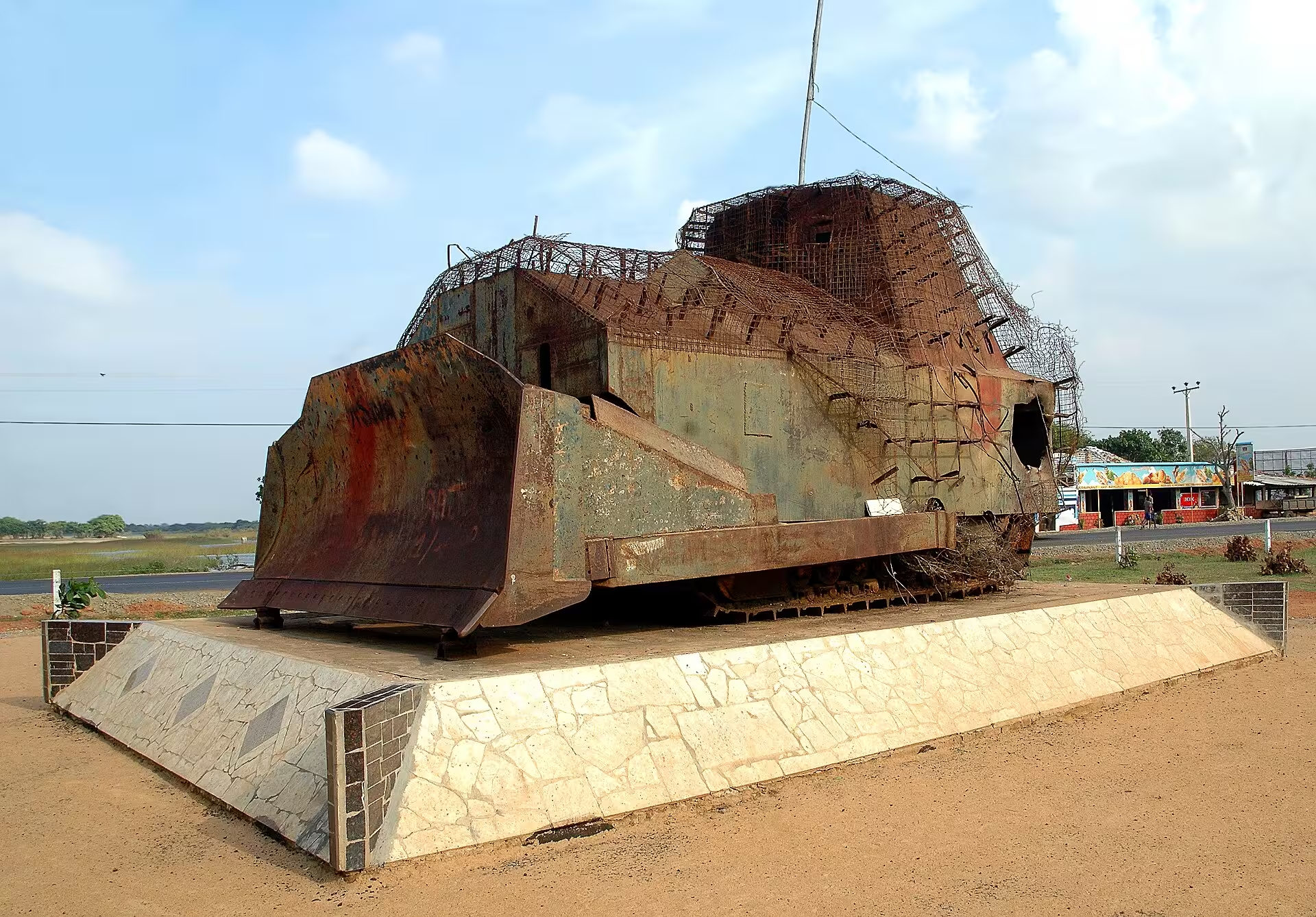
The end came on May 18, 2009, in Mullivaikal. Outnumbered and depleted of ammunition, the remaining LTTE forces were destroyed. Velupillai Prabhakaran, aged fifty-four, was killed alongside eighteen top commanders during a final ambush as they attempted to escape in an armored vehicle. His eldest son, Charles Anthony, was also killed in the final offensive. On May 19, 2009, the military released television footage of Prabhakaran’s body to provide proof of his death to the country. President Mahinda Rajapaksa formally addressed Parliament, declaring the end of the twenty-six-year war and the unification of the country.
| Conflict Phase / Parameter | Timeline | Primary Combatants | Key Turning Points | Estimated Human Cost |
|---|---|---|---|---|
| Eelam War I | 1983 – 1987 | SLAF vs. LTTE | Thirunelveli Ambush; Black July; Jaffna Siege. | ~10,000 deaths. |
| Indian Intervention | 1987 – 1990 | IPKF vs. LTTE | Jaffna Helidrop; Premadasa-LTTE arms deal. | 1,165 Indian soldiers; 5,000 Sri Lankans. |
| Eelam War II | 1990 – 1995 | SLAF vs. LTTE | Mass police executions; Rajiv Gandhi & Premadasa assassinations. | ~20,000 deaths. |
| Eelam War III | 1995 – 2002 | SLAF vs. LTTE | Central Bank Bombing; Katunayake Airport Raid. | ~40,000 deaths. |
| Ceasefire Period | 2002 – 2006 | Peace Monitors | Karuna Split; political assassinations; ISGA demands. | ~1,000 deaths. |
| Eelam War IV | 2006 – 2009 | SLAF vs. LTTE | Mavil Aru; Kilinochchi capture; Mullivaikal battle. | 40,000 to 70,000 Tamil civilians; 6,261 soldiers. |
The civil war left a legacy of deep-seated trauma. Over 100,000 people were killed, and millions were displaced over the course of the conflict. While the military victory ended the LTTE’s campaign of violence, it came at a high cost, leaving unresolved questions of accountability, thousands of missing persons, and a persistent search for political reconciliation.