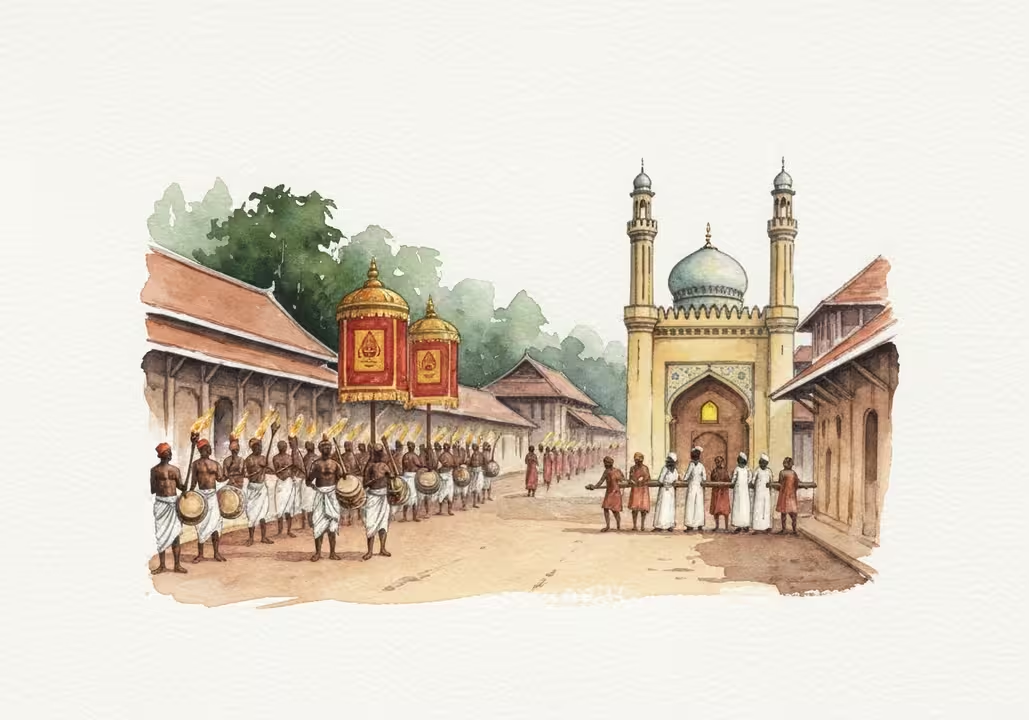
In the early hours of May 29, 1915, a Buddhist perahera procession wound its way through the ancient streets of Kandy, drums beating and torches flickering in the darkness. When the procession reached Castle Hill Street at 1 AM, the celebrants found their path blocked. The mosque stood illuminated, Indian Moors and Afghan traders forming a human barrier across the road, directing the procession to take a side street. What happened next would change the course of Ceylon’s history forever.
The Powder Keg: Years in the Making
The confrontation on Castle Hill Street did not emerge from nowhere. For over a decade, tensions had been building between Ceylon’s Sinhalese Buddhist majority and the Muslim community, particularly the Coast Moors who had recently arrived from India and established themselves as successful merchants and moneylenders. At the heart of the conflict lay what colonial authorities termed “noise worship” – the Buddhist tradition of processing through streets with drums, cymbals, and music.
The British Police Ordinance of 1865 had granted authorities the power to regulate religious processions, a provision that Sinhalese Buddhists viewed as specifically targeting their ancient customs. Between 1899 and 1915, at least fourteen confrontations over such processions had occurred between the two communities. Each incident added another layer of resentment, another grievance left to fester.
The immediate spark came from the courts. In June 1914, District Judge Sir Paul E. Peiris had ruled in favor of Buddhist temple authorities, permitting the Wallahagoda Dewala perahera in Gampola to proceed with music. The Buddhist lawyers, including E.W. Perera and D.R. Wijewardena, had argued that such rights were ancient customs protected by the Kandyan Convention of 1815, the treaty that had brought the Kandyan Kingdom under British rule.
But in February 1915, the Supreme Court overturned this decision. Justices Walter Shaw and Thomas De Sampayo ruled that subsequent legislation – the Police Ordinance and Local Boards Ordinance – superseded the protections of the Kandyan Convention. Emboldened by this legal victory, Muslim communities in Kandy felt justified in asserting their rights to prevent processions from disturbing worship.
The collision was inevitable.
Nine Days That Shook an Island
What began as a confrontation in Kandy on the night of May 28, 1915, exploded into island-wide communal violence within days. By May 30, the riots had spread to neighboring villages. On May 31, violence erupted in Colombo. For nine days, Ceylon burned.
The statistics, clinical in their precision, cannot capture the terror of those days: at least 25 people murdered, four women raped, 189 wounded. Over 4,000 Muslim shops were looted and destroyed. Three hundred and fifty homes reduced to ashes. Seventeen mosques set ablaze. The violence was targeted and systematic, directed primarily at symbols of Muslim economic success – the shops, the businesses, the visible markers of a community’s prosperity.
But the violence of the riots would pale in comparison to what came next.
The Iron Fist: Martial Law Descends
Governor Robert Chalmers, a career civil servant and Pali scholar who had spent thirty-one years in His Majesty’s Treasury before his posting to Ceylon, faced a terrible decision. The riots erupted while the First World War raged in Europe, and paranoia about colonial security ran high. Chalmers feared not just communal violence, but potential rebellion against British rule.
On June 2, 1915, martial law was declared, first in the Western and Sabaragamuwa Provinces, then rapidly extended across the island. The order was stark: police and military forces could shoot without trial anyone deemed a rioter. The British military, supplemented by European auxiliaries and Punjabi regiments from India, descended upon Ceylon with overwhelming force.
What followed was not just the suppression of riots – it was the systematic crushing of an entire generation of Ceylonese leaders.
Hundreds were arrested, but these were not common rioters. Among those seized were the future architects of Ceylon’s independence: F.R. Senanayake and his younger brother D.S. Senanayake, who would later become the nation’s first Prime Minister. The Buddhist reformer Anagarika Dharmapala, who happened to be in Calcutta during the riots, was placed under house arrest for five years. His brother Edmund Hewavitharana was arrested on trumped-up charges of treason and shop-breaking. Baron Jayatilaka, A.E. Goonesinghe, Charles Batuwanthudawe, and countless other educated middle-class leaders found themselves imprisoned without charges.
The British had reason for their paranoia about this group. Many of these men had been leaders in the Temperance Movement, a campaign against the opening of new arrack and toddy taverns that the colonial government used to raise revenue. Governor Chalmers and his administration viewed the temperance campaign as seditious – the first stirrings of a nationalist movement that could threaten British control. The riots provided the perfect pretext to decapitate this emerging leadership.
The Senanayake brothers were held for forty-six days without charges. Throughout the island, military tribunals delivered summary justice. The earliest and most infamous of these trials would create a martyr whose name would echo through Ceylon’s fight for freedom.
The Execution That Changed Everything
Captain Duenuge Edward Henry Pedris was twenty-seven years old, a Ceylonese militia officer and prominent socialite. On July 1, 1915, he was brought before a Field General Court Martial composed entirely of British officers from the 17th Punjab Regiment. The charge: treason by levying war against the King, based on allegations that he had fired two revolver rounds into the air.
The trial was swift. Within days, the verdict came down: guilty. The sentence: death by firing squad. The date of execution: July 7, 1915. No appeal was permitted.
The irregularities of Pedris’s case were glaring. The King’s Courts were open and functioning in Ceylon – there was no legal justification for trying a civilian before a military tribunal. The alleged offenses occurred on June 1, the day before martial law was declared on June 2, meaning the military law was being applied retroactively. Most damning of all, Brigadier General Leigh Malcolm failed to refer the case to Governor Chalmers, as regulations required.
Appeals flooded in from prominent citizens, both British and Ceylonese. The elected representative Sir Hector Van Cuylenberg made desperate representations. All were ignored. On July 7, 1915, Henry Pedris was executed by firing squad.
His death sent shockwaves through Ceylonese society. If a prominent militia officer from a respected family could be executed on questionable charges after a summary trial, no one was safe. The execution was intended as a warning. Instead, it became a rallying cry.
The Birth of a Movement
The British had miscalculated catastrophically. By August 30, 1915, when martial law was finally lifted, more people had died from police and military action than in the original riots. Governor Chalmers, perhaps recognizing the disaster his policies had created, simultaneously issued The Ceylon Indemnity Order in Council, 1915, legally protecting himself and others from consequences for actions taken during martial law. By December 1915, he was quietly removed from his post and transferred to Ireland. Four years later, he was raised to the peerage as Baron Chalmers – the British establishment taking care of its own.
But the damage to colonial authority was irreversible. The events of 1915 had accomplished what decades of scattered grievances could not: they had united the Ceylonese elite across ethnic and religious lines in opposition to British rule. The arrested leaders, imprisoned together, emerged with a shared purpose. The executed and detained became martyrs and heroes.
In 1919, just four years after the riots, the Ceylon National Congress was founded. Leaders of all communities – Sinhalese, Tamil, and Muslim – came together on a common platform to voice nationalist demands. Ponnambalam Arunachalam, a Tamil, was appointed its first president. The Congress united previously separate organizations like the Ceylon National Association (founded in 1888) and the Ceylon Reform League (founded in 1917) into a coordinated movement.
The men imprisoned in 1915 now led this movement. D.S. Senanayake, once arrested and held without charges for forty-six days, emerged as a central figure in the independence struggle. The temperance campaign that British authorities had sought to crush evolved into explicit demands for self-governance. The middle class, educated in British institutions and fluent in the language of constitutional reform, now turned those tools against their colonial masters.
Historians have drawn direct parallels between the 1915 riots and their aftermath and the Jallianwala Bagh massacre of 1919 in India. Both events demonstrated colonial brutality in response to civil disturbances. Both created martyrs. Both transformed diffuse nationalist sentiment into organized political movements. Both fundamentally delegitimized colonial rule in the eyes of the colonized and, increasingly, in international opinion.
The Long Road to Freedom
The path from 1915 to independence was neither straight nor simple. It would take three more decades of political organizing, constitutional negotiations, and persistent pressure. The Second World War would accelerate the process, as Britain, exhausted and indebted, could no longer maintain its far-flung empire.
But the seeds planted in 1915 bore fruit on February 4, 1948, when Ceylon became independent as a dominion within the British Commonwealth. D.S. Senanayake, the young temperance activist arrested during the 1915 crackdown, became the nation’s first Prime Minister. His brother F.R. Senanayake’s role in the independence movement was honored posthumously – he had died in 1925, before seeing the freedom for which he had fought.
Henry Pedris would wait even longer for vindication. For 109 years, his execution stood as a stain on both British and Ceylonese history. Finally, in September 2024, the President of Sri Lanka granted him a posthumous pardon, officially acknowledging the injustice of his death.
Legacy: The Double-Edged Sword
The 1915 riots and their aftermath occupy a complex place in Sri Lankan memory. On one hand, they mark the birth of the organized independence movement, the moment when scattered resistance coalesced into purposeful political action. The British overreach during martial law exposed the fundamental illegitimacy of colonial rule and created the leaders who would dismantle it.
Yet the riots also revealed and deepened fault lines within Ceylonese society that would haunt the nation long after independence. The communal violence between Sinhalese Buddhists and Muslims in 1915 prefigured the ethnic and religious conflicts that would plague independent Sri Lanka. The targeting of Muslim businesses, the organized nature of the violence, the conflation of economic resentment with religious and ethnic identity – all these patterns would recur throughout the twentieth century and beyond.
The supreme irony of 1915 is that the communal violence that divided communities ultimately united the Ceylonese elite against colonial rule, while the seeds of division it planted would grow to threaten the very nation that elite would create.
When the Buddhist perahera was blocked on Castle Hill Street that night in May 1915, no one present could have imagined the chain of events they were about to set in motion. A dispute over a procession route became a riot. A riot became a brutal crackdown. A crackdown became a cause. And a cause became a nation.
The temple drums that British authorities tried so hard to silence would beat again on February 4, 1948, celebrating not the passage of a religious procession, but the birth of an independent Ceylon. Yet even in that moment of triumph, the echoes of 1915 remained – both the promise of unity across communities that briefly emerged in the independence movement, and the specter of communal violence that had sparked it all.
History, as the 1915 riots demonstrate, is rarely simple. The same events can simultaneously birth a nation and sow the seeds of its future struggles. Understanding this complexity is essential for comprehending not just the path to Ceylon’s independence, but the challenges that independent Sri Lanka continues to face more than a century after those fateful nine days in 1915.