Introduction
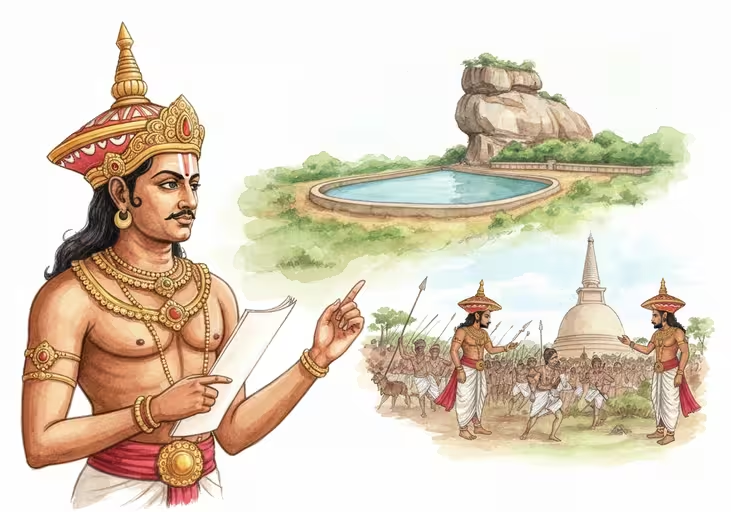
Vimaladharmasuriya I (1591-1604 AD) was the king of the Kandyan Kingdom, and for the first time, he brought the entire island under the rule of the Kandyan Kingdom. He was an eminent ruler who fought against the Portuguese, dedicated himself to uplifting Buddhism, and strengthened the economy.
Early Life and Accession to the Throne
King Vimaladharmasuriya, originally known as Konappu Bandara, was the son of a chieftain suspected of rebelling against the reign of King Rajasinghe I, who was then entrapped and executed. Thereafter, seeking protection from the Portuguese, he converted to Catholicism and was baptized under the name “Don Juan” (Don Juan of Austria).
He assisted the Portuguese, along with a claimant to the throne named Don Philip (Yamasinghe Bandara), to defeat King Rajasinghe I, who ruled from Sitawaka after subjugating the Up Country. However, the Portuguese appointed Don Philip as king, not him. Opposing this, Don Juan waited until the Portuguese left, then poisoned and killed Don Philip. It is also said that he threatened the Portuguese and drove them out of Kandy. Subsequently, he publicly renounced Catholicism and embraced Buddhism, becoming king of Senkadagala (Kandy) as “Vimaladharmasuriya I”.
He was the son of Weerasundara Bandara and is considered the founder of a new dynasty in the Up Country. Upon his accession, he faced various challenges, primarily the lack of a legitimate royal inheritance. This was resolved by marrying Dona Catherina, also known as Kusumasana Devi.
Conflicts with the Portuguese
The Portuguese, having reorganized with assistance from Goa, India, attacked the Up Country in 1594 with Dona Catherina (Kusumasana Devi). However, they were defeated at Danture and fled. Dona Catherina fell into the hands of King Vimaladharmasuriya’s army, and the king married her. He succeeded in defeating the Portuguese in the Battles of Danture and Balana, saving the Kandyan Kingdom from their grasp. He also acted to free the Up Country kingdom from Sitawaka’s influence in the Battle of Ganethenna.
Religious and Ecclesiastical Service
King Vimaladharmasuriya’s ecclesiastical service was outstanding. By bringing the Sacred Tooth Relic, which was hidden in a kurahan rock in Delgamuwa, Kuruwita, Ratnapura, to Senkadagala (Kandy), he established his legitimate claim to kingship and officially became the king of the entire island (although the coastal areas were still under Portuguese control). He pioneered the upliftment of the declining Buddhist dispensation by arranging for the reintroduction of Upasampada (higher ordination) from Burma. He renovated temples such as Gadaladeniya, Ridi Viharaya, and Lankathilaka.
Economic Development
King Vimaladharmasuriya took various measures to strengthen Sri Lanka’s economy. He took steps to develop farming and cotton cultivation. His economic reforms included the development of iron and steel industries in the Kothmale and Walapane regions, as well as the development of the saltpeter industry.
Alliance with the Dutch
The idea of forming an alliance to fight and expel the Portuguese was proposed by Dutch explorer Joris van Spilbergen. Following these discussions, Admiral Wybrand van Warwijck sent Sebald de Weert to launch a joint counter-attack. This alliance ended in tragedy. The Dutch, who behaved disrespectfully at an alcohol-fueled party, insulted the king, resulting in the death of all of them.
No opportunity arose for a new alliance until 1612. In 1612, the new Dutch representative, Marcellus de Boschouwer, made a treaty with King Senarat, who succeeded King Vimaladharmasuriya. This led to the beginning of the Dutch period of rule, which lasted from the expulsion of the Portuguese from Sri Lanka until the arrival and subjugation by the British.
Demise and Legacy
King Vimaladharmasuriya I died in 1604 AD from a sudden severe fever. He was a great king in Sri Lankan history. During his reign, the Kandyan Kingdom was strengthened, and he made a significant contribution to protecting the island’s sovereignty by successfully fighting against Portuguese dominance.