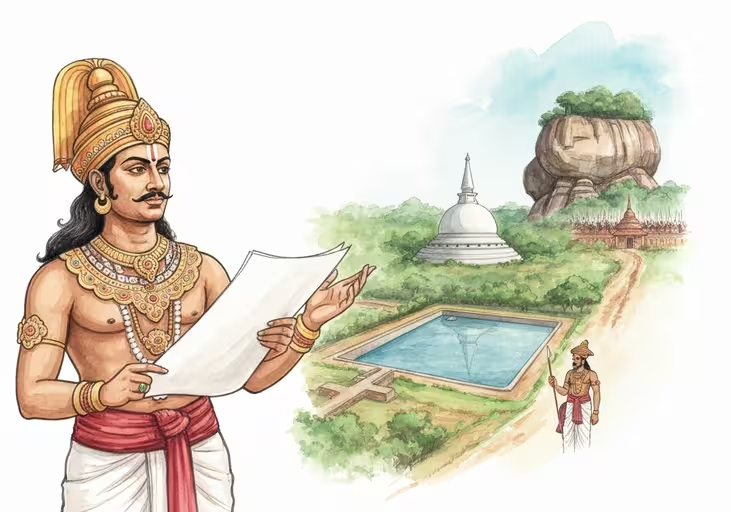
King Vasabha was a prominent ruler of the Anuradhapura period in Sri Lanka. He is historically recognized as a pioneer in building large-scale irrigation systems, which were crucial for rice cultivation. King Vasabha, who killed King Subharaja and seized the throne, initiated a new Lambakanna dynasty in the history of Sri Lankan kings.
Early Life and Accession to the Throne
Born into a family belonging to the Lambakanna tribe, Vasabha spent his childhood in the northern province of the country. At that time, he served his uncle, who was a commander in the king’s army. Fortune-tellers had informed King Subharaja, the then ruler of the country, that a person named Vasabha would defeat him and become king. To prevent this, King Subharaja ordered that all citizens bearing that name be killed.
Vasabha’s uncle attempted to take him to the king under the pretense of enlisting him for royal service. However, Metta, his uncle’s wife, who was aware of the king’s intentions, saved Vasabha from impending harm. Vasabha escaped into hiding and secretly gathered an army. Ultimately, in 67 CE, he led a rebellion against King Subharaja, killing both Subharaja and his uncle, and seized the throne. King Vasabha married his aunt, Metta, and ruled for 44 years until his death in 111 CE. His accession marked the beginning of the Lambakanna ruling dynasty.
Reign and Achievements
King Vasabha’s reign marked significant development in Sri Lanka. During his rule, 11 reservoirs and 12 canals were constructed. Due to a food shortage in the Krishna River valley of South India, there was a high demand for grain produced in Sri Lanka. To prevent such a situation from arising in his own country, he took steps to build large reservoirs. Among the reservoirs built by him are Mahawilachchiya, Manaketiya, Nochchipothana, Hiriwadunna, and Alahara Wewa.
Buddhist Religious Activities
In addition to renovating existing Buddhist monasteries, King Vasabha also constructed many new Buddhist temples. These demonstrate both his religious devotion and his commitment to enhancing the country’s religious infrastructure.
Expansion of the Kingdom
There is evidence that King Vasabha’s power extended throughout the entire island. He established the Vallipuram Gold Plate inscription. He also controlled Jaffna through the minister Isigiri. Inscriptions found from the Jaffna Peninsula in the north, Sithulpawwa in the south, Batticaloa in the east, and Kurunegala District in the west confirm his sphere of influence.
Legacy
It is mentioned that the Lambakanna Dynasty, which began with King Vasabha, ruled the island for 370 years. He is remembered as a visionary ruler who opened new avenues for irrigation and agriculture in Sri Lanka.