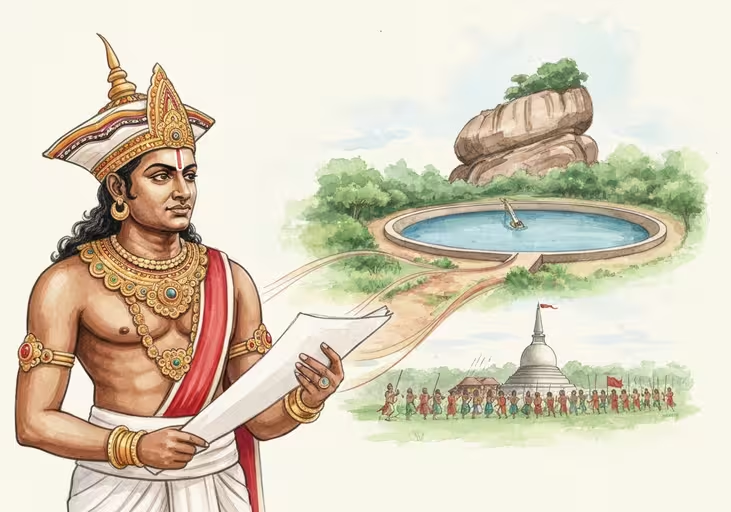
King Sri Vikrama Rajasingha (also known as Kannasamy) was the last king of Sri Lanka, ruling the Kandyan Kingdom from 1798 to 1815 CE. His reign marked the end of the Sri Lankan monarchy, which had lasted for over 2,300 years.
Birth and Background
Sri Vikrama Rajasingha was born in 1780 into a Nayakkar family in Madurai, South India. His original name was Kannasamy, and he was the son of Sri Venkata Perumal and Subbamma Nayaka.
Accession to the Throne
In 1798, when King Sri Rajadhi Rajasingha died without male heirs, an heir was chosen from a South Indian Nayakkar family, according to Kandyan Nayakkar tradition. The 18-year-old Kannasamy was brought to Kandy and enthroned as Sri Vikrama Rajasingha.
Challenges of the Reign
Foreign Origin
Sri Vikrama Rajasingha’s reign faced challenges from the very beginning:
- Tamil Origin: His South Indian origin caused displeasure among some Sinhala nobility.
- Language Barriers: He did not speak Sinhala or Tamil well in the early years.
- Cultural Differences: Challenges in adapting to Sinhala royal traditions.
British Threat
Sri Vikrama Rajasingha’s reign coincided with the period of British colonial expansion:
- 1796: The British acquired coastal areas from the Dutch.
- 1803: First British-Kandyan War - The Kandyans defeated the British.
- 1815: Second British-Kandyan War - Kandy was finally defeated.
The 1803 Kandyan War
In 1803, the British attempted to invade the Kandyan Kingdom. During this war:
- The British army reached Kandy.
- The Kandyan army used guerrilla tactics.
- The British army suffered heavily due to disease and treacherous routes.
- The Kandyans almost entirely annihilated the British force.
This victory was the zenith of Sri Vikrama Rajasingha’s reign.
Internal Issues
Over time, Sri Vikrama Rajasingha’s rule faced internal problems:
Relations with the Nobility
Some of the king’s actions led to displeasure among the Sinhala nobility:
- Katupana System: Punishing suspected chieftains by the sword.
- Loss of Trust: Executing many members of prominent noble families.
- Tamil Proximity: Showing greater affinity to his South Indian ties.
Ehelepola and the British Alliance
Some members of the Kandyan nobility began to conspire against the king:
- Displeasure: Fear and dissatisfaction with the king’s ruling style.
- Foreignness: Viewing his South Indian origin as a problem.
- British Connections: Some chieftains established secret contacts with the British.
Defeat in 1815
British Invasion
In 1815, the British launched a second major offensive against Kandy:
- Betrayal by Kandyan Nobility: Prominent noble families joined the British in conspiring against the king.
- Ehelepola’s Role: The Adigar (chief minister) assisted the British.
- Isolation: The king received no support from the army or the principal nobility.
The Kandyan Convention
On March 2, 1815, the Kandyan chieftains signed the Kandyan Convention with the British:
- Deposition of the King: Sri Vikrama Rajasingha was deposed from the throne.
- British Rule: The Kandyan Kingdom came under British rule.
- Religious Rights: Special protection was promised for the Buddhist religion.
On March 5, 1815, the British arrested Sri Vikrama Rajasingha.
Exile and Death
After his arrest:
- Vellore: Sri Vikrama Rajasingha was exiled to Vellore Fort in South India.
- Detainment: He and his family were kept under British supervision.
- Death: On January 30, 1832, he died in Vellore at the age of 52.
Legacy
Sri Vikrama Rajasingha’s legacy is complex and controversial:
Criticisms
- Katupana Crisis: Accusations regarding the execution of many members of the principal nobility.
- Weak Rule: Alienating the support of the nobility.
- Paving the Way for British Victory: Arguments that his actions contributed to the kingdom’s defeat.
Positive Aspects
- 1803 Victory: Defeating the first British attack.
- Protection of Buddhist Culture: Maintaining the Temple of the Tooth Relic and Buddhist institutions.
- Last Independent Ruler: Ending over 2,300 years of monarchy in Sri Lanka.
Historical Significance
Sri Vikrama Rajasingha’s defeat holds great significance:
- End of an Era: The end of over 2,300 years of Sri Lankan monarchy.
- Beginning of the Colonial Period: The start of 133 years of British colonial rule.
- Cultural Transition: The transformation between traditional Sri Lankan society and European colonial structures.
Today, Sri Vikrama Rajasingha remains a controversial figure in Sri Lanka, and his reign marks the end of independent Sri Lankan civilization and the beginning of the colonial era. His imprisonment and the signing of the Kandyan Convention are considered pivotal moments in Sri Lankan history.