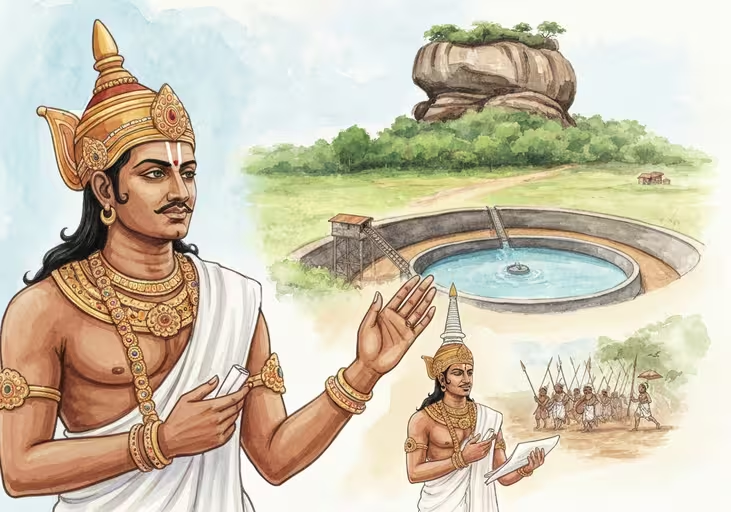
King Siri Sanghabodhi I
King Siri Sanghabodhi I, who ascended the Anuradhapura throne in 790 BE (247 CE) after King Sangha Tissa, is renowned as one of the most righteous rulers in Sri Lankan history. Governing by the Five Precepts, he faced numerous challenges but successfully overcame them. Ultimately, without any royal ambition, he made the supreme sacrifice of his life, embodying the character of an exalted Bodhisattva.
Accession to the Throne and Righteous Rule
Prince Siri Sanghabodhi, as the second eldest prince after King Sangha Tissa, ascended the Anuradhapura throne in 790 BE (247 CE). He was one of the most righteous kings mentioned in the history of Lanka and governed based on the Five Precepts. His righteous practices were so advanced that, at times, even the council of ministers might not have unanimously accepted them.
Calamities Faced and Their Suppression
During his reign, King Siri Sanghabodhi providentially faced numerous calamities.
Drought
Firstly, a severe drought spread across the country due to the lack of rain. Thereupon, the king performed an Act of Truth, lay down in the courtyard of the Great Stupa, and resolved to sacrifice his life to bring rain. Through his action, rain fell upon the country, and the people became happy and prosperous.
Bandit Activities
The emergence of bandit groups who robbed travelers was another major problem. Instead of punishing them like ordinary kings, King Siri Sanghabodhi explained their wrongdoings to the captured bandits, gave them wealth, and sent them away. He also brought dead bodies and displayed them to show that bandits were being punished.
Rakthakshiya Plague
Subsequently, a demon named Rakthakshiya began to sicken people and prey on them, devastating the country. Critics speculate that this might have been a severe fever (epidemic). The king, by the power of Dhamma, observed the Eight Precepts, summoned the demon, debated with him, and subdued him. In this way, King Siri Sanghabodhi suppressed all these calamities through his righteous power.
Abandonment of Kingship and Self-Sacrifice
However, after suppressing these calamities, King Siri Sanghabodhi could not maintain his reign for long. Prince Gothabhaya, who served as the king’s treasurer, conspired to kill the king and seize the kingdom. Since Gothabhaya believed that the king would rule for a long time due to the affection the people had for him, King Siri Sanghabodhi understood that Gothabhaya would oppose him out of royal ambition.
King Siri Sanghabodhi, devoid of royal ambition, allowed anyone who wished to claim the kingdom, and left Anuradhapura in the guise of an ascetic. Gothabhaya, who had taken over the kingdom, sent out a proclamation offering a thousand Kahavanu (gold coins) to anyone who brought him King Siri Sanghabodhi’s head. Criminals, eager to claim this reward, severed the heads of innocent people and presented them to the king, only to be eventually put to death themselves. The Mahavamsa states that King Siri Sanghabodhi’s act of offering his head took place at a monastery named Hatthavanagalla.
Legacy
No text mentions any other king who ruled Lanka making such a life sacrifice. It is clear that he was not merely a supreme human being, but an unparalleled ruler endowed with the character of a perfect Bodhisattva. Consequently, many Sinhala kings were prompted to use the epithet “Sri Sanghabodhi” at the beginning of their names. Accordingly, 19 rulers of the Anuradhapura kingdom and four kings of the Polonnaruwa era adopted the name “Sanghabodhi” as an adornment to their names. King Siri Sanghabodhi’s sacrifice remains an immortal event in Lankan history.