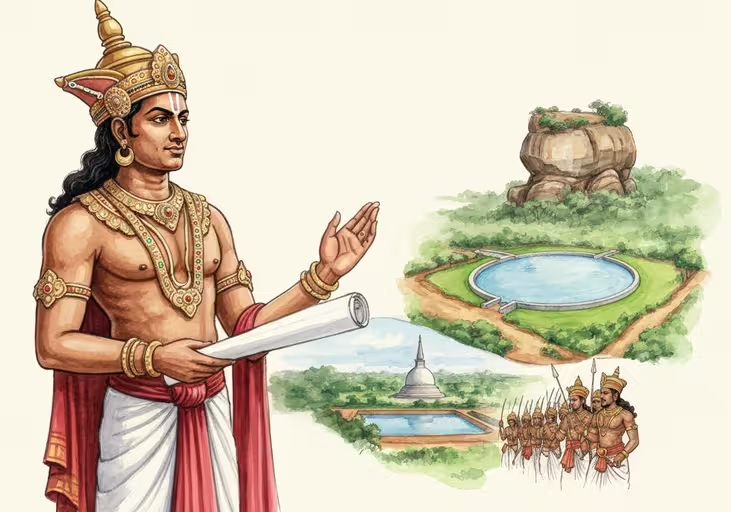
Siri Sanga Bo Dynasty
The Siri Sanga Bo Dynasty is an important royal lineage that existed for a long period in Sri Lankan history. Kings who ruled Sri Lanka from Vijayabahu III (AD 1220–1224), who reigned in Dambadeniya, to Rajasinghe I (AD 1581–1591), who ruled the Sitawaka Kingdom, belonged to this dynasty. This dynasty successfully faced numerous foreign invasions and managed to protect its independence for centuries.
The Rise and Establishment of the Dambadeniya Kingdom
During a time when the Polonnaruwa Kingdom was unstable due to Kalinga Magha’s cruel rule, the indigenous Sinhala people migrated to the southern regions and Maya Rata. Against this backdrop, a prince named Vijayabahu III, descended from the Siri Sanga Bodhi royal lineage, bravely fought against Kalinga Magha’s forces. He expelled Magha’s power from Maya Rata, established his fortress in Dambadeniya, and became king.
One of King Vijayabahu III’s main responsibilities was the protection of the Sacred Tooth Relic and the Alms Bowl of the Buddha. He retrieved these sacred objects, which had been safely hidden in Kotmale by Magha’s forces, and brought them to Dambadeniya. He made a significant contribution to rebuilding the ruined Buddhist Sasana and promoting its prosperity. King Vijayabahu III is considered the first king of the Siri Sanga Bo Dynasty.
Migration of the Capital and Safeguarding Independence
During the reign of the Siri Sanga Bo Dynasty, Sri Lanka faced various foreign invasions and internal conflicts. To protect their independence in the face of these challenges, the kings of this dynasty had to adopt various strategies. To defend against severe attacks, they also had to move their capital to strategically important areas such as Yapahuwa, Kurunegala, and Gampola. This enabled them to protect the kingdom from enemy attacks and maintain their continuous rule.
Decline of the Sitawaka Kingdom and the End of the Dynasty
The last king of the Siri Sanga Bo Dynasty was Rajasinghe I, a powerful warrior of the Sitawaka Kingdom. Rajasinghe, son of King Mayadunne, achieved many great victories in his early reign, but his later decisions during his rule led to the decline of the dynasty.
King Rajasinghe appointed a South Indian named “Aritta Kivendu” (Mannamperuma Mohattala) as his chief advisor. Mannamperuma encouraged King Rajasinghe to embrace Hinduism and advised him to attack Buddhist shrines. The attacks on sacred Buddhist sites like Sigiriya and Sri Pada caused great dissatisfaction and resentment among the Buddhist people and monks towards the king.
In response to these actions, Buddhists revolted, and King Rajasinghe suppressed the rebellion. It is stated that he arrested the leaders of the rebellion and killed hundreds of monks, including the Chief Monk of Sitawaka. These cruel acts caused a significant rift between the Buddhist people and the king.
Furthermore, the assassination of Veerasundara Bandara, King Rajasinghe’s Udarata representative (Samanta), was another problem. Konappu Bandara, Veerasundara Bandara’s son, fled from Sitawaka to the Portuguese forces in Mannar. Later, with Portuguese support, he returned to the Kandyan Kingdom and rebelled against Rajasinghe. Konappu Bandara became the king of the Kandyan Kingdom under the name Vimaladharmasuriya I. Although Rajasinghe attempted to recapture the Kandyan Kingdom, King Vimaladharmasuriya thwarted all his efforts, including the Battle of Balana.
In March AD 1592, while returning from Balana to Sitawaka, King Rajasinghe died from poisoning after pricking his foot with a bamboo thorn in the Pethangoda garden. As he had no sons (this is one theory only), his kingdom was inherited by King Vimaladharmasuriya I. This marked the political end of the Siri Sanga Bo Dynasty.
Current Descendants
It is said that the descendants of Princess Waskaduwe Thammita Bandara (Dharmasena) belonging to the Sitawaka lineage, and the Thudugala Muditha Thennakoon lineage (Wijewardena) of the Kotte lineage, as well as the Corea lineage descended from Ulakudaya Devi of Chilaw, are still alive and belong to the Siri Sanga Bo lineage.
Sources
- Varshakhandarastra by Ven. Waskaduwe Sri Subhuti Thero - 1875