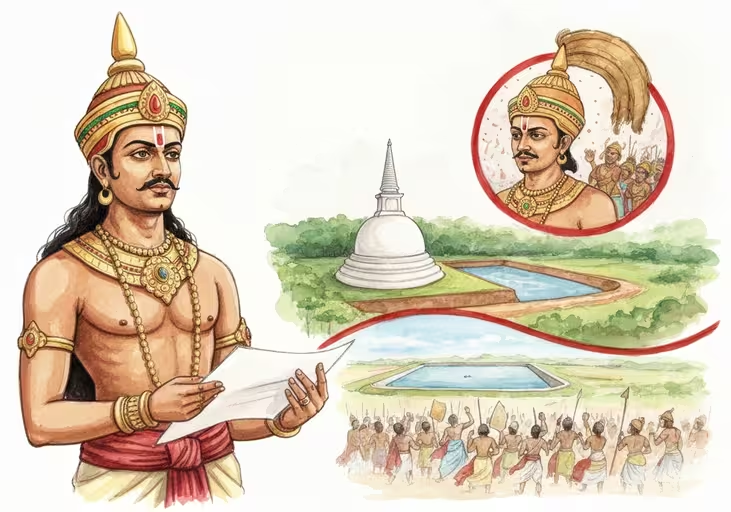
King Rajasinghe I (born Prince Tikiri Bandara) was one of the most renowned and powerful rulers of the Sitawaka Kingdom. History records his great courage, patriotism, and strong anti-Portuguese policy. He is considered the first Asian king to fight against and defeat a European power.
Early Life and the Acquisition of the Title “Rajasinghe”
Born as Tikiri Bandara to King Mayadunne, he received the title “Rajasinghe” after the fierce battles fought against the Portuguese forces. This name implies the meaning “King of Lions” or “Royal Lion.” Like his father, King Mayadunne, he pursued a strong anti-Portuguese policy.
Accession to the Throne
King Mayadunne transferred his kingdom to King Rajasinghe in 1578, and King Mayadunne passed away in 1581. Thereafter, King Rajasinghe ascended the throne.
Parricide Controversy
There are conflicting reports in various sources regarding King Rajasinghe’s involvement in the death of his father, King Mayadunne. The 4th chapter of the Mahavamsa, written by Tibbotuwawe Buddarakkhita Thero during the reign of Kirti Sri Rajasinghe, states that King Rajasinghe killed his father Mayadunne. The Chulavamsa also mentions that Buddhist monks considered this an act of parricide, leading to conflicts between the king and the monks, and as a result, the king adopted an anti-Buddhist policy.
However, historical critics believe that the absence of this parricide incident in important sources like the Rajavaliya and Alakeshwara Yuddhaya makes the accusation of the king killing his father dubious and controversial. Even Ribeiro did not report any parricide by the king. According to Queyroz’s detailed account, King Mayadunne died of natural causes at the age of 85. Thus, many historians opine that the accusations against King Rajasinghe of committing parricide are controversial and doubtful.
Battles and Military Victories
King Rajasinghe I’s reign was predominantly marked by wars fought against the Portuguese and with regional leaders.
Battles with Prince Vidiye Bandara
One significant exploit of Prince Tikiri Bandara was the conflict with his brother-in-law, Prince Vidiye Bandara. King Mayadunne initiated this war due to Prince Vidiye Bandara insulting his daughter and failing to support the war against Kandy (Sengkadagala). Sitawaka forces, led by twelve-year-old Prince Tikiri Bandara, allied with the Portuguese, attacked Prince Vidiye Bandara’s stronghold at Pelanda and drove him as far as Devundara. Later, after a terrible battle at Alutnuwara, Prince Tikiri Bandara decisively defeated Prince Vidiye Bandara. Following this victory, Prince Tikiri Bandara received the title “Rajasinghe.”
Wars Against the Portuguese
King Rajasinghe’s primary warfare was conducted against the Portuguese to protect the sovereignty of the Sinhala kingdom.
- Battle of Mulleriyawa (1562 AD): In the Battle of Mulleriyawa, considered one of the most brutal battles to date, the Sinhala forces defeated the entire Portuguese army. According to accounts, the Mulleriyawa battlefield was stained red with the blood of Portuguese soldiers. This is recorded as the most severe defeat suffered by a European army on Asian soil. 1700 Portuguese soldiers, including Pereira de Lacerda, were annihilated in this battle.
- Sieges of Colombo Fort: The king, a constant thorn in the side of the Portuguese, besieged and attacked Colombo Fort twice, in 1581 and 1587. However, due to the lack of a royal navy, the objective of expelling the invaders from the country could not be fully achieved through these sieges.
Against Kandy (Sengkadagala)
While Rajasinghe was waging his war against the Portuguese, King Karaliyadde Bandara utilized Portuguese soldiers to protect his Kandyan (Sengkadagala) Kingdom. Angered by this association with the Portuguese invaders, King Rajasinghe, with the help of Weerasundara Mudali of Peradeniya, led his army to Balana Pass in 1583 and drove out Karaliyadde Bandara.
Fall of the Sitawaka Kingdom
Towards the latter part of King Rajasinghe’s reign, several factors contributed to the decline of the Sitawaka Kingdom.
Religious Policies
The king appointed a person of South Indian origin named Aritta Kiveṇḍu as his chief priest and acted according to his advice. The king bestowed upon this priest the title “Mannamperuma Mohattala” and also arranged for him to marry the daughter of one of his consorts. It is reported that the king embraced Hinduism and settled Brahmins in important Buddhist sacred sites like Sigiriya and Sri Pada. Furthermore, it is mentioned that, under the guidance of Mannamperuma Mohattala, the king destroyed several Buddhist temples. The king’s cruel actions against the Buddha Sasana caused dissatisfaction and opposition among the Sanghanayaka Theros and the Buddhist people, which was a major factor contributing to the downfall of the kingdom.
Rebellions and Internal Conflicts
Due to the king’s anti-Buddhist policy, anti-royal rebellions even arose with the intervention of the Sanghanayaka Theros. In the Sat Korale region, Prince Potupala Bandara, with Portuguese support, revolted against the king. According to the Mandarampura Puvata, Buddhist monks also intervened to make Prince Konappu Bandara king of Kandy (Sengkadagala). The text states that after this conspiracy was revealed, hundreds of monks were killed, and on one occasion, 121 monks were slain by King Rajasinghe. Thus, the blessing of the Maha Sangha, which was a major reason for the public support received by King Mayadunne and Prince Tikiri Bandara, was very quickly lost.
Battle and Defeat Against Konappu Bandara
Prince Konappu Bandara, who arrived in Kandy (Sengkadagala) from Mannar, led a rebellion there. Konappu Bandara defeated both the contingent sent first under Aritta Kiveṇḍu and, subsequently, the army led by King Rajasinghe himself. According to the Rajavaliya, King Rajasinghe retreated, stating that he had never seen a king fight so valiantly.
Demise
After the defeat at Balana Pass, the retreating king died in March 1592. The cause of death was a severe injury sustained from being pierced by a bamboo thorn in the Pethangoda garden while returning to Sitawaka. According to some sources, while ill from the bamboo thorn injury, a sorcerer named Dodampe Ganithaya poisoned the king. The king’s body was interred in Sitawaka, the capital at the time.
Legacy
After the death of King Rajasinghe I, the Sitawaka Kingdom became unstable due to the lack of a definite heir. Although King Rajasinghe was a skilled general and a powerful ruler, historians believe that his religious policies and conflicts within the royal family contributed to the downfall of the Sitawaka Kingdom. Nevertheless, he is considered a prominent king in Sri Lankan history due to his relentless efforts to fight against Portuguese invaders and protect the country’s sovereignty.