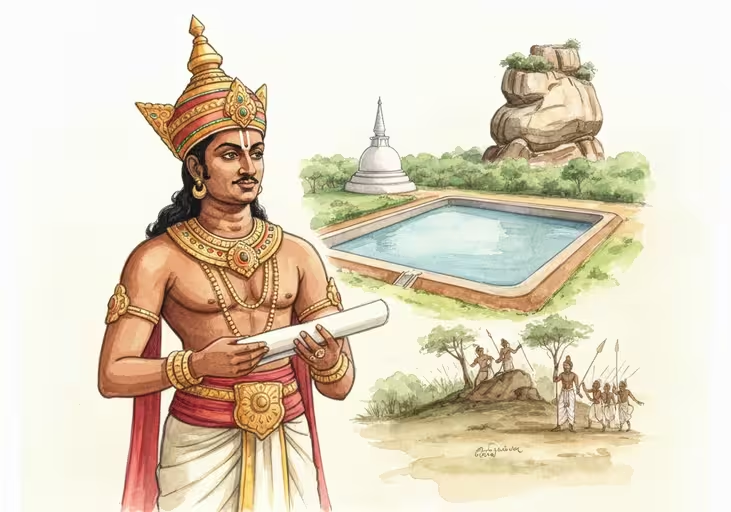
King Nissankamalla
Introduction
King Nissankamalla, also known by the names Kirti Nissanka and Kalinga Lokeshvara, ruled Sri Lanka for nine years from 1187 to 1196 CE. As the successor to King Maha Parakramabahu, he was a foreign prince of the Kalinga dynasty who came from Kalinga, India. The king carried out significant constructions such as the Nissanka Lata Mandapaya, Hatadage, and Rankoth Vehera, and also restored numerous ancient temples and tanks.
Sources of Information about King Nissankamalla
For anyone researching King Nissankamalla, information can be obtained from both literary sources and rock inscriptions.
Literary Sources
Among literary sources, the second part of the Mahavamsa holds a unique place. The Pujavaliya, written by Ven. Buddhaputra, the chief incumbent of the Mayurapada Pirivena during the Dambadeniya era, also provides a wealth of information about King Nissankamalla. According to the Pujavaliya, King Nissankamalla is mentioned as follows:
”… having slain him, King Kirti Sri Nissankamalla, who came from Kalinga, accumulated much merit and ruled for nine years.”
Furthermore, literary sources such as Rajavaliya, Dalada Sirita, and Rajaratnakaraya also provide important information about the king.
Inscriptions
Among the sources providing information about King Nissankamalla, rock inscriptions also hold a special place. The credit for erecting the highest number of rock inscriptions in Sri Lanka belongs to King Nissankamalla. Among the inscriptions set up by the king, the Gal Asana inscription at Giritale, the Galpotha inscription, the Weligahawatta inscription, the Katugahagalle inscription, and the Rameswaram inscription hold prominent positions. These inscriptions reveal a wealth of important information, such as King Nissankamalla’s circumambulation of the three kingdoms, his bringing prosperity to the distressed people of Lanka, his conquest of the Pandyan kingdom, and his reception of tributes from foreign states.
Archaeological Remains
Another important medium providing information about King Nissankamalla is archaeological remains. Constructions such as the Nissanka Lata Mandapaya, Hatadage, and Vatadage bear witness to his reign.
Overcoming Challenges as a Foreign Ruler
As a foreign noble, it was very difficult for King Nissankamalla to ascend to power in this country. Since the Sri Lankan people did not approve of a foreign ruler governing the country, the king had to become a prominent figure among the people. For this, he used various strategies and epithets.
Use of Epithets
King Nissankamalla, in order to build his prestige,