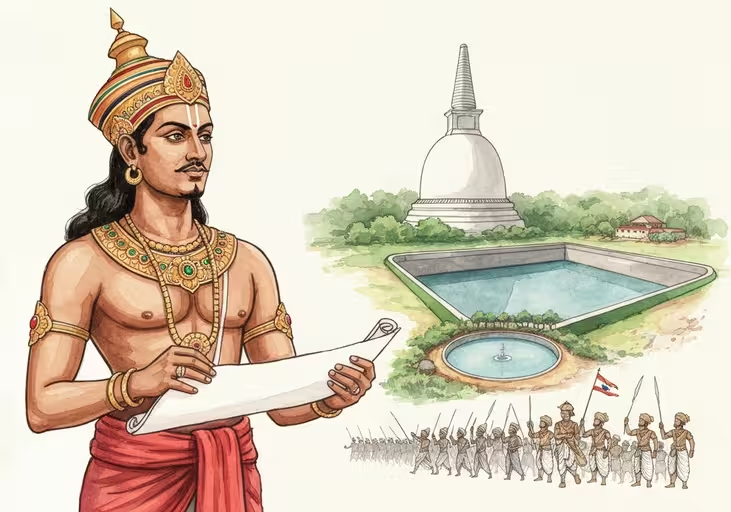
King Mayadunne was a prominent warrior-ruler in Sri Lankan history. He was the first ruler of the Kingdom of Sitawaka, which emerged in the early 16th century following the collapse of the Kotte Kingdom. King Mayadunne played a significant role in defending indigenous independence by offering strong resistance against Portuguese invasions. His reign marked the rise of the Sitawaka Kingdom and a period that brought about major changes in the political power balance of the island.
Early Life and Accession to the Throne
In the early 15th century, the Kotte Kingdom was a major power in Western Sri Lanka under King Parakramabahu VI. However, the political situation became critical with the arrival of the Portuguese in Sri Lanka in 1505, and their commencement of building a fort in Colombo by 1518.
During the ‘Wijayaba Kollaya’ (Pillage of Wijayaba) in 1521, a palace coup launched by the three sons of King Vijayabahu VII of Kotte (1509–1521), the king was overthrown. This coup, carried out to prevent Devaraja from ascending to the throne, resulted in the eldest son, Bhuvanekabahu VII, being enthroned. The other two sons, Mayadunne and Pararajasinghe (Raigam Bandara), partitioned the Kotte Kingdom. Accordingly, Mayadunne began ruling Sitawaka, while Pararajasinghe ruled the Kingdom of Raigama. Thus, the Kingdom of Sitawaka was established in 1521.
Initially, the Kingdom of Sitawaka comprised a relatively small territory including Kosgama, Ruwanwella, Yatiyantota, Hanwella, Padukka, Eheliyagoda, Kuruwita, and Ratnapura. The capital, Avissawella, was situated in a hilly region.
The Rise of the Sitawaka Kingdom
After ascending to the throne, King Mayadunne strongly challenged the dominance of the Kotte Kingdom and the Portuguese. In 1537, he attempted to capture Kotte, but Mayadunne’s forces were defeated by the armies under Afonso de Sousa, the Portuguese Captain-General in Colombo. The fleet sent from Calicut to assist Mayadunne was also defeated by the Portuguese at Vedalai.
Following this conflict, a temporary ceasefire was agreed upon between Sitawaka and Kotte. King Mayadunne’s next focus was on the southern Kingdom of Raigama. After the death of Raigam Bandara (Pararajasinghe) in 1538, King Mayadunne annexed the Kingdom of Raigama into Sitawaka. This was an important step in the territorial expansion of the Sitawaka Kingdom.
Conflicts with the Portuguese and Kotte
During King Mayadunne’s reign, several more invasions were launched against the Portuguese and the Kotte Kingdom. An attempt to invade Kotte in 1539 was thwarted by counterattacks organized by Miguel Ferreira, the new Portuguese Captain-General in Colombo. On this occasion, Calicut again supplied troops and weapons to Sitawaka. However, after the defeat, with the surrender of two Calicut generals to the Portuguese, the alliance between Calicut and Sitawaka came to an end.
In 1543, King Bhuvanekabahu of Kotte naming his grandson Dharmapala as his successor spurred King Mayadunne to another invasion. However, Mayadunne’s forces were defeated with the support of Portuguese troops under the command of the new Captain-General António Barreto.
Portuguese interference in Kotte’s internal politics further intensified in 1550 with the arrival of Portuguese Viceroy Afonso de Noronha and a force of 500 soldiers. Later that year, the Portuguese plundered the city of Sitawaka but failed to hold it.
Legacy
King Mayadunne ruled Sitawaka until his death in 1581 CE, and his son, King Rajasimha I, succeeded him to the throne. King Mayadunne’s reign symbolized indigenous resistance against the Portuguese and marked a significant milestone in the medieval history of Sri Lanka.