Introduction
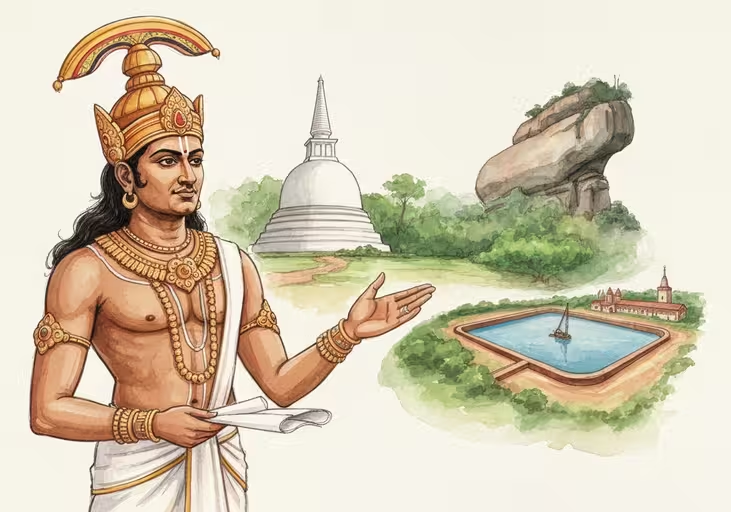
King Mahasena, also known as Mahasen, was a powerful ruler of Sri Lanka who reigned over the Anuradhapura Kingdom from 276 to 303 CE. Also renowned among the people as the god Minneri, he was a ruler who rendered immense service to the island’s irrigation sector.
Early Life and Religious Policies
Prince Mahasen was the younger son of King Gothabhaya and, from childhood, associated with a monk named Sanghamitta, who resided at the Abhayagiri Vihara. After becoming king, following the advice of Thera Sanghamitta, he leaned towards Mahayana Buddhism. This led to a severe religious conflict with the Mahavihara monks.
Venerable Sanghamitta convinced the king that the Mahavihara monks were not following the true Vinaya prescribed by the Buddha. For this reason, King Mahasena decreed punishment for anyone who provided food to the Mahavihara monks, and as a result, the Mahavihara monks left Anuradhapura and went to the southern part of the country (Rohana).
Destruction of the Mahavihara
Upon the advice of Bhikkhu Sanghamitta, the king authorized the destruction of the Mahavihara and the Lohapasada (Lower Great Edifice), which had been abandoned by the Mahavihara monks. Venerable Sanghamitta sent soldiers to demolish the Mahavihara and Lohapasada. Building materials obtained from these two structures were used for the construction of buildings at the Abhayagiri Vihara. (Note: The original Mahavihara was built by King Devanampiyatissa for Arahant Mahinda, and by the time of King Mahasena, it was destroyed about six hundred years later.)
Revolt of Minister Meghavarnabhaya
The destruction of the Mahavihara caused great hardship in the country. One minister, Meghavarnabhaya, a close friend of the king, went to Rohana, gathered an army, and initiated a rebellion against the king. The king arrived with his defense forces. Both parties camped on opposite sides of the Duratissa reservoir. At night, the minister went to the king’s camp and introduced himself, and the king gave him a warm welcome. The two ate and conversed together. When the king asked the reason for the rebellion, the minister stated that the destruction of the Mahavihara had made him a rebel.
The king apologized for his actions and promised to reconstruct the Mahavihara. Thus, the rebellion was quelled.
Death of Sanghamitta
After the destruction of the Mahavihara, Bhikkhu Sanghamitta came with people to demolish the Thuparama. At this point, one of the king’s consorts offered money to have Sanghamitta killed. Workmen assassinated Sanghamitta, and the Thuparama was saved from destruction.
Reconstruction of the Mahavihara
As promised, the king rebuilt the Mahavihara. The monks who had left the Mahavihara returned and resided there.
Construction of Jetavanarama
Thera Tissa (the chief monk of Dakkhinarama), a friend of Sanghamitta, encouraged the king to construct a large stupa (Jetavanarama) on land belonging to the Mahavihara. Although the Mahavihara monks tried to stop this act, they were unable to prevent it. Jetavanarama was built on land belonging to the Mahavihara, and by dedicating it to Thera Tissa, the Jetavana Nikaya (sect) was established in Lanka. Jetavanarama was larger than both Ruwanweliseya and Abhayagiri Stupa.
Irrigation Constructions
Despite the religious crises, King Mahasena made a significant contribution to irrigation technology in Sri Lanka. He constructed 16 reservoirs and several canals.
Major Reservoirs Constructed:
- Minneriya Tank (Manihira) - approximately 4560 acres in size.
- Mahagama Tank
- Chalura Tank
- Khan Tank
- Mahamani Tank
- Kokavata Tank
- Dhammarama Tank
- Kumbalaka Tank
- Vanana Tank
- Rathmalakandu Tank (identified as Padaviya Reservoir)
- Tissa Vadaman Tank (identified as Kaudulla Reservoir)
- Velangavitti Tank
- Mahagalkadawala Tank
- Seera Tank
- Mahadaragallaka Tank (identified as Nachchaduwa Reservoir)
- Kalapasana Tank
- Hulugalla Tank
- Hiramulla Tank
- Hurulu Tank
- Maminiya Tank
- Magala Tank
- Kalawana Tank
- Merawapiya Tank
Major Canals Constructed:
- Pabbatanta Canal
- Rideebendi Canal
- Thalawatu Canal
Alahara Canal
The Alahara Canal scheme was initiated by King Vasabha, and King Mahasena developed it to its current state. Neglected for centuries, this canal was later restored by British Governor Henry Ward. Originating from the Amban River near Alahara, the Alahara Canal flows north, supplying water to large reservoirs such as Minneriya, Giritale, and Kanthale. The total length of this canal is 54 miles, and its width varies from 70 to 200 feet. It is considered one of the greatest canals built in the ancient world. Sir Emerson Tennent even described it as: “excepting the Lake Moeris and the mysterious Labyrinth of Al Aram in Egypt, no other work of this class, of such prodigious dimensions, has been constructed by any race of mankind.”
Legacy
According to the Mahavamsa, King Mahasena accumulated many merits as well as many demerits. Although he was the first king to destroy the Mahavihara, the people later regarded him as a deity. Even today, two thousand years later, the people of Sri Lanka refer to him as Mahasen Deviyo or Minneri Deviyo. Some even interpret his era not as an era of Buddhism in Sri Lanka, but as an era of the Buddha’s dispensation.