Introduction
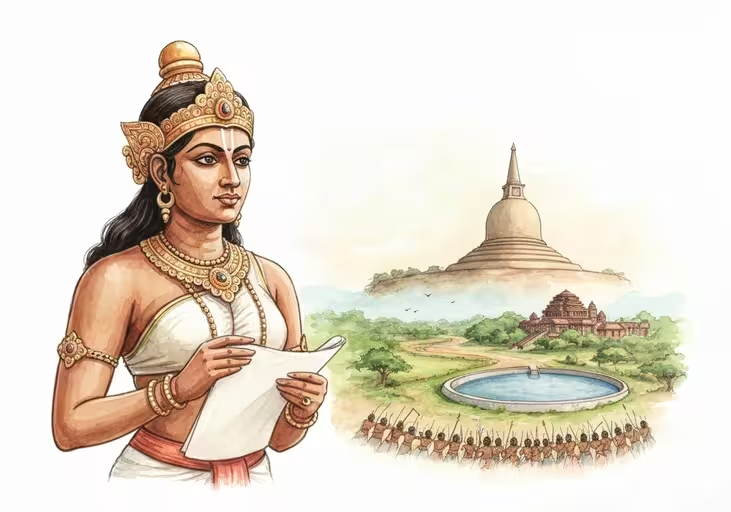
Queen Lilavati (CE 1197-1200, 1209-1210, 1211-1212) stands out as the second woman in Sri Lankan history to rule independently. She was the chief consort of King Parakramabahu the Great of Polonnaruwa, and after his death, amid severe political instability in the country, she ascended to the throne and ruled as the chief queen of Lanka several times. Information about her life and rule is mainly found in the Chulavamsa, particularly in its 80th chapter. Her reign coincided with the decline and collapse of medieval Sinhala state power.
Early Life and Family Background
Information about Queen Lilavati’s birth and childhood is scarce in the Chulavamsa. However, it is clear that she was the daughter of Prince Sri Vallabha and his wife Sugala. She also had a brother named Manabharana. During her youth, there was intense political instability in Lanka. Although King Vijayabahu I expelled the Chola empire and re-established the Rajarata kingdom, the island later became divided into three parts: Rajarata, Dakkhinadesa, and Ruhuna. During this period, Princess Lilavati met Prince Parakramabahu, who was both her cousin and future husband. Parakramabahu was the son of Manabharana, the sub-king of Dakkhinadesa. There is no clear information about when Lilavati and Prince Parakramabahu got married.
Relations between Lilavati’s family, especially her brother Manabharana of Ruhuna and her mother Queen Sugala, and Parakramabahu were not very good. Manabharana fought with Parakramabahu on several occasions. There is no mention of what actions Queen Lilavati took during these periods of conflict.
As Chief Consort of Parakramabahu the Great
Information about Queen Lilavati’s activities during the powerful reign of King Parakramabahu the Great (Parakramabahu I) is also scarce. As chief consort, she would have held a high status within the royal palace. Although the throne should have been inherited by her children, the Chulavamsa does not even speculatively mention that she had children by King Parakramabahu. It is conceivable that she may have even participated in military campaigns with the king, but there is no definite information about this.
Periods of Reign
After the death of King Parakramabahu, the political situation in Lanka became extremely unstable. It was at this juncture that Queen Lilavati re-enters historical records.
First Reign (CE 1197-1200)
After the death of King Nissankamalla (CE 1187-1196), his younger brother Vikramabahu became king. A few months later, he was deposed by his nephew, Chodaganga. Kitti, a powerful general at the time, also deposed Chodaganga, and instead of taking power himself, he had Queen Lilavati consecrated as queen. According to the Chulavamsa, the first three years of her reign were considered without fault. This may have been due to her superior lineage as the chief consort of King Parakramabahu, compared to others who claimed the throne. However, on August 23, CE 1200, she was deposed by Sahasamalla, a prince of the Okkaka dynasty.
Second Reign (CE 1209-1210)
After Sahasamalla was deposed, a military chief named Ayasmanta, like General Kitti, refused the kingship and handed the throne to Kalyanavathi, the chief consort of Nissankamalla. Later, the child Dhammasoka also became king under Ayasmanta’s guardianship. However, in CE 1209, Ayasmanta and Dhammasoka were killed by a Chola invading army that arrived under Anikanga Mahadipada.
Fourteen days later, Queen Lilavati once again rose to prominence due to the killing of Anikanga by a military chief named Vikkanta Samunakka. The Chulavamsa refers to this military chief as a “villain.” It states: “The villain slew the king named Anikanga. Thereafter, the queen Lilavati, chief consort of Parakramabahu, who had formerly reigned, ruled the country for a year.” In CE 1210, a South Indian army (“a great Tamil army from the opposite shore”) arrived under the leadership of Lokissara and deposed Lilavati from the throne.
Third Reign (CE 1211-1212)
In CE 1210, Lokissara brought the whole of Lanka under his command and ruled the country for nine months, after which he was deposed by the military leader Parakrama. This “person of great power and might” re-instated Queen Lilavati to the throne as queen in CE 1211. It can be assumed that she was favored by the Chulavamsa authors, as it states: “The royal dynasty shone with royal glory as long as the sun and moon endured.” This final period of her reign was limited to seven months. She was deposed by Parakrama Pandyan, her own blood relative, who then became the king of Rajarata.
Death
After her deposition by Parakrama Pandyan, nothing further is mentioned about Queen Lilavati in historical records. While there is no mention of Parakrama Pandyan having her killed, it is speculated that Magha, who arrived as an invader and is known as a cruel ruler in CE 1215, might have done so. Magha’s invasion marked a crucial turning point in the royal history of Sri Lanka.
Significance and Legacy
Queen Lilavati’s life and reign coincided with the decline and fall of medieval Sinhala state power. In the twenty-six years following her husband’s death, nine rulers ascended the throne, and three South Indian Chola and Pandyan invasions occurred. The prestige that Lilavati’s lineage (the Sinhala-Pandyan dynasty) had gained by expelling the Cholas and establishing an indigenous state was shattered during this unstable period.
She clearly belonged to the Sinhala-Pandyan dynasty, to which Vijayabahu I also belonged, while Nissankamalla, Vikramabahu, Chodaganga, Queen Kalyanavathi, and Dhammasoka represented the Kalinga lineage. Queen Lilavati is prominently mentioned as the last significant ruler of the great Sinhala-Pandyan royal lineage that unified Lanka and rebuilt indigenous power. After her reign, with the invasion of the cruel Magha (CE 1215 - 1236), the island became fragmented into several competing kingdoms.
In Zoology
In honor of her name, an endemic armored spider from Sri Lanka, belonging to the family Tetrablemmidae, has been named Shearella lilawati.
Sources
The Chulavamsa is the primary historical source providing information about Queen Lilavati, with its 80th chapter being particularly important.