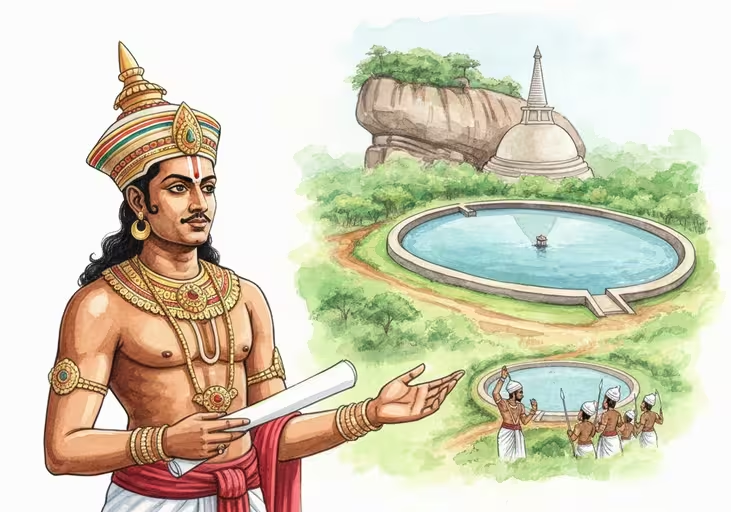
King Kirti Sri Rajasimha
Introduction
King Kirti Sri Rajasimha was the elder brother of King Vijayarajasinghe’s wife. He came from the city of ‘Madurai’ and is considered another brother-in-law who succeeded his brother-in-law to the throne. The second ruler of the South Indian royal lineage, he ascended the throne as a young man in 1751 CE.
Religious and Literary Services
The early period of his reign was primarily dedicated to the advancement of literature and religious affairs.
- Establishment of the Siam Nikaya: With the support of the Dutch, he invited Buddhist monks from Siam (Thailand) for the propagation of Buddhism. This led to the establishment of the Siam Nikaya, one of the main Buddhist sects in Sri Lanka. According to the Siam Nikaya, the position of Sangharaja was bestowed upon Ven. Saranankara.
- Construction of Viharas: He had the Kandy Rajamaha Vihara (Gangaramaya) constructed. Furthermore, he built the inner shrine for the Sacred Tooth Relic, which can be seen today.
- Completion of the Mahavamsa: He arranged for the completion of the Mahavamsa chronicle, detailing events from the reign of King Vikramabahu IV up to his own period.
- Development of the Dalada Perahera: Another significant service by King Kirti Sri Rajasimha was the integration of the processions of the four great devales—Natha, Vishnu, Kataragama, and Pattini—into the Dalada Perahera.
Conflicts with the Dutch
The King’s reign was a period marked by struggles against Dutch influence.
Attacks on Dutch Forts
In 1761 CE, King Kirti Sri Rajasimha attacked and destroyed Dutch forts and garrisons in places such as Matara, Katuwana, Tangalle, Marakade, and Urubokka, killing many Dutch soldiers. Those who surrendered were imprisoned.
Dutch Counter-attacks
In retaliation for this act, Van Eck, who had been appointed as the new governor, quickly planned an attack on Kandy. However, due to defensive strategies and the weakness of his troops, his invasion was unsuccessful. Nevertheless, the Dutch attacked Kandy again in 1764 CE and 1765 CE.
Peace Negotiations and Seeking British Support
In early 1763, the Dutch were primarily focused on consolidating their power, gradually driving the Kandyan people out of the territories they had conquered. Throughout 1763, the King continuously sought peace, sending his envoys to the Dutch to negotiate terms.
The Dutch governor expected the King to cede the Three Korales, Four Korales, and Seven Korales, as well as Puttalam, thereby handing over complete control of the coastal areas. However, the King could not be persuaded to agree to these demands. The King refused to do anything that would compromise the independence of his kingdom. The King deliberately delayed reaching an agreement, hoping for assistance from the English in Madras. In 1762, he had discussions and exchanged ideas with John Pybus regarding this matter.