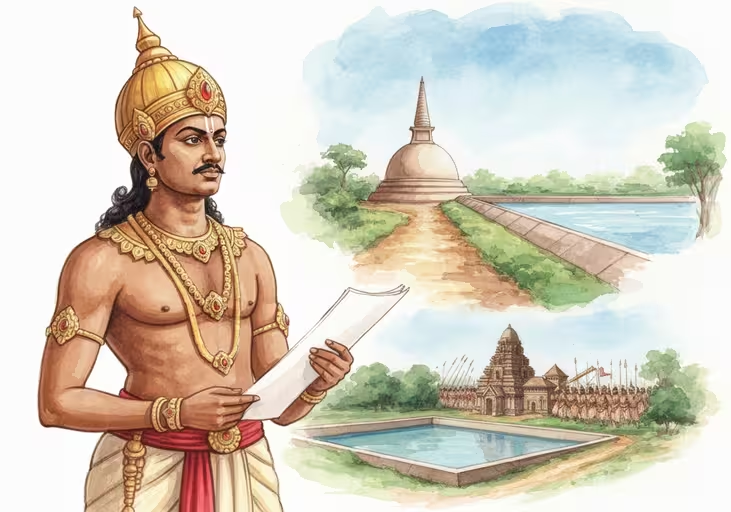
King Parakramabahu VI
Introduction
King Parakramabahu VI is considered the greatest ruler of the Kotte era. Ascending to power in 1415 CE after King Bhuvanekabahu V, he ruled Sri Lanka for a long period of 53 years until 1467 CE. During his reign, the entire country was unified for the last time in Sri Lankan history, marking it as the final glorious period in the island’s chronicles.
Reign and Kingship
Three years after his coronation, King Parakramabahu VI moved his capital to Kotte. By this time, the city of Kotte had become a fully developed capital. The king’s visionary rule greatly contributed to the prosperity of the Kotte Kingdom and its emergence as a powerful cultural and educational center.
Important Events and Achievements
During the reign of King Parakramabahu VI, several significant events occurred, contributing to the political and geographical stability of Sri Lanka.
- Unification of the Kingdom: The king succeeded in unifying the country by annexing the entire island, including the Jaffna and Vanni regions, to the Kotte Kingdom. Notably, he also brought the independently rising leaders in the Vanni regions under his suzerainty.
- Suppression of Rebellions: The king successfully suppressed a rebellion that erupted in the Malayarata (hill country). The dispatch of Prince Ambulugala to quell a rebellion instigated by Jotiya Sitana in 1462 CE is a notable event.
- Control over Jaffna: By appointing Prince Sapumal as the ruler of Jaffna, the king was able to maintain the northern region under Kotte’s control.
- Foreign Relations and Wars: The invasion of a port belonging to the Vijayanagara Empire and the invasion of Adiviraramapatnam in South India based on a trade dispute demonstrated the strength of the Kotte Kingdom’s foreign policy.
Services and Legacy
The reign of King Parakramabahu VI is considered a period that brought about an educational, literary, and cultural renaissance in Sri Lanka.
- Educational Revival: An educational revival occurred in the country. The establishment of prominent educational centers such as the Sunethra Devi Pirivena in Pepiliyane and the Padmavathi Pirivena in Keeragala is notable in this regard.
- Era of Scholars: A group of exceptionally talented and learned scholars, including Vidagama Maithri Thera, Totagamuwe Sri Rahula Thera, and Wettewe Thera, emerged during this period.
- Creation of Literary Works: The creation of numerous great literary works, such as the Sandesha Kāvya (messenger poems) including Hansa, Gira, Salalihini, Kokila, and Paravi, is a golden feature of this era.
Demise
King Parakramabahu VI passed away in 1467 CE. After his demise, his daughter Ulakudaya Devi’s son, Prince Jayabahu, ascended to the Kotte throne as King Jayabahu II.