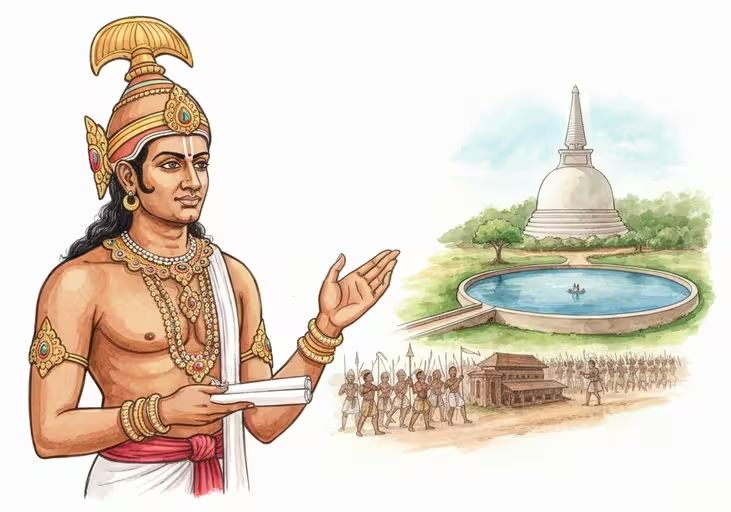
King Dutugemunu, also known as Gamini Abhaya, is one of the most eminent kings in Sri Lankan history. He was also known as Dutthagamani Abhaya. He ruled Sri Lanka from 161 BCE to 137 BCE, defeating the invading King Elara, who was the ruler of Rajarata, and protected the Sri Lankan people from the Chola Empire. His main objective was to ensure the lasting stability of Buddhism. He had Ten Great Warriors: Suranimala, Mahasona, Gotaimbara, Theraputtabhaya, Bharana, Velusumana, Labhiyavasabha, Khanjadeva, Pussadeva, and Nandimithra.
Early Life and Family Background
According to the Mahavamsa, 11 chapters are dedicated to the story of King Dutugemunu. Chapter 22 states that King Kavantissa, who ruled Ruhunu Mahagama during the reign of King Mahanaga, the brother of King Devanampiyatissa (who descended from an ancient royal family in Rajarata), was King Dutugemunu’s father. Queen Viharamahadevi, daughter of King Kelanitissa who ruled the Kalyana region, was his mother. As punishment for a fault committed by her father, King Kelanitissa placed his daughter in a golden boat and set her adrift in the sea. This boat drifted to the Magama region of Ruhunu and was found by King Kavantissa. Later, King Kavantissa married Viharamahadevi. Their first son was named Gamini Abhaya, and their second son was named Tissa.
Internal Conflicts
By the age of 16, Prince Gamini, though somewhat headstrong, was strong, intelligent, and a royal leader. With the idea of overthrowing the king of Rajarata, he organized an army from the Rohana region. He then expressed his intention to invade the North to his father. The king did not permit this idea, stating that “the land on this side of the river is sufficient.” The exchange of views between father and son ultimately led to Gamini being given the name - Dushtha Gamini (Wicked Gamini), and he fled to Malaya country with his friends.
After the death of King Kavantissa, King Dutugemunu needed to secure royal power from his younger brother, Tissa, who had taken control of the elephant Kandula and the widowed Queen Viharamahadevi. In the war that ensued between the two at a place called ‘Kulanganiya Pitti’, King Dutugemunu was defeated. Thousands of his men perished. Dutugemunu had to flee to ‘Mahagama’. There, he once again organized an army and waged war against Tissa at a location visible from the city. On this occasion, he was victorious. Tissa escaped by employing a tactic of carrying a monk’s dead body. A short while after this incident, through the intervention of Viharamahadevi and Buddhist monks, the two became friends, and Prince Tissa later became the king’s chief general.
The Campaign to Liberate Rajarata
After securing his own safety, King Dutugemunu planned to liberate the North. The Mahavamsa states that his endeavor was not merely for royal pleasure but for the lasting stability of Buddhism. This war involved not only Rajarata but also a large number of semi-independent governing entities. A group of Sangha (Buddhist monks) also accompanied him, carrying a finial containing sacred relics, seeking blessings and hoping for meditation.
The Ten Great Warriors, trained and summoned from various parts of the island by his father, also joined this military campaign. Their names are: Suranimala, Mahasona, Gotaimbara, Theraputtabhaya, Bharana, Velusumana, Labhiyavasabha, Khanjadeva, Pussadeva, and Nandimithra. During this military campaign, Dutugemunu defeated a large number of Tamil rulers (as many as 32 according to the Mahavamsa).
After besieging Vijithanagara for four months, the Tamil forces poured hot water and tar on Dutugemunu’s elephants for defense. During this time, he married Ran Ethana, the daughter of a village chief. This village chief had been sending tribute to Elara in Anuradhapura. The king’s strategic skill and the elephant Kandula’s bravery contributed to the victory in the war. The war reached its climax at the eastern gate of Anuradhapura. There, Dutugemunu, riding the elephant Kandula, fought with the elderly Elara, who was riding the elephant Mahapabbata, and ultimately killed Elara with a spear. This battle is one of the significant events in Sri Lankan history.
Dutugemunu’s victory at Anuradhapura led to an unprecedented situation where almost the entirety of Sri Lanka came under his rule. However, his difficult situation did not end there. Although Elara, whom he defeated, was a king from the Chola Empire, he was renowned as a just and righteous ruler. Dutugemunu took a different path than others, and to bestow reverence upon the deceased King Elara, he ordered that Elara’s body be cremated, a tomb built, and that the tomb should be honored. Furthermore, reflecting on his glorious victory, he felt no joy because millions of lives had been destroyed. This is confirmed when considering the innumerable religious buildings, including stupas, viharas, and sacred sites, believed to have been constructed by him (between chapters 68 and 69) according to the chronicles.
Reign and Constructions
During King Dutugemunu’s reign, apart from the countless building projects he undertook, the rift between him and his son was also a significant matter. His son, Saliya, also known as Prince Saliraja, fell in love with a young woman named Ashoka Maladevi, or Ashoka Mala, from the Rodi caste. This young woman belonged to the Rodi caste, which was considered low by Sinhalese society. Saliya refused to be separated from her and rejected the throne. Although the Mahavamsa does not mention any subsequent reconciliation between the king and his son, popular folklore suggests that they both received the king’s blessings.
It is stated that during King Dutugemunu’s reign in Sri Lanka, trade relations with Arabia, Persia, and some Western countries were very good. It can be said that this included the Roman Empire as well.
After firmly establishing his royal power, King Dutugemunu initiated large-scale construction projects. Many of these are still preserved in Anuradhapura today. Like everything else in King Dutugemunu’s life, there is a historical legend associated with the inception of each construction. Many of these reveal insights into the information and aspirations of ancient Sinhalese society.
Major Constructions
-
Mirisawetiya Dagoba: The first building foundation mentioned in the Mahavamsa is the base of the Maricavatti stupa, known today as Mirisawetiya. According to historical legends, King Dutugemunu planted his spear on the tank’s shore before going to Tissa Wewa for water sports with his inner-chamber queens. (It is said that this spear contained sacred relics). When he was ready to return to the palace and tried to retrieve the spear, neither the king nor anyone present could remove it. Considering this a special sign, the king ordered a stupa to be built covering the spear.
-
Lovamahapaya (The Brazen Palace): King Dutugemunu also ordered the construction of the Lovamahapaya. It was built with nine stories for the Sangha (Buddhist monks). It received its name because it had a roof covered with copper plates. It is said that a group of monks, having seen the shape of a palace in a celestial realm, designed it. These monks drew the plan with red arsenic on a linen cloth and sent it to the king.
-
Ruwanwelisaya (Mahathupa, Swarnamali Chethiya): Perhaps his most famous creation is the Ruwanwelisaya. It was built to enshrine a drona (measure) of Buddha’s relics. Its construction began on a Vesak full moon day. Crushed stone was used as the foundation. Elephants were used to place the stones in the correct position; leather coverings were placed on the feet of these elephants. King Dutugemunu personally went and supervised these tasks. It is said that he sat at the construction sites and watched how the relic chamber was completed and how the relics were enshrined amidst wondrous miracles. Details regarding the consecration of the Thupa are described in Chapter 29 of the Mahavamsa. It states that hundreds of thousands of lay devotees and monks arrived, including Arahants from various parts of India and 30,000 Arahants from Alexandria in the Caucasus, led by the Indo-Greek monk named Mahadharmarakshita.
Among other notable works, the construction of a stupa at Mundeswari (present-day Bihar) is also mentioned. The Ten Great Warriors were very important among those who contributed to the king’s creations.
Legacy
King Dutugemunu’s contribution to developing Anuradhapura as a beautiful and historically significant city is very important. His first construction, Mirisawetiya, is highly significant. The Lovamahapaya, a residence built for Buddhist monks, is also an important creation by him. Furthermore, the Ruwanwelisaya, built by him, is a paramount creation. The Ruwanwelisaya Dagoba is a sacred stupa located in the city of Anuradhapura. This sacred stupa, revered by the people, holds the foremost position in terms of architecture and construction. This magnificent dagoba created by King Dutugemunu is also known by the names Mahathupa, Swarnamali Dagoba, and Rathnamali Maha Dagoba.