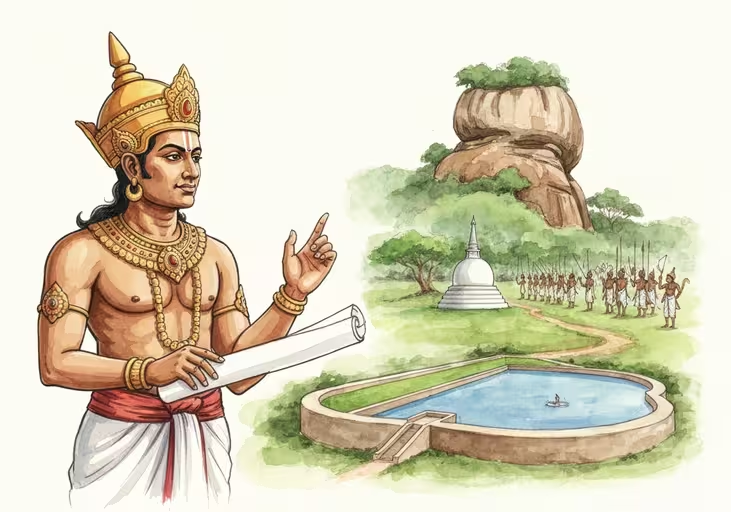
King Devanampiya Tissa (247-207 BCE) was an important ruler who reigned in Sri Lanka, centered on the Anuradhapura Kingdom. Initially ascending to the throne as Tissa, he later received a second anointing ceremony and adopted the name ‘Devanampiya Tissa’. The meaning of this name is ‘Beloved of the Gods’. His reign is of immense significance in the history of Sri Lanka because it was during this era that Buddhism arrived in Lanka with the patronage of Emperor Ashoka of the Mauryan dynasty. This historical event completely transformed the island’s cultural, social, and religious trajectory. Primary information about King Devanampiya Tissa is derived from indigenous literary sources such as the Mahavamsa and Dipavamsa, as well as from local and foreign inscriptions.
Early Life
Prince Tissa was the second son of King Mutasiva, who reigned in Anuradhapura. As described in the Mahavamsa, he was the wisest and most virtuous among his brothers. In 247 BCE, he ascended the throne with Anuradhapura as his capital. His brother, Prince Mahanaga, was appointed as the sub-king (Yuvaraja).
Reign and Relations with Emperor Ashoka
King Devanampiya Tissa’s reign lasted for 40 years, from 247 to 207 BCE. This period marked a significant turning point in the political and religious history of Lanka. The Mahavamsa describes a friendship between King Tissa and Emperor Ashoka of the Mauryan dynasty that existed even before they met. Although they did not see each other, strong ties prevailed between the two kingdoms. The king sent gifts to Emperor Ashoka, and in response, Emperor Ashoka also sent gifts. Furthermore, he informed King Tissa that he had embraced Buddhism and appealed to him to do the same.
This friendship with Emperor Ashoka brought several unique gifts to Lanka. Among them were:
- Receiving a formal anointing ceremony and the five insignia of royalty
- Receiving honorific titles such as
Devanampiya - The Sri Lankan army becoming equipped with the four divisions of the army
- Construction of fortresses in Sri Lanka, modeled after the city of Pataliputra
Due to these influences, King Tissa, adhering to the Mauryan tradition, added the prefix ‘Devanampiya’ to his name and, by holding a second splendid coronation ceremony, declared himself a sacred king.
Embracing Buddhism and the Arrival of Mahinda
The pinnacle of the friendship between King Devanampiya Tissa and Emperor Ashoka was the reception of Buddhism in Lanka. Emperor Ashoka’s ultimate aspiration was to spread the Dhamma throughout the world. Accordingly, he decided to send his son, Arahant Mahinda Thera, to Sri Lanka to convert the people of Lanka to Buddhism.
The arrival of Arahant Mahinda Thera in Lanka holds a very significant place in Sinhala historical narratives. According to the Mahavamsa, on a Poson Poya day, King Devanampiya Tissa was engaged in a hunting expedition near the Missaka mountain with an army of 40,000. While chasing a deer into the forest, he encountered Arahant Mahinda Thera. Arahant Mahinda Thera addressed the king, stating, “Great King, we are disciples of the recluse, the Venerable Gotama. We have come from Jambudvipa out of compassion for you.” King Tissa recalled information about his friend, Emperor Ashoka. Arahant Mahinda Thera questioned the king to test his intelligence and delivered a discourse on the Dhamma, after which the king embraced Buddhism.
Notable Locations
Locations associated with the reign of King Devanampiya Tissa continue to be revered in Sri Lanka to this day. Especially,
- Mihintale: This is the place where Arahant Mahinda Thera met King Devanampiya Tissa. The sacred site where Ambasthala is located is considered the spot where Arahant Mahinda Thera tested the king’s intelligence. The rock cave there is where Arahant Mahinda Thera resided for forty years, and the Mahaseya (stupa) enshrines the relics of the Buddha.
- Sri Maha Bodhi: The Sri Maha Bodhi, brought to Lanka by Theri Sanghamitta, the daughter of Emperor Ashoka, is planted in the sacred grounds of Anuradhapura. It is considered one of the oldest trees in the world.
- Although it is mentioned that the Tissamaha Vihara and several other monasteries were built by the king, their exact locations have been difficult to identify.
Significance and Legacy
King Devanampiya Tissa is historically recorded as a highly significant monarch in ancient Lanka. His embracing of Buddhism paved the way for subsequent kingdoms to take a different cultural and religious path than the Indian subcontinent. Later kings regarded King Devanampiya Tissa’s conversion to Buddhism as a pivotal event during the Anuradhapura Kingdom period. The city of Anuradhapura remained the capital of a powerful kingdom until the early medieval period.
After King Devanampiya Tissa, the kingship was inherited by his two younger brothers, Uttiya and Maha Siva, according to the traditional succession.
Sources
The following sources are important for studying information about King Devanampiya Tissa:
- Indigenous Literary Sources: Dipavamsa, Mahavamsa, Vamsatthappakasini (Mahavamsa commentary)
- Indigenous Inscriptions: Rajagala Lenakanda Inscription, Mihintale Tablet Inscription
- Foreign Literary Sources: Ashokavadana, Divyavadana