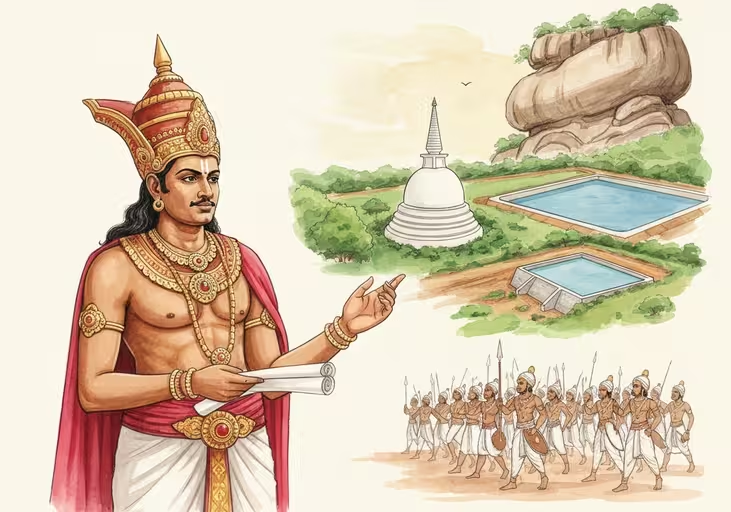
Biography of King Buwanekabahu VII
King Buwanekabahu VII was the eldest son of King Vijayabahu VII of the Kotte Kingdom and his chief queen. Born in 1468, he had two brothers, Mayadunne and Raigam Bandara. His father’s new queen from his second marriage brought a son named Deva Rajasinghe, and the king intended to make him his successor. As a result, Buwanekabahu and his two brothers were compelled to abandon the kingdom and flee, returning later with an army provided by the Kandyan Kingdom.
Accession to the Throne and Division of the Kingdom
King Mayadunne successfully waged war against his father, who ruled Kotte, with the help of the army of King Jayaveera of the Kandyan Kingdom. Subsequently, the three legitimate sons of King Vijayabahu VII divided the kingdom into three parts. Prince Buwanekabahu became King of Kotte as Buwanekabahu VII, Mayadunne became King of Sitawaka, and Raigam Bandara, also known as Pararajasinghe and Maha Raigam Bandara, became King of Raigama.
Internal Conflicts and the Portuguese Alliance
However, after the death of Raigam Bandara in 1538, Mayadunne annexed Raigama to his kingdom and became an enemy of the kingdom of his elder brother, King Buwanekabahu, whom he had distrusted since the assassination of their father, in which he had played a significant role. During Buwanekabahu’s reign, Mayadunne, together with his son Rajasinghe I, continuously fought against the Portuguese to expel them and attempted to depose Buwanekabahu to seize the Kotte Kingdom. As a result, the king was forced to side with the Portuguese, needing their power to protect his kingdom from his brother. During his rule, he was a weak ruler and became excessively reliant on the Portuguese, eventually allying with them.
Religious Relations and Saint Francis Xavier
Although he allied with the Portuguese to protect himself from his brother, King Buwanekabahu VII opposed them regarding religious matters. In the mid-16th century, King John III of Portugal sent Saint Francis Xavier to preach Catholicism in India and Lanka. He met the King of Kotte and discussed his conversion to his faith. This historic meeting was a significant event in the religious history of Sri Lanka.
Legacy
King Buwanekabahu VII was a ruler who held the Kotte throne during a period when Sri Lanka’s complex political landscape and European influences were intensifying. His reign is considered a period that further paved the way for the establishment of Portuguese power in Sri Lanka. His reliance on the Portuguese to protect his kingdom significantly impacted the island’s political and religious transformations in later times.