Introduction
Bhatikabhaya, the elder son of King Kutikanna Tissa, became renowned throughout the country by the name “Bhatika Rajjuruvō.” King Bhatikabhaya, who ascended the throne around the Buddhist Era 522 (roughly 22 BCE), maintained a close relationship with his brother Prince Mahānāma, and is noted for holding a special place in Sri Lankan history due to his immense devotion to the Buddhist Sasana. His profound dedication to Buddhism, evident even before his ascension to kingship, was reflected throughout his entire reign. King Bhatikabhaya was known as a righteous ruler.
Righteous Rule and Reforms
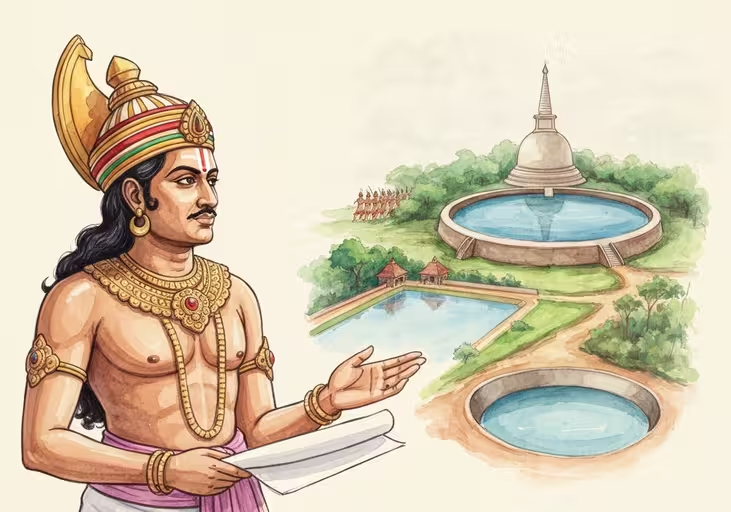
The reign of King Bhatikabhaya serves as an excellent example of righteous governance. He undertook renovation work at the Lovamahapaya and offered flower and water tributes to the Ruwanweliseya. Especially noteworthy were the water offerings, performed by spraying water from the Abhaya Wewa (Abhaya Tank) onto the Ruwanweliseya using technological methods. History records that he imported beads from Rome, fashioned them into nets, and adorned the Ruwanweliseya with these bead nets for devotional purposes.
He is renowned among the Buddhist populace as the first king to prohibit the sale of meat and the slaughter of animals during his reign. In doing so, he made a determined effort to bring the country to a righteous state. Many historical records confirm that he governed the country righteously.
International Relations and Administration
There is evidence of Sri Lanka having international relations during King Bhatikabhaya’s reign. Pliny’s historical records confirm that envoys were sent to Rome during the time of Emperor Claudius, establishing a treaty. The import of beads and other ritualistic items from Rome, as well as later journeys for trade with Seri country, or China, further substantiate these relations.
The king’s edicts were enforced throughout the island, with about 15 inscriptions identified from various provinces. It is mentioned that Dakkhina-desa (Southern country) was assigned to his brother and Rohana-desa to his son. It also appears that a naval service was maintained along Sri Lanka’s western coast during his time. It is clear that the chief of the offerings made to the Anula Pavata Vihara in the Kala Wewa valley was the minister “Ahala.”
He also implemented a Dhammādhikarana (judicial system based on Dhamma) and sought advice from a Thera named Godatta in judicial matters. The killing of cattle and consumption of beef were also important laws prohibited by this king.
Reign
Although various information regarding King Bhatikabhaya’s reign is provided in texts such as the Raja Ratnakaraya and Rajavaliya, the Mahavamsa states that he ruled for twenty-eight years.
Services to the Buddhist Sasana
King Bhatikabhaya rendered great service to the Buddhist Sasana, especially performing numerous unique meritorious deeds related to the Ruwanweliseya. On one occasion, he applied sandalwood paste, spread jasmine flowers upon it, and sprayed perfumed water from above. On another occasion, the stupa was adorned with valuable beads imported from Rome. The reign of this king, who treated both Mahavihara and Abhayagiri equally without any distinction, is considered a very righteous era. He consistently organized Vesak festivals for 28 years. He also rendered great service in ensuring the proper implementation of Dāna (generosity), Sīla (morality), and Bhāvanā (meditation) programs for Buddhist monks, himself being virtuous.
Unparalleled Devotion to Ruwanweliseya
King Bhatikabhaya, who had immense devotion to the Great Ruwanweli Seya, would partake in food only after worshipping the stupa both morning and evening every day. One day, delayed due to royal duties, the king regretted being unable to worship in the evening, abandoned his meal, and immediately set out to worship the stupa. Even though darkness had fallen, he worshipped with intense faith.
There, the king encountered a wondrous event. He heard the sweet chanting of Pirit (Buddhist scriptures) emanating from within the relic chamber of the stupa. Seeing no monks or individuals, the king resolved to continue his worship until he could see those who were chanting. Due to the king’s virtuous power, the seat of Sakra Devendra (the king of gods) became warm, and he descended from Tavatimsa heaven to inform the Maharahats (fully enlightened ones) possessing psychic powers, who were chanting Pirit within the relic chamber, of the king’s resolve.
One Arahant, by psychic power, emerged from the relic chamber, took King Bhatikabhaya by the hand, led him into the relic chamber, and allowed him to witness many events related to the life of the Buddha, which were depicted in seven precious gems. After returning the king to the Salapathala Maluwa (stone pavement), the king had goldsmiths create a model of the relic chamber he had seen and displayed it in the royal palace courtyard. The Thupavamsa states that this model was exhibited to the townspeople annually, and many who saw it were delighted and ordained as monks.
There are also legends of a connection between King Bhatikabhaya’s palace and the Ruwanweliseya, spanning the areas between Anuradhapura and Kandy.
Unique Creations for Ruwanweliseya
King Bhatikabhaya is the only king in history who, for the first time, filled a large stupa like the Great Ruwanweli Seya with flowers, adorned it as a floral crown, brought water from the Tisa Wewa, and performed offerings for a week by mechanically spraying water up to the pinnacle in the form of a water fountain. For this unique offering, the king cultivated fragrant flowers like ‘Idda’ and jasmine in many parts of the country. A water-spraying mechanism was also designed using the knowledge of skilled craftsmen. He filled the Great Ruwanweli Seya, built by King Dutugemunu, with flowers from the courtyard to the pinnacle, covered it with a floral crown, and performed offerings for a week by mechanically spraying water with immense faith and devotion. Even today, you can see a statue of such a devout king on the Salapathala Maluwa of the Ruwanweliseya. These offerings clearly illustrate the reverence kings held for the Great Ruwanweli Seya.